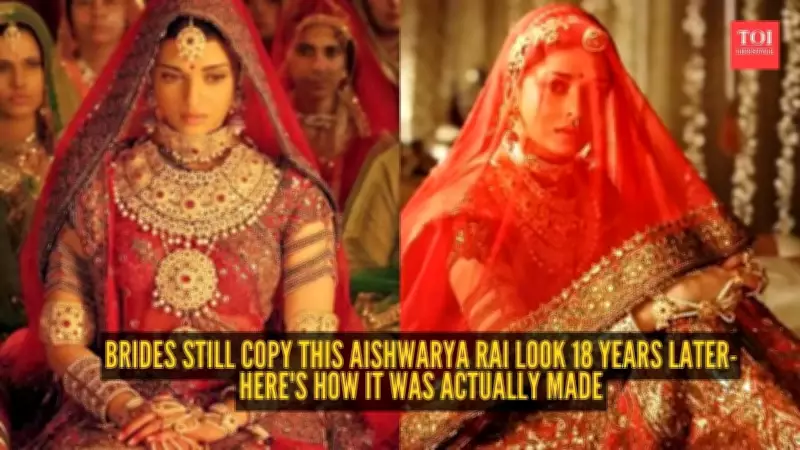
Some movie costumes fade from memory the moment the credits roll. Others become part of fashion history. Aishwarya Rai's red bridal lehenga in Jodhaa Akbar belongs firmly in the second category.
Nearly two decades after the film released, brides across India are still taking screenshots of that look and carrying them to their designers. The lehenga has inspired countless wedding outfits, Pinterest boards and bridal mood boards over the years. And now, designer Neeta Lulla has revealed the surprising amount of work that went into creating what remains one of Bollywood's most iconic costumes.
The Challenge of Natural Light
At first glance, the outfit looked every bit like a royal Rajput bridal ensemble. Rich, regal and dripping in old-world grandeur, it perfectly suited Aishwarya's portrayal of Jodhaa Bai. But behind the scenes, creating that effect was far more complicated than it appeared. In a recent Instagram video, Neeta Lulla shared that one of the biggest challenges came from director Ashutosh Gowariker's decision to shoot much of the film in natural light.

While natural light creates beautiful visuals on screen, it also exposes every shiny detail in a costume. Fabrics that look luxurious under artificial lighting can often appear distracting or overly reflective outdoors.
That meant the costume team had to rethink everything.
"I designed 2,600 costumes for Jodhaa Akbar in the limited colours we set out for the canvas," Neeta explained. "The DOP was shooting almost entirely in natural light. It sounds beautiful, right? Except that natural light highlights every shiny fabric. So every lehenga, every dupatta, every single piece had to be matte. No shimmer, no shine, nothing."
For a film centred around Mughal royalty, that created a major design puzzle. How do you make a queen look royal without relying on the sparkle and shine that traditionally define bridal wear?
Craftsmanship Over Embellishment
According to Neeta, the answer lay in craftsmanship rather than embellishment. The famous red lehenga was constructed using organic cotton and mull as the base fabrics. To recreate the richness usually achieved through brocades, the team hand-embroidered the outfit using kasab and resham work. Layers of gota patti, kundan and metal embellishments were then carefully added, but with a twist. Everything was specially toned down to maintain the matte finish required for filming.
The result was something rather unusual. Up close, the outfit wasn't flashy at all. In fact, Neeta revealed that it looked almost dull to the naked eye. But once the cameras started rolling, the intricate textures came alive and created the luxurious effect audiences eventually saw on screen.
Months of Research and Development
The work didn't happen overnight either. The designer revealed that she spent nearly three months researching historical references, fabrics and traditional motifs from both Mughal and Rajput cultures. Another four months went into developing the textiles, embroidery techniques and ageing treatments needed to achieve the final look.
Every floral motif and every zardozi detail was carefully considered. "Every bagh-booti, every zardozi pattern was historically grounded, camera-ready, and never crowded the frame," she said.
A Lasting Legacy
Perhaps that's why the lehenga has enjoyed such a long life beyond the film itself. Unlike many cinematic costumes that remain tied to a particular era, Jodhaa's bridal look has continued to resonate with generations of brides. It feels timeless rather than trendy.
Its influence was recognised globally as well. In 2025, the costume became part of the Academy Museum's Colour in Motion exhibition in Los Angeles, introducing the craftsmanship behind Indian costume design to an international audience.
For many fashion lovers, though, the lehenga's biggest achievement is much simpler. Eighteen years later, people still remember it. And in an industry where trends change almost every season, that's a rare kind of fashion legacy.