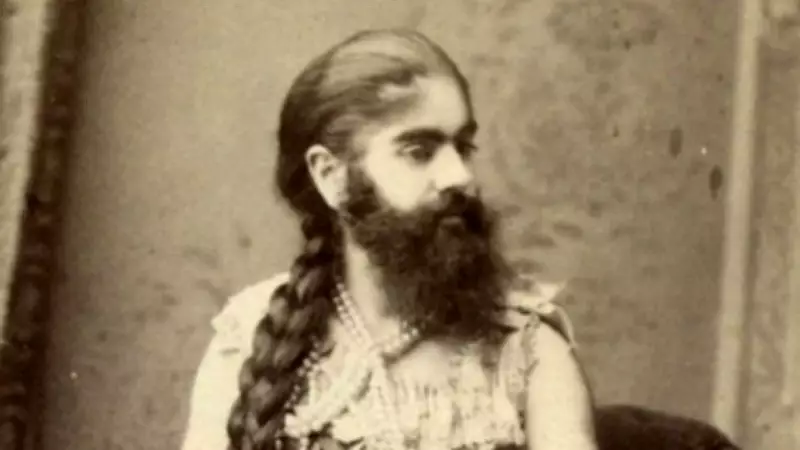
In the world of 19th-century sideshows, no performer was more famous than Annie Jones. Born in Marion, Virginia, in 1865, she arrived with a full moustache already on her face, a feature that would shape her entire life. While other babies with unusual traits were hidden away, Jones was placed on stage before she could even walk. Under the showman P.T. Barnum, she travelled the world, earned a fortune for her family, and became one of the most recognised faces in America. Crowds called her the "Bearded Lady," a title she came to resent. But behind the glittering posters and roaring applause was a story of exploitation, kidnapping, heartbreak, and an early death. This is her story.
Annie Jones, the Bearded Lady, Was Born with Hirsutism in 1865
Annie Jones was born on July 14, 1865, in Marion, Virginia. According to records held by the Wellcome Collection, her parents and siblings had a perfectly ordinary amount of hair, but baby Annie arrived already carrying what doctors of the era described as a "good-sized moustache." Her parents were reportedly distressed, unsure of what this meant for their daughter's future.
Doctors today believe Jones most likely had hirsutism, a condition that causes women to develop thick, dark hair in patterns usually seen in men. According to a 2025 clinical review published in The Journal of Clinical Endocrinology & Metabolism, hirsutism affects roughly one in ten women globally and is often tied to hormonal imbalances. In Jones's case, no treatment was sought. Instead, her appearance became the foundation of her entire career.

By the 1860s, "freak shows" were already booming across America. P.T. Barnum had opened his American Museum in New York back in 1842, and bearded women were already crowd-pullers thanks to performers like the Mexican-born Julia Pastrana. Sensing an opportunity, Jones's parents decided their daughter's unusual face could change the family's fortunes for good.
P.T. Barnum Turned Baby Annie Jones into the Famous 'Infant Esau'
Jones was barely a year old when she made her stage debut. P.T. Barnum signed her up almost immediately, billing the infant as the "Infant Esau," a reference to the hairy elder brother of Jacob from the Bible.
As Jones grew, her facial hair grew with her. By the age of five, she already had a full beard and thick sideburns, and her stage name shifted from "Infant Esau" to "Esau Child." Photographers of the era, including the celebrated Mathew Brady, captured several portraits of Jones as a young girl. These images are now preserved in the Smithsonian's National Portrait Gallery, part of a collection documenting the so-called "human curiosities" exhibited at Barnum's American Museum.
Eventually, "Esau Child" gave way to the name that would follow Jones for the rest of her life: the Bearded Lady. Posters across America and Europe used this title to draw in curious crowds, slowly turning Jones into one of the most photographed women of her generation, long before she had any say in the matter.
Life as a Sideshow Star Brought Annie Jones Fame, Fortune, and Danger
Annie Jones quickly became one of Barnum's biggest earners. He reportedly paid her family $150 a week, close to $3,000 in today's money, a sum that helped support Jones's eleven siblings back home. But fame also came with serious risks.
Rival circus owners wanted Jones for their own shows, and at least one attempt was made to kidnap her. A New York phrenologist took the young performer and tried to pass her off as his own daughter, but police eventually tracked her down at a church fair and reunited her with her real parents.
Despite the dangers, Jones became a genuine global star. She toured Europe and Russia, where painters reportedly asked her to pose as Jesus, a request she politely turned down. On stage, she leaned into femininity, wearing elegant gowns and playing musical instruments to contrast with her beard, a choice that made her one of the most talked-about performers of the Victorian era.
Still, life on the sideshow circuit was exhausting. Performers like Jones often had few other career paths available to them, and many endured mockery from audiences and harsh treatment from managers, even while becoming famous faces on posters and postcards sold across continents.

The Final Days of Bearded Lady Annie Jones Ended in Tragedy
Away from the stage, Jones's personal life was marked by loss. Around the age of 16, she married a sideshow "barker" named Richard Elliot. The couple stayed together for roughly 15 years before divorcing in 1895. Jones later married William Donovan, and the pair performed together across Europe, but Donovan died just four years into the marriage.
Jones also spent her final years fighting against the word "freak," a term used to describe performers like herself. She argued that it stripped them of their dignity, though her campaign went largely unheard during her own lifetime.
In 1902, while visiting her mother in Brooklyn, Jones fell seriously ill with tuberculosis, a bacterial infection that, according to the World Health Organisation, remains one of the world's leading infectious killers even today. She died on October 22, 1902, at just 37 years old. Her final wish was reportedly to be buried with her beard intact.
Annie Jones spent almost her entire life on display. But beneath the posters and the stage name, she was a daughter, a wife, and a woman who quietly fought to be seen as more than just a "freak."