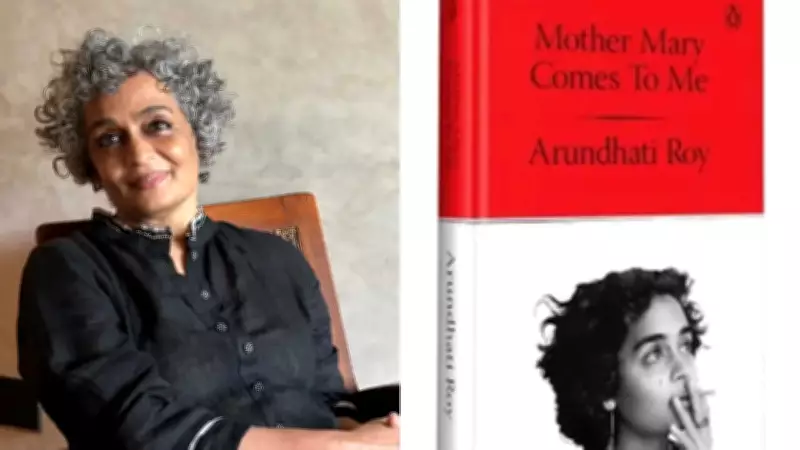
Reading Arundhati Roy is like exploring the labyrinths of a brilliant, yet disruptive, mind that refuses to settle into tidy certainties. I have always viewed her as something of an enigma, and I began reading 'Mother Mary Comes to Me' hoping to understand her better. A Booker Prize winner, she has often seemed angry, even irritable, determined to push boundaries, yet strangely elusive. However, this is only one facet of her. She has also stood shoulder-to-shoulder with those fighting for causes, displaying immense courage in challenging authority and provoking debate. She has never hesitated to use her celebrity to amplify struggles against injustice. Success, in her case, does not draw her toward public approval; instead, it thickens the veil of privacy around her. Fascinatingly, she who shuns the public gaze lays herself bare in her latest book—a memoir unapologetic and unfiltered, exposing her vulnerabilities, contradictions, rebellions, and the role of her formidable mother during her formative years.
Unwavering Tracing of Insecurities
All her insecurities, eccentricities, pain, and angst are traced unwaveringly to her relationship with her mercurial mother, renowned educationist and women's rights activist Mary Roy. 'She was my shelter and my storm,' Arundhati claims plaintively in this memoir that exposes their tumultuous relationship, describing her mother as 'a woman who was amazing, and also very, very dark.' Trained at an early age not to react to jibes and humiliation from a 'crazy, violent single parent,' Arundhati grew up confused about what she wanted, scared of secure places and relationships. 'Once again for me, the safest place became the most dangerous one. Once again, I made it so… my behaviour was inexplicable even to myself.' In an interview, she admits, 'I naturally gravitate to the unsafe.'
Candor and Provocative Anecdotes
There is total candor in Roy's writing, but at times confession morphs into spectacle. The narrative is peppered with anecdotes designed to provoke or shock: young Roy peeing in gardens of rich homes, her bed tea with maimed beggars, the 'old man Santa' who groped her, a young man pressing against her on a bus, the grand-uncle stroking her back commenting on her lack of a bra, and first seeing her father in a Delhi hotel: 'He was lying on his stomach with his knees bent, his feet waving at the ceiling.' Some moments feel so bizarre that you wonder if they are faithful memories, deliberate exaggeration, or performative. The reader wonders if some scenes are meant to titillate as much as advance the narrative. For long stretches—especially after she leaves home to study architecture—the book circles back to Roy herself with relentless self-preoccupation that tests patience.

Redemption in the Latter Half
Just when you feel the memoir is sinking under self-absorption, it steadies itself. The latter half redeems the book. The narrative moves beyond the dramatics of her rebellious younger self into the larger world she has engaged with fiercely. Her activism, writings on development, displacement, and state power, brushes with the law, a night in jail, traveling with guerilla fighters to understand the Maoist insurgency, and standing with Narmada Bachao activists—the memoir gains depth as the writing sharpens, turning outward. Roy writes with the bluster and astuteness that have always been her hallmark, making her a formidable public voice. She is playful, irreverent, sometimes rebellious, at other times accusatory and morally outraged. Her keen observations and wit are irresistible, even as she remains the hero of her own narrative. The memoir is most moving in pages about her mother's final years. The tone becomes vulnerable, morphing into that of a daughter grappling with loss, memories, and a complicated relationship.

Understanding Arundhati Better
Do I understand Arundhati better now? I think I do. The book offers clues to the contradictions defining her public persona: eccentricities, deliberate courting of center stage in rebellious causes, refusal to inhabit coveted stages, air of elusiveness, fierce independence, impatience with authority, defiance, and simmering anger—all traceable to her childhood. The child she once was can be glimpsed in the woman today—curious, questioning, rebellious, unwilling to submit to tropes or expectations. As she says, 'As a child, I had a very adult mind… so maybe there is something childlike about me as an adult.'
The Question of Honesty
One striking quality is how disarmingly raw Arundhati chooses to be, without softening memory or tidying up embarrassments. Yet that unapologetic bareness raises the question: how much honesty is too much? Memoirs are not just about memory—they are also about craft. To gain resonance beyond the self, a story needs some filter so as not to overwhelm the reader. The very quality that makes a memoir startlingly alive can also make it occasionally exhausting. Would a little restraint have sharpened the memoir further?