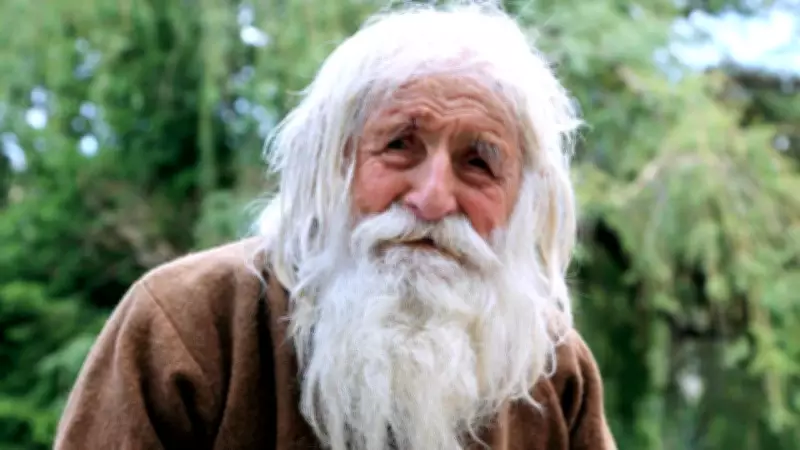
On a bustling day in Sofia, Bulgaria's capital, passersby would often notice an elderly man standing quietly outside churches, holding a plastic cup. His clothes were worn, his beard long and white. To many, he resembled a homeless pensioner seeking spare change. Yet, something unusual marked the way people greeted him. Some stopped to kiss his hand; others bowed their heads respectfully. The man collecting coins was not asking for money for himself. Day after day, year after year, he gathered donations that would eventually exceed $46,000, almost entirely given away to orphanages, churches, and charitable causes.
How Bulgaria's 'saint' spent decades walking 20 km with a plastic cup
His name was Dobri Dobrev, though most Bulgarians knew him simply as Grandpa Dobri. Born in 1914 in the village of Bailovo, he lived through some of the most turbulent periods of the 20th century. He lost his father during World War I and later suffered severe hearing damage during World War II after a bomb exploded near him. By the time he became a familiar figure on Sofia's streets, Dobrev had already endured wars, political upheaval, and economic hardship. Yet, the role that would make him famous arrived late in life.
Instead of spending his retirement quietly, he adopted an ascetic lifestyle centered on faith and service. He gave up most of his possessions, moved into a small room belonging to a local church, and dedicated himself to helping struggling institutions. For decades, he traveled between Bailovo and Sofia, carrying little more than a plastic cup and an unwavering sense of purpose.

The journey itself became part of the legend
Bailovo sits roughly 20 kilometers from Sofia, a distance many would hesitate to cover on foot even in their younger years. Dobrev continued making the trip well into old age. Some days he walked the entire route; on others, he combined walking with public transport. Age did not alter the routine. Residents grew accustomed to seeing him outside landmarks such as the Alexander Nevsky Cathedral, one of Bulgaria's most recognizable religious buildings. Tourists often mistook him for a beggar, but locals knew there was more to the story.
Coins dropped into his cup rarely stayed with him for long. Dobrev kept only enough to cover basics; the rest was carefully directed toward churches, monasteries, orphanages, and restoration projects that needed support.
Where the money really went
The donations were far from symbolic. Over the years, Dobrev gave away more than 80,000 Bulgarian lev, equivalent to over $46,000. For a man living on a modest pension and owning almost nothing, it was an extraordinary sum. One donation alone amounted to 35,700 lev for Sofia's Alexander Nevsky Cathedral. Church officials described it as the largest private donation the cathedral had received in modern times. Other contributions helped restore monasteries and support local churches that struggled financially after decades of communist rule, when religious institutions faced restrictions and neglect.
The recipients varied, but the principle remained the same: money collected from strangers would be passed on to people and places Dobrev believed needed it more than he did. His approach turned conventional ideas about charity upside down. Most philanthropists give from abundance; Dobrev gave from scarcity.
Why Bulgaria embraced him as a living saint
The Bulgarian Orthodox Church never formally canonized Dobri Dobrev, yet throughout the country he became known as the 'Saint of Bailovo.' The title emerged organically. People were drawn less by his donations than by the consistency of his actions. Years passed; the routine remained unchanged. He continued traveling, collecting coins, and giving them away. Photographs of Dobrev began circulating widely. In some, he is blessing children; in others, he stands quietly in the snow. His image became associated with humility, faith, and generosity.
Many who met him spoke of the calm presence he projected. He rarely sought attention and never attempted to turn his work into a public campaign. Recognition arrived anyway. By the 2010s, he had become one of Bulgaria's most beloved public figures, admired by religious and secular communities alike.

The challenge of measuring a life like this
Stories about wealth are easy to quantify; stories about influence are harder. The amount Dobrev donated is impressive, particularly given his circumstances. Yet focusing solely on the figure risks missing the larger point. His significance lies partly in the contrast between appearance and reality. People saw an old man asking for coins; behind that simple image was a decades-long effort that channeled thousands of donations toward causes many had forgotten. There is also something deeply unusual about his timing. Most people slow down in their later years; Dobrev's charitable work became more visible as he entered his eighties, nineties, and beyond. The image of a centenarian continuing his daily mission challenged assumptions about aging, purpose, and contribution.
What remains after the coins are gone
Dobri Dobrev died in February 2018 at the age of 103. The plastic cup is gone; the familiar figure outside Sofia's churches is gone too. Yet his story continues to circulate far beyond Bulgaria, often shared by people searching for examples of generosity that feel genuine rather than performative. Perhaps that is why he remains so memorable. Many famous philanthropists are remembered for the fortunes they accumulated before giving them away; Dobrev's reputation grew from the opposite path. He possessed very little, yet spent years acting as though other people's needs mattered more than his own.
The next time someone passes an elderly stranger standing quietly on a street corner, they are unlikely to be looking at another Grandpa Dobri. Then again, that was precisely the point. For years, thousands of people walked past him without realizing they were looking at one of the most remarkable philanthropists in modern Bulgaria.