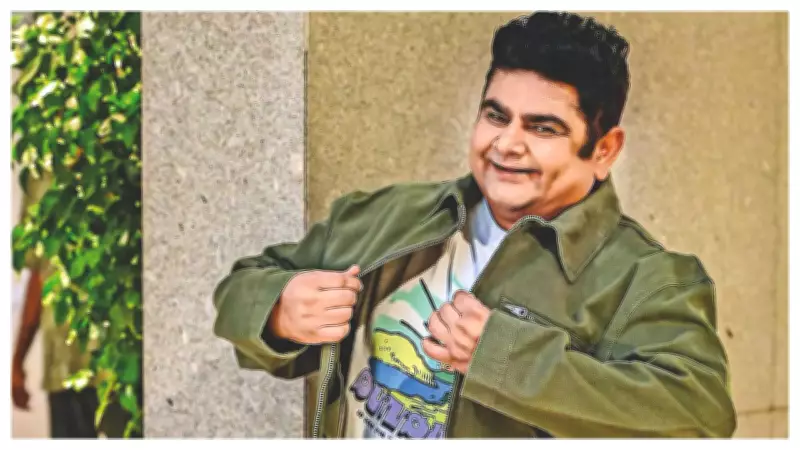
For generations of television viewers, Deven Bhojani has been synonymous with some of Indian TV's most iconic comedies. However, with the Gujarati film Dhabkaaro, he ventured into a far more nuanced and emotional role, delivering a performance that surprised many — including Aamir Khan, who was deeply moved after watching the film.
'I am more selective now'
Having worked across mediums and languages, has Bhojani become more selective now? “Yes, definitely — whether it’s Hindi or Gujarati. Offers have kept coming, but I feel that in the past, I took on projects I didn’t fully enjoy, often because of circumstances or other compulsions. Now, I only want to do work that excites me, brings me joy and offers creative satisfaction,” he says.
Bhojani adds, “There’s also a practical aspect to it. A Hindi project naturally reaches a much larger audience than a Gujarati film. But Gujarati is my mother tongue, and I’ve always wanted to contribute something meaningful to Gujarati cinema. Even after Udan Chhoo, I received several offers, including opportunities to direct Gujarati films. But none of them gave me that spark, that ‘kick’, or there were scheduling issues. So, I chose to wait for the right project.”

Speaking about the current state of Gujarati cinema, Bhojani says, “A different kind of cinema has emerged over the past few years, and that’s wonderful. Filmmakers are exploring diverse subjects, scales, styles, and genres. The only concern is that we tend to typecast very quickly — whether it’s actors, directors or even films. The moment one film succeeds, everyone starts replicating the same formula. Laalo, for instance, was a beautiful film and a matter of immense pride for our industry. But we shouldn’t assume that anything built around the same theme or devotion will automatically work. However, I am happy that a lot of diverse and beautiful films are being made today.”
'TV leaves little room for creative fulfilment'
Talking about his choice of work and medium, Bhojani says, “I stopped doing television serials five or six years ago because I had grown tired of the monotony. While TV offers financial security, playing the same character every day for years can be exhausting. The industry functions at a relentless pace, leaving little room for creative fulfilment. I wanted to step away from that cycle and explore OTT. I also made a conscious decision not to begin with comedy, having been typecast in the genre for years on television. I was prepared to wait for the right opportunities, even if they meant smaller roles, as long as they allowed me to do something different.”
He adds, “Fortunately, things fell into place with projects like Scoop, Taaza Khabar and Murder Mubarak, where I got to play varied characters unlike anything I had done before. More recently, I took on a negative role in a light-hearted satirical family show and am also portraying a journalist in an upcoming project with Parineeti Chopra. For that part, I underwent a complete transformation, shedding weight and changing my hairstyle. Getting the chance to explore such diverse roles brings me immense joy — it’s an absolute blast.”
'Every style of humour has its own audience'
Reflecting on changing times and the evolving boundaries of comedy, Bhojani says, “For me, entertainment extends far beyond comedy; it is about evoking genuine emotions, whether laughter, fear, sadness, joy, or even anger. While my work has largely been rooted in family-orientated comedy, I believe every style of humour has its own audience and measure of success. There is no right or wrong approach. I do not judge other genres or formats, and though I have my personal preferences, I am always open to exploring interesting subjects on OTT platforms. Ultimately, it is all about the artiste’s work.”

'I learn something new every day'
Bhojani, who frequently collaborates with younger actors and filmmakers, shares, “I love meeting new people and understanding how they think. As an actor and director, observing people comes naturally to me, but I’m equally interested in their perspective — how they approach a script, a character, acting itself, or their creative process. I genuinely enjoy watching and learning from them. I learn something new from actors, technicians, everyone, every single day.”
'Dhabkaaro brought Abhishek and me creatively closer'
“I loved Abhishek’s Hellaro, so when he approached me with a fascinating synopsis for Dhabkaaro, I was immediately intrigued. He flew from Ahmedabad to Mumbai for an exceptional four-hour narration, and by the end of it, I was completely sold. Abhishek was remarkably open to ideas and feedback, which created a strong creative synergy between us. Once the final draft was locked, we held a workshop to fine-tune the film’s tone and approach. Because we were so aligned creatively, the shoot itself was effortless.”
'Aamir is a secure and large-hearted superstar'
Talking about Aamir Khan attending a screening of Dhabkaaro despite his son Junaid’s Ek Din releasing on the same day, Bhojani says, “Though we meet only occasionally, I wanted Aamir to watch Dhabkaaro, so I sent him a message. Despite being busy promoting his own film, he came for the screening with Junaid. Later, a friend told me he had tears in his eyes throughout the film. He loved it and was extremely generous in praising my performance. Aamir is remarkably grounded. Years after visiting my home during Jo Jeeta Wohi Sikandar, he met my parents at the screening, touched their feet, and jokingly complained that I hadn’t invited him over for Gujarati food in years. He told the media that while people should watch his son’s film, they must watch mine first. It was the gesture of a secure, large-hearted superstar.”