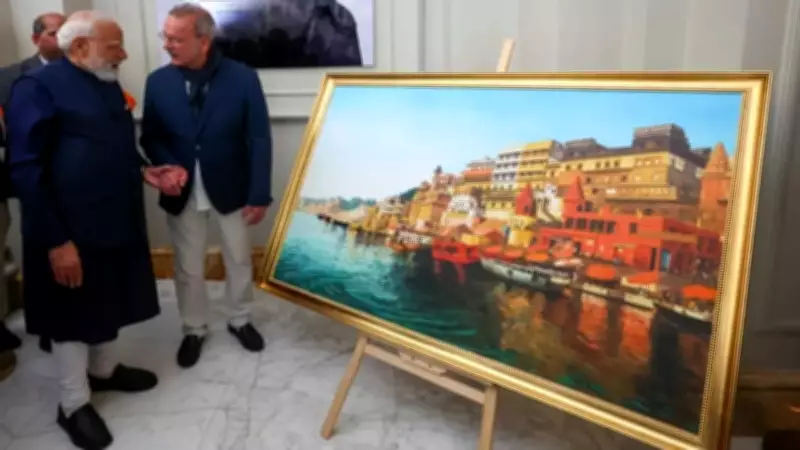
When Prime Minister Narendra Modi arrived in Rome during his recent visit to Italy, few anticipated that he would return with a souvenir deeply rooted in Indian heritage rather than Italian culture. Yet, an Italian painter managed to surprise Modi during his trip to Rome with a remarkable artwork that is now generating widespread attention.
Giampaolo Tomassetti's 'Holy Varanasi' Painting
While political leaders engaged in handshakes and diplomatic discussions, Giampaolo Tomassetti quietly made his mark on Modi's heart with his painting titled 'Holy Varanasi.' This artwork transports viewers directly to the sacred ghats of Varanasi, capturing the ancient steps, spiritual aura, and the enchanting essence of Kashi, all set in the heart of Italy.
Tomassetti's Fascination with India
According to the Northeast Herald, Tomassetti is not merely a painter enchanted by the vibrant colors of India. He has immersed himself in Indian philosophy, Vedic texts, and epic narratives for over four decades. What began as a simple artistic curiosity in the 1980s evolved into a lifelong intellectual and spiritual journey.

Modi publicly commended Tomassetti's dedication on social media, sharing the artwork as 'a glimpse of Kashi in Rome' and praising the artist's decades-long exploration of Indian culture. The painting sparked widespread discussion online, with many describing it as 'a beautiful bridge between civilizations.' Observers expressed amazement at the depth with which an Italian had engaged with India's philosophy and mythology.
In a world where superficial engagement often reduces Indian spirituality to yoga mats and Instagram trends, Tomassetti's approach stands out as deep, methodical, and genuinely sincere.
More on Giampaolo Tomassetti
Born in Italy in 1955, Tomassetti began his artistic career in Florence in the early 1980s, initially working as an illustrator for books on Vedic culture and ancient Indian traditions. This work ignited a deeper passion, leading him to explore India's art and philosophy extensively.
By 1987, Tomassetti had relocated to Città di Castello, a town renowned for its artistic heritage. Over time, he developed what critics describe as a 'metaphysical figurative style'—a fusion of classical European techniques with India's symbolic and spiritual themes.
His most notable achievement is the ambitious Mahabharata project completed between 2008 and 2013, comprising twenty-three paintings inspired by the epic's narratives and philosophical dilemmas. Modi referenced this work during their meeting.
Tomassetti's Brush with the Mahabharata
The Mahabharata is a complex epic that even Indian scholars spend lifetimes deciphering. Tomassetti, however, devoted years to studying its text, symbolism, ethical conflicts, and spiritual depth. His paintings are not merely aesthetically pleasing; they are imbued with emotion, intricate detail, and historical imagination. On forums like Reddit, fans praise the vivid and cinematic quality of Tomassetti's scenes.
What is particularly touching is his approach to Indian culture—not as an outsider seeking exotic inspiration, but as a genuine student. His art draws from the Bhagavad Gita, the Upanishads, and the full spectrum of Vedic tradition. He avoids capitalizing on stereotypes, instead delving into authentic philosophical meaning.
This sets him apart from many contemporary artists who pursue abstraction or commercial appeal. Tomassetti seeks to address profound questions—spiritual conflicts, metaphysical mysteries—the very themes woven into Indian epics.
Tomassetti's Artistic Journey So Far
Tomassetti's recent painting of Varanasi, gifted to Modi, carries this weight of significance. Kashi is not just any city; in the Indian imagination, it represents an eternal space where ritual, death, rebirth, and liberation converge. Modi remarked that Rome and Kashi are 'eternal cities,' steeped in history and culture. Tomassetti's work connects them visually, emotionally, and spiritually.
The way his art bridges Italy and India transcends mere symbolism. It reflects how Indian philosophy has become a global fascination. Yoga, meditation, Vedanta, and the Gita continue to inspire writers, artists, and thinkers worldwide.

Tomassetti's journey serves as a reminder that Indian culture has always traveled through stories and philosophy, even when politics dominates headlines. These quieter moments of cross-cultural admiration carry profound meaning, especially when they stem from years of genuine curiosity and artistic drive.