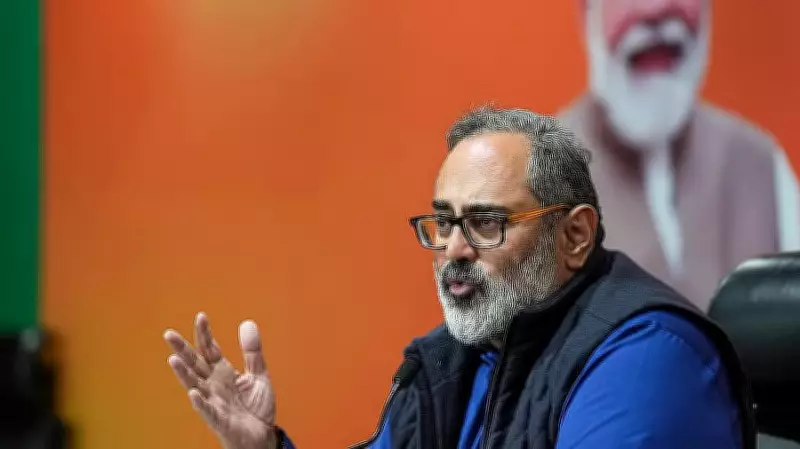
Union Minister Rajeev Chandrasekhar has strongly criticized a group of Stanford University students for boycotting a talk by Google CEO Sundar Pichai, describing the move as a reflection of growing intolerance and a disregard for free speech on American campuses.
Background of the Controversy
The controversy erupted when a student group at Stanford University announced a boycott of an event featuring Sundar Pichai, citing concerns over Google's business practices and its alleged complicity in human rights violations. The students accused the tech giant of unethical behavior, particularly in relation to its operations in China and other authoritarian regimes.
Chandrasekhar's Remarks
Chandrasekhar, who serves as India's Minister of State for Electronics and Information Technology, took to social media to express his disappointment. He stated that the boycott was indicative of a troubling trend where dissent is stifled and open dialogue is replaced by censorship. He emphasized that Pichai, an alumnus of Stanford, deserved respect for his achievements and contributions to the tech industry.

In a series of tweets, Chandrasekhar wrote: "The boycott of Sundar Pichai by Stanford students is a sad reflection of the growing intolerance and lack of respect for free speech. It is alarming that a premier institution like Stanford is witnessing such behavior."
Support for Pichai
Chandrasekhar also highlighted Pichai's journey from a middle-class family in India to becoming the CEO of one of the world's largest companies, calling him an inspiration for millions. He urged the students to engage in constructive dialogue rather than resorting to boycotts.
Reactions from the Tech Community
The incident has sparked a broader debate within the tech community about the role of corporate responsibility and the limits of protest. Some have supported the students' right to dissent, while others have echoed Chandrasekhar's concerns about the erosion of free speech.
Google has not officially commented on the boycott, but sources close to the company have expressed disappointment over the decision to exclude Pichai from the event.
Broader Implications
The controversy comes at a time when universities across the United States are grappling with issues of free speech and campus activism. Critics argue that such boycotts undermine academic freedom and discourage the exchange of diverse viewpoints.
Chandrasekhar's remarks have resonated with many in India, where Pichai is widely admired. The minister's intervention highlights the global attention on the incident and its potential impact on India-US relations in the tech sector.