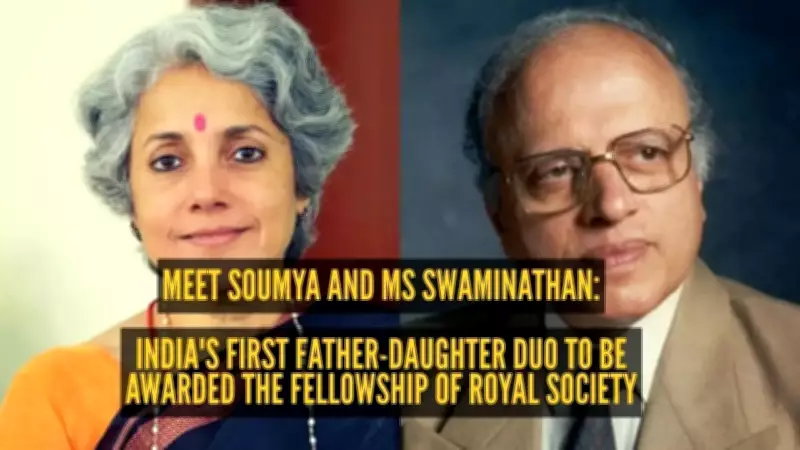
Science is a dream that demands more than just time to become reality. It requires years of mastering fundamentals, then years of discovering the unknown, driven by relentless grit and unwavering belief. In India, many are born with scientific curiosity, but few etch their names in history. Among them is a father-daughter duo: India's leading scientist Dr. Soumya Swaminathan was elected as a Fellow of the Royal Society (FRS), the world's oldest continuously existing scientific academy. She follows the path of her late father, Bharat Ratna Dr. M.S. Swaminathan, who was also an FRS.
A Historic Achievement
With this honor, Soumya enters the elite league of scientists that includes Isaac Newton. Announcing the news from London, Raghunath Mashelkar, former Director General of the Council of Scientific and Industrial Research and ex-President of the Indian National Science Academy, posted on X: 'Dr. Soumya Swaminathan has been elected as FRS, Fellow of the Royal Society, one of the highest global honors a scientist can receive. With her father Bharat Ratna MS Swaminathan also elected as FRS, this is the first daughter-father FRS duo from India.'
She becomes the second Indian woman scientist elected in the Royal Society's over 400-year history, after Prof. Gagandeep Kang, a renowned vaccinologist elected in 2019.

Who is Soumya Swaminathan?
Dr. Swaminathan is an Indian physician and scientist, currently serving as principal advisor to the National Tuberculosis Elimination Programme (NTEP). She leads strategies to achieve TB elimination targets by recommending policy decisions and course corrections. She was Chief Scientist at the World Health Organization during the peak of COVID-19 and Director General of the Indian Council of Medical Research (ICMR).
Born on May 2, 1959, in Chennai, she grew up in a family valuing science, education, and social responsibility. Her mother, Mina Swaminathan, was an influential social worker specializing in preschool education for underprivileged children. Her father, Dr. M.S. Swaminathan, was a globally recognized geneticist and architect of India's Green Revolution.
Her interest in medicine sparked when she completed a project for a scholarship from the All-India Science Talent Competition. Initially planning to study zoology and become a veterinarian, she later took the entrance exam for Armed Forces Medical College. After graduating in 1980, she specialized in pediatrics at AIIMS, New Delhi. She pursued medical fellowships in neonatology and pediatric pulmonology at Children's Hospital Los Angeles and research at the University of Leicester, UK, before returning to India in 1992. She joined as a research fellow at the National Institute for Research in Tuberculosis (NIRT) in Chennai.
Her work spans pediatric pulmonology, tuberculosis research, HIV, and global health policy. She played a key role in shaping India's and the world's response to public health challenges, notably during her WHO tenure. She is also a Fellow of the US National Academy of Medicine, the Academy of Medical Sciences (UK), and all major Indian science academies. She holds honorary doctorates from Karolinska Institute, EPFL Lausanne, and McGill University.
Who was MS Swaminathan?
Professor Mankombu Sambasivan Swaminathan was an eminent agricultural scientist and plant geneticist, remembered as the 'Father of the Green Revolution' in India. His high-yielding wheat and rice varieties transformed India from food-scarce to self-sufficient.
Elected FRS in 1972, he was Founder Chairman of the M.S. Swaminathan Research Foundation in Chennai, former Director General of ICAR, and recipient of 84 honorary doctorates. He received Padma Shri, Padma Bhushan, Padma Vibhushan, and the Bharat Ratna.
The father-daughter duo has not only achieved a record for the country but also contributed immensely to its scientific growth and health, inspiring many to pursue STEM fields.