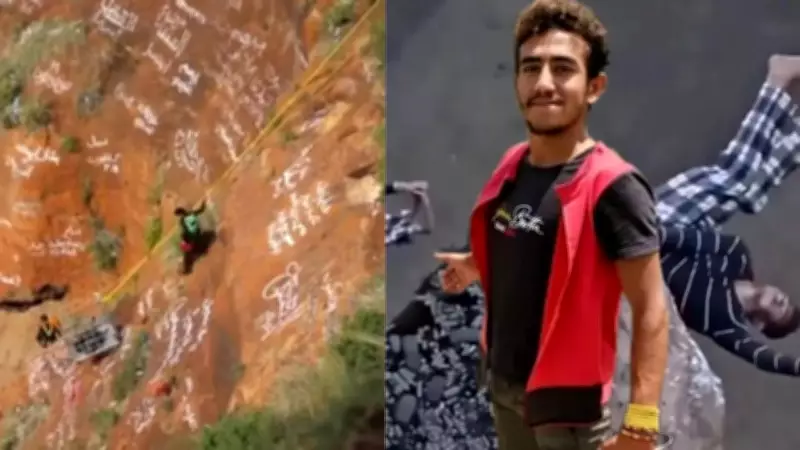
The reports began circulating late in the evening, carried first through short posts and then picked up by larger news feeds, each version adding a few more details than the last. A man known locally for climbing sheer rock faces without ropes had fallen into a volcanic crater in southern Yemen. The location was remote enough that confirmation came slowly, shaped by fragments of official statements and eyewitness accounts rather than any single clear narrative. His name was already familiar to online audiences, where he had built a following around dangerous ascents and unguarded scrambles up cliffs and quarry walls. This time, there was no ascent back out. Only a descent that did not end the way his videos usually did.
Details of the Incident
USA Today reports that Al-Qaqa' Antar Al-Absi had been filming at the Hardah volcanic crater near Damt when the fall happened on 12 June. What followed was a search that stretched into the next day, complicated by the terrain and the depth of the opening he had entered.
The Dangerous Hardah Crater
The Hardah site is not the kind of place that invites casual movement. Locals describe it as a vast hollow cut into volcanic ground, steep at the edges and uneven underfoot. Heat lingers in pockets below the rim, rising in waves that make visibility and movement difficult. On the day of the incident, conditions were not unusual for the region, but the structure of the crater itself creates its own hazards. Once inside, angles change quickly. What looks reachable from above can become distant within a few steps. Those familiar with the area say even trained climbers tend to approach it cautiously, often avoiding full descents unless necessary.

Videos Show No Safety Equipment
A clip posted over X (formerly Twitter) before the fall shows him working without visible safety equipment, moving between holds with a familiarity that had become part of his online identity. The videos were typical of what had brought him attention in recent years: vertical surfaces, sharp drops, and the absence of anything resembling standard climbing gear. There is a moment in one of the recordings where he pauses briefly, steadying himself against the rock before continuing. Nothing in the footage suggests what would follow later that day. The descent appears controlled, even routine, in the way such stunts often look once someone has repeated them enough times to build confidence. After news of the accident spread, those same clips began to circulate again, viewed through a different lens.
Rescue and Recovery Operation
As reported, Yemen's Civil Defense Authority confirmed that teams were deployed shortly after the incident was reported. The response involved divers and rescue personnel, brought in to navigate both the depth and the unstable conditions inside the crater. Locating the body did not take long once teams were able to access the lower sections, according to official updates shared on social media. The retrieval itself took longer. The structure of the crater slowed movement, forcing careful coordination rather than direct extraction. By the following day, the recovery had been completed. Officials later acknowledged the effort publicly, noting the difficulty faced by those involved in reaching the site and bringing the operation to a close.

Rise of the 'Spider-Man of Yemen' on Social Media
The 'Spider-Man of Yemen' is a nickname given to a Yemeni free-climber who became viral on social media for filming himself climbing steep cliffs and crater walls without any safety equipment like ropes or harnesses. He gained attention mainly through short mobile-shot videos where he is seen scaling extremely dangerous rock formations, often natural cliffs or rugged volcanic terrain, including areas around the Hardh crater region. Because of his ability to climb smooth, near-vertical surfaces with agility, viewers online started comparing him to Spider-Man. There is no officially confirmed or widely documented real identity consistently agreed upon in major media sources; instead, he is mostly known through social media posts and viral clips shared on platforms like Facebook. His fame grew rapidly as his videos circulated beyond Yemen, attracting hundreds of thousands of views. The nickname is more of an internet label than a formal title, used to describe his style of extreme, rope-free climbing and the dramatic, high-risk nature of his content.
How Simple, Risk-Focused Videos Found a Massive Audience
Outside the crater, he had already become a recognisable figure across social platforms. His videos, often filmed on mobile phones, showed him climbing without harnesses or ropes, sometimes on natural cliffs, sometimes on man-made structures. The appeal lay partly in the lack of obvious protection, partly in the setting itself. His audience had grown steadily, passing hundreds of thousands of followers on Facebook. Some posts reached far wider than that, shared beyond his immediate circle of viewers. The clips rarely carried an explanation. They did not need much context. A climb would begin, continue, and end at a summit or ledge, often with the camera still running.