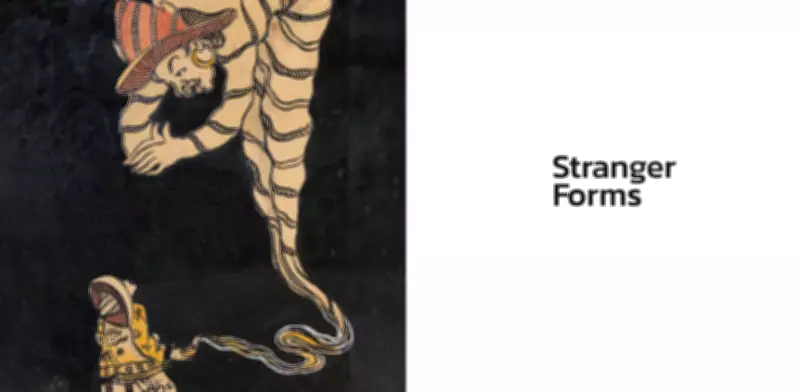
Kolkata is set to revisit a largely overlooked chapter of its artistic past with Stranger Forms: The Forgotten Art of G. C. Chakravarty, opening at the Birla Academy of Art and Culture from June 16 to 28. The exhibition, presented by Dwija Gallery, marks the first major retrospective of Gopesh Chakravarty (1905–1993), a once-prominent yet now under-recognised figure in Bengal’s modernist movement.
A Long-Overdue Reassessment
Bringing together a substantial body of paintings, drawings, illustrations, and archival material, the show attempts a long-overdue reassessment of Chakravarty’s contribution to twentieth-century Indian art. Though he exhibited alongside stalwarts such as Jamini Roy, Gopal Ghose, and D. P. Roy Chowdhury during his lifetime, his legacy gradually slipped from mainstream narratives.
Early Life and Artistic Journey
Born in Sylhet in 1905, Chakravarty’s artistic journey was shaped as much by personal hardship and spiritual inquiry as by the socio-political upheavals of his time. Largely self-taught after leaving formal training at the Government School of Art in Calcutta, he developed a distinctive visual language that moved between introspective lyricism and unsettling figuration.

The works on display trace this evolution. Early pieces reflect a fascination with the subconscious and the mystical, while later works respond more directly to historical ruptures—famine, displacement, communal violence, and authoritarian politics. His figures often appear fragmented, suspended in ambiguous, dreamlike spaces that blur the boundaries between the real and the imagined.
Curator’s Perspective
“More than a historical recovery, Stranger Forms reintroduces an artist whose significance extends beyond established narratives of Indian modernism,” says Mit Vyas of Dwija Gallery. “Chakravarty was not only a painter but also an educator and cultural activist who worked across regions such as Uttar Pradesh, Assam, and the Northeast, engaging with communities beyond metropolitan art circles.”
Indeed, Chakravarty’s practice extended beyond the canvas. A prolific illustrator, he developed a hybrid style that bridged fine art and popular visual culture, allowing him to explore both intimate psychological states and broader societal anxieties. Across his work, the grotesque emerges not as spectacle but as a critical lens—exposing the tensions and contradictions of a rapidly changing world.
Historical Recognition
The exhibition also revisits the recognition he once received. A catalogue of his works published by Rabindra Bharati in the 1950s featured praise from figures including President Rajendra Prasad and philosopher S. Radhakrishnan, alongside noted art critics and artists of the time.
By situating Chakravarty within both his historical context and contemporary relevance, Stranger Forms invites viewers to reconsider an artist who navigated the fragile thresholds between beauty and disquiet, faith and doubt, memory and imagination.
As Kolkata’s art calendar gathers pace this season, the retrospective offers not just a rediscovery, but a prompt: to look again at the artists history has quietly set aside.