Sriram Raghavan's latest film, 'Ikkis', presents a profoundly moving narrative that stands in stark contrast to the jingoistic war films often seen in Hindi cinema. At its heart is a father's emotional journey to find closure, set against the backdrop of the 1971 Indo-Pak war.
A Father's Pilgrimage and a Son's War
The film weaves together two timelines. In the present day, Madan Lal Khetarpal (Dharmendra) travels to Lahore, Pakistan, ostensibly for a college reunion. His true, unspoken mission is far more personal: to visit the place where his son, Second Lieutenant Arun Khetarpal (Agastya Nanda), was killed during the 1971 war. Dharmendra, in what is touted as his final role, delivers a performance of pure, unfiltered emotion, portraying an elderly man seeking love and understanding in the twilight of his life.
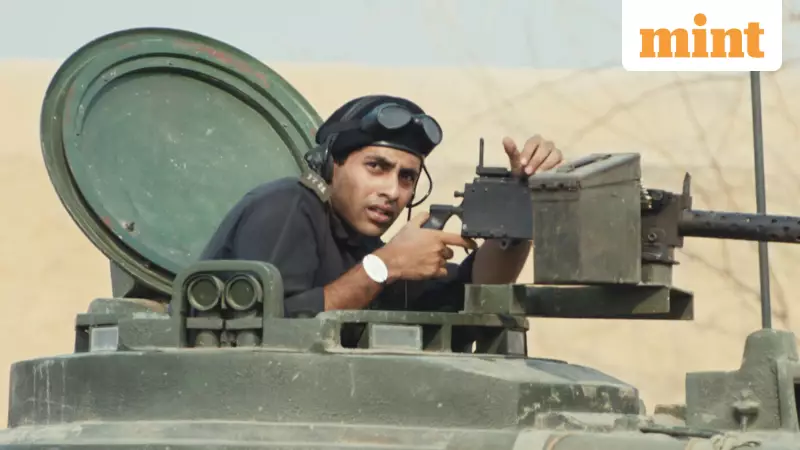
Parallelly, the film delves into the past, following the young and eager Arun. On his 21st birthday, his first question to his commanding officer at military school is, "Sir, ladaai hone waali hai?" (Are we going to fight?). His wish is soon granted as his regiment is deployed. Under the tutelage of a tough risaldar (Sikandar Kher), Arun masters tank warfare and is given charge of a tank rolling towards Lahore.

Raghavan's Refreshing Pacifist Stance
In a cinematic landscape often charged with anti-Pakistan rhetoric, 'Ikkis' makes a rare and passionate case for pacifism. The film consciously avoids drumming up war hysteria. Raghavan, along with co-writers Pooja Ladha Surti and Arijit Biswas, repeatedly cuts from tense battlefield action to Khetarpal senior's quiet, unassuming peace mission in Pakistan.
This thematic choice is highlighted through key characters. Khetarpal is warmly received in Lahore by Nissar (Jaideep Ahlawat), a former Pakistani army officer whose connection to Arun's death is gradually revealed. The film humanizes the 'other side', showing Nissar as a complex individual who drinks, smokes, and has posters of both Sachin Tendulkar and Imran Khan in his home. Even Pakistani ISI agents are portrayed merely as officials doing their job, devoid of villainous caricatures.
Beyond Performative Patriotism
'Ikkis' deliberately steps away from the chest-thumping nationalism of recent films. It focuses, much like the 2004 film 'Lakshya', on the army as an institution. Arun's identity is forged by his squadron and regiment, and his family's military legacy. The film extends this sense of martial pride to Pakistani soldiers as well. In a parallel to an Indian officer's speech, Nissar gives a rousing address to his armoured unit, emphasizing the history and honour of their own battalion.
The film also subtly critiques tropes of contemporary cinema. It features only one utterance of 'Allahu Akbar', used positively when an Indian officer says his regiment has Allah's blessings. Scenes of Khetarpal enjoying kabab and biryani in Pakistan counter the recent trend of using meat consumption to vilify Muslim characters.
The tank warfare is depicted with a gritty, physical realism, focusing on the clunking machinery, the laborious process of loading and firing, and the slow swivel to target. Cinematographer Anil Mehta's work, with minimal VFX, gives these sequences a timeless, almost nostalgic quality, contrasting with the sleek modernity often associated with fighter jets in films.
Agastya Nanda is convincingly wide-eyed and earnest as the young Arun. The supporting cast, including Vivaan Shah as a compassionate Indian captain and Deepak Dobriyal as a handicapped veteran, is impeccably chosen. Jaideep Ahlawat delivers a restrained, respectful performance opposite the legendary Dharmendra.
'Ikkis' represents a tonal departure from Sriram Raghavan's typically acidic and self-aware thrillers. This sincere, heartfelt examination of war, loss, and reconciliation is a courageous risk in today's climate of cinematic belligerence. It is a film that speaks from the heart, hoping to find an audience still willing to listen to its message of peace.