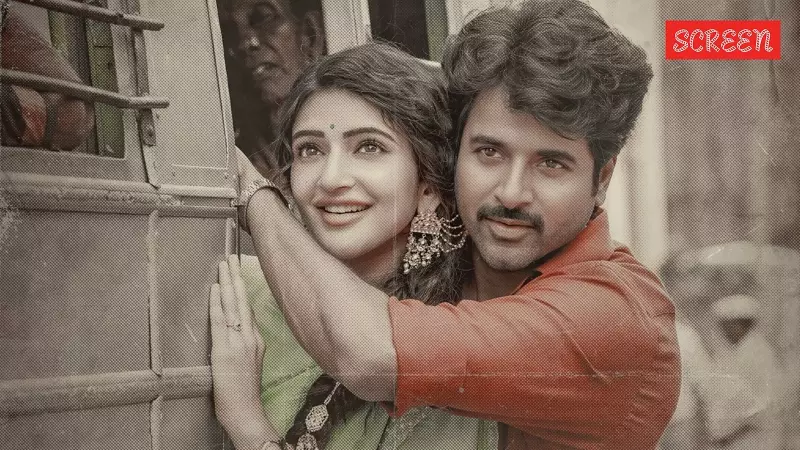
Director Sudha Kongara's latest film, Parasakthi, is a bold cinematic venture that delves into the historical anti-Hindi imposition agitations in Tamil Nadu. Headlined by Sivakarthikeyan, the film attempts to blend political history with personal drama but is ultimately hampered by inconsistent writing, earning it a rating of 2.5 out of 5 stars.
A Powerful Premise Let Down by Execution
Set against the backdrop of the 1950s and 60s student protests, Parasakthi tells the semi-fictional story of Chezhiyan (Sivakarthikeyan), the leader of the Purananooru Padai. His life collides with that of a ruthless, KGB-trained officer, Thirunaadan (Ravi Mohan), in a violent confrontation that leaves both men physically and emotionally scarred. Years later, Che has retreated to a quiet life as a railway employee, while Thiru, now marked by a deep-seated rage against Tamils, is obsessively hunting for the man who maimed him.
The film's younger generation, led by Che's brother Chinnadurai (Atharvaa) and Che's girlfriend Ratnamala (Sreeleela), continues the fight against linguistic imposition. The narrative positions this not just as a personal feud but as a struggle against oligarchy and the erosion of India's "unity in diversity." The film's relevance in today's sociopolitical climate is undeniable, and its very existence, given the numerous mutes imposed by the CBFC, is a statement in itself.

Where Parasakthi Stumbles: Disjointed Narrative and Weak Emotional Core
The film's most significant flaw is its lack of narrative flow and emotional depth. Scenes often feel isolated, serving individual plot points rather than weaving a cohesive story. Key character motivations remain underexplored. For instance, Che's transition from a fearless leader to a withdrawn man after his friend's death lacks the impactful storytelling needed to make it resonate. Similarly, Thiru's hatred and Che's personal relationships feel superficially sketched.
This issue extends to the handling of the romantic subplot. Casting 24-year-old Sreeleela opposite 40-year-old Sivakarthikeyan results in a noticeable lack of chemistry, making their scenes together feel awkward. Furthermore, Sreeleela's performance as Ratnamala, while playing a character with potential agency in the movement, often comes across as amateurish, failing to land both the lighter and intense moments.
Technical Brilliance and Standout Performances
Where the writing fails, technical prowess and Ravi Mohan's performance elevate the film. The cinematography by Ravi K Chandran and the production design meticulously recreate the era, immersing the audience in the period. The protest sequences, particularly the one leading to the interval, are exceptionally well-crafted, charged with adrenaline and showcasing Sudha Kongara's skill in staging large-scale drama.
Without question, Ravi Mohan steals the show as the villainous Thiru. Despite the character's limited layers on paper, Mohan injects him with a chilling, calm menace that becomes the film's most compelling element. His performance is a masterclass in controlled villainy. Sivakarthikeyan is convincing as the revolutionary leader Che but is less effective in the quieter, domestic moments of his character.
In conclusion, Parasakthi is an important film with a timely message, ambitious scale, and a stellar antagonist performance by Ravi Mohan. However, its impact is diluted by disjointed writing, underdeveloped characters, and a weak emotional core, preventing it from becoming the powerful cinematic statement it aspires to be.