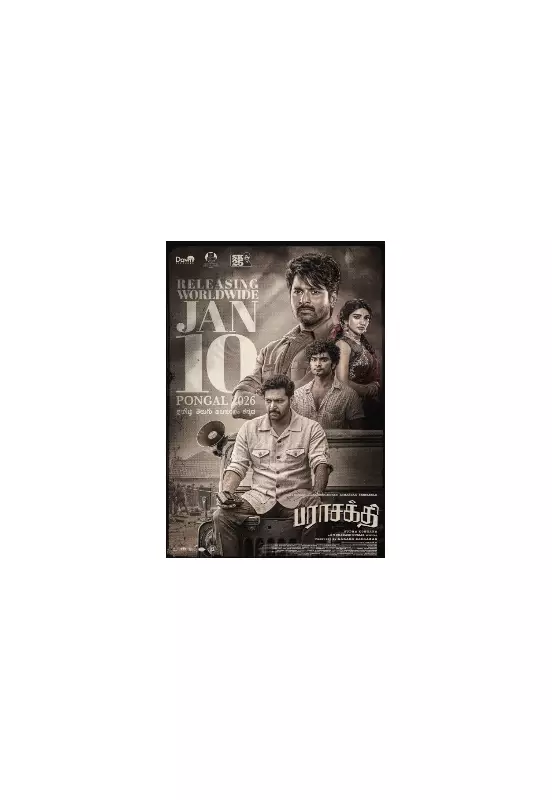
Director Sudha Kongara delivers a bold and emotionally resonant cinematic experience with her latest film, Parasakthi, which hit theatres on January 10, 2026. This Tamil and Telugu bilingual, spanning 2 hours and 34 minutes, is an ambitious historical drama that dives deep into a defining chapter of Tamil Nadu's past—the widespread student-led agitations against Hindi imposition in the late 1950s and 1960s.
A Cinematic Journey into a Political Movement
The film's narrative is firmly rooted in the turbulent period of linguistic resistance. Parasakthi follows two brothers, Chezhiyan and Chinnadurai, who find themselves at the epicentre of the growing protest movement. Sivakarthikeyan plays Chezhiyan, the head of the Puranaanooru squad spearheading the resistance, with a confident and restrained performance that brings a grounded masculinity to the role. He is ably supported by Atharvaa, who portrays his strong-spirited younger brother, commanding attention in every scene with his powerful screen presence.
Sudha Kongara treats this complex historical subject with conviction. She successfully articulates the intensity and the reasons behind the protests, making them accessible even to viewers unfamiliar with this slice of history. The film manages to educate while entertaining, though it occasionally goes overboard before finding its footing again. A tighter runtime could have sharpened its impact further.

Stellar Cast and Technical Prowess
The film boasts a sprawling cast, with each character, including cameo roles, given a discernible arc. Sree Leela, in her Tamil debut, shines as Ratnamala—far more than just the male lead's love interest. Her character is multifaceted: the Tamil Nadu Chief Minister's daughter, a college mate of Chinnadurai, a National Radio employee, and the Secretary of the All India Anti-Hindi Council. Her relationship with Chezhiyan is portrayed as one between equals, adding depth to the narrative.
Ravi Mohan plays the antagonist, Thirunaadan, who functions more as an ideological force than a fully fleshed-out character, yet his background detailing adds nuance. Veteran actress Kulappulli Leela stands out as Muthamma, the film's motherly figure, whose interactions with a group of elderly women lend sensitivity to the hard-hitting plot.
On the technical front, Ravi K. Chandran's cinematography captures the period with richness, elevating the visual storytelling. GV Prakash Kumar's background score effectively amplifies the emotional highs, though the songs feel somewhat stretched. A romantic track placed at the start of the second half momentarily disrupts the narrative momentum.
Embracing Its Political Heart
Parasakthi is not a subtle film. It is deliberately dramatised, emotionally charged, and stylised, proudly wearing its politics on its sleeve. Every dialogue is crafted like a punchline, a fitting choice for a story filled with impassioned speeches and debates. The makers have been careful to ensure the film is not perceived as anti-Hindi; instead, the core driving force remains the broader fight for linguistic freedom and identity.
While the film incorporates prominent real-life figures and features 'pan-Indian' cameos for a wow factor, its true strength lies in the quieter human interactions. The bond between the brothers, the evolving relationship between Sree Leela and Sivakarthikeyan's characters, and the scenes with Muthamma provide the emotional heft that balances the political fervour.
Some distractions, like noticeable censor cuts where dialogue is muted, do not significantly derail the overall experience. Parasakthi is, by its own admission, nowhere near flawless. However, it stands as a powerful and ambitious attempt to capture a pivotal historical moment. It combines strong performances, technical finesse, and unwavering political commentary, making it a significant cinematic outing that resonates long after the credits roll.