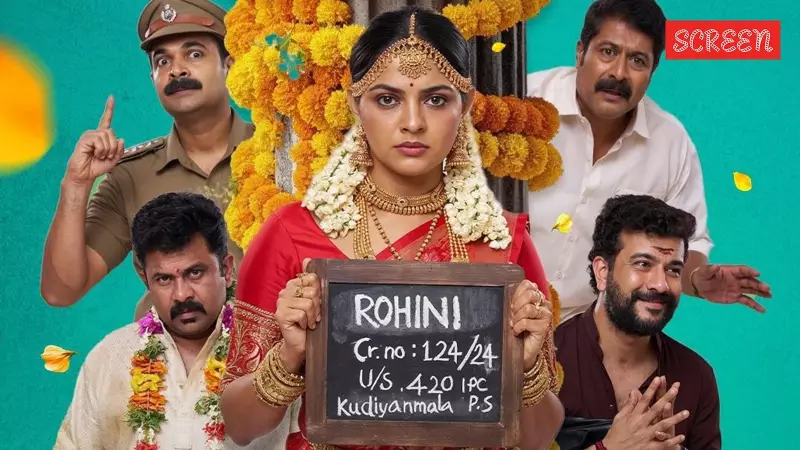
The directorial debut of Febin Sidharth, Pennu Case, arrives with a premise that intriguingly sidesteps the overt misogyny plaguing some corners of Malayalam cinema. Starring Nikhila Vimal and Hakim Shahjahan, the film attempts to weave a narrative around a morally ambiguous female character without descending into hate. However, despite this foundational strength, the movie ultimately settles as a largely passive viewing experience, earning a modest rating of 2 out of 5 stars.
A Plot Centered on Matrimonial Fraud
The story kicks off on what should be the happiest day for Subash, played by Aju Varghese. His wedding day, long doubted by many, is finally here. The celebrations in Kannur district are abruptly interrupted when a group of men storms the venue, claiming the bride, Bindu (Nikhila Vimal), has duped them all through marriage fraud. The local Kudiyanmala police, led by CI Manoj (Hakim Shahjahan), swiftly take charge.
Their investigation reveals the bride's alleged real identity as Rohini. Under interrogation, she narrates a tale that began in Mysuru, where she first colluded with a gang led by local don David (Shivajith) to fund her mother's medical treatment. This initial step, she claims, trapped her in a cycle of crime, with David forcing her to commit further frauds. With all evidence pointing squarely at her, Rohini finds herself in serious legal trouble. Moved by her story, CI Manoj and his team decide to help her expose the larger racket, which appears to involve local political heavyweight Jeevan (Kiran Peethambaran).

Strengths Undermined by a Lack of Depth
One of the film's noted virtues is its focus on smaller, intimate moments—modest drama, light jokes, and tiny delightful interactions. This approach prevents the narrative from overreaching, but it also becomes its primary limitation. The film rarely digs beneath a superficial layer, leaving the audience as detached observers rather than emotionally invested participants.
For a significant portion of its runtime, Pennu Case feels flat and overly plain, relying on sporadic humorous exchanges to maintain interest. Unfortunately, neither the jokes nor the dramatic moments pack enough punch, placing the burden of engagement squarely on the viewer's shoulders. This issue is compounded by the film's dialogue-heavy nature; more compelling writing could have partially salvaged the experience.
The Climax and Character Concerns
The screenplay, co-written by Febin Sidharth, banks on a major suspenseful reveal in the climax, using misdirection and an unreliable narrator to shield its secrets. However, the buildup to this twist is not sufficiently gripping, allowing astute viewers to predict the outcome early. When the reveal finally arrives, it may feel underwhelming, rendering the film's deliberate pacing and subdued energy counterproductive.
While Rohini's character might spark some curiosity in retrospect, the same cannot be said for the rest of the cast. Characters like Manoj are largely defined by their dialogues, while several supporting figures, such as Manoj's fiancé Vijisha (Anarkali Nazar) or fraud victim Thomas (Irshad Ali), appear arbitrarily and add little to the core plot.
Furthermore, although the film consciously avoids the misogynistic traps of movies like Aabhyanthara Kuttavaali, it stumbles with certain problematic depictions. The portrayal of female police officers—one obsessed with vegetable gardening and another glued to TV soaps, both seemingly indifferent to their duties—leans into regressive stereotypes.
Performances and Final Verdict
Nikhila Vimal as Rohini delivers a performance that, while occasionally critiqued for a limited emotional range, fits the character's restrained portrayal. With more nuanced writing focused on her psyche, the role could have been more impactful. Hakim Shahjahan and Aju Varghese are adequate in their parts, but it is Ramesh Pisharody as another victim, Vijayakumar, who provides the film's most genuine laughs.

In conclusion, Pennu Case is a film with a commendable foundational idea that lacks the executional vigor to fully realize its potential. It opts for a safe, small-scale narrative but forgets to inject the necessary depth or excitement to keep the audience truly hooked. The result is a watchable yet forgettable drama that prompts little more than passive viewing.