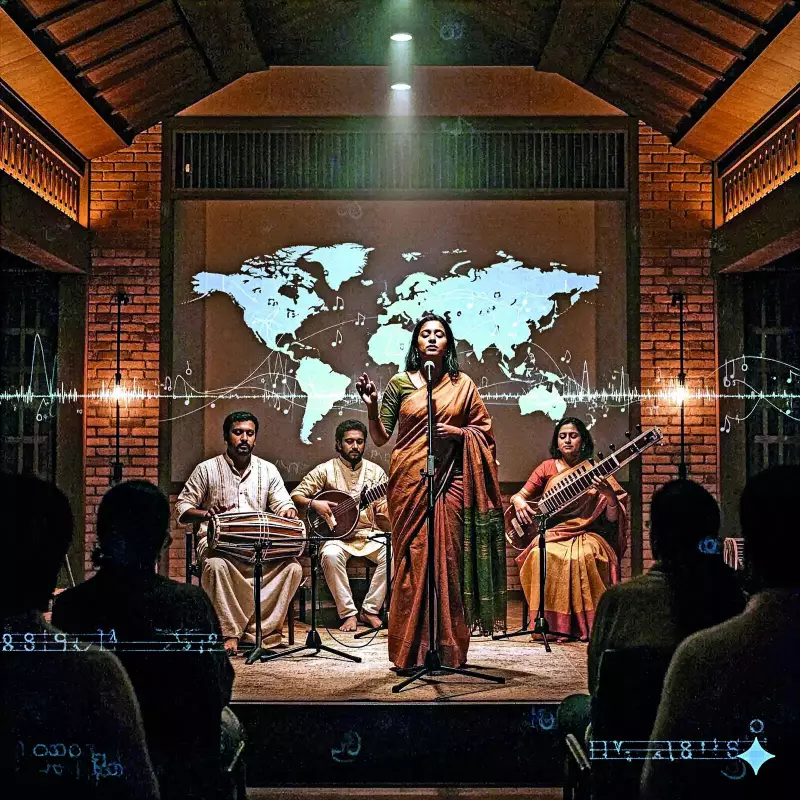
Carnatic music, one of India's most revered classical traditions, is undergoing a remarkable transformation. Moving from the intimate setting of the guru-shishya parampara to grand global festival stages and collaborations with jazz ensembles and electronic producers, it is expanding its artistic vocabulary without abandoning its foundational grammar. This journey reflects a decades-long evolution where a closely guarded tradition has learned to converse with the world.
The Global Stage: From Representation to Shared Experience
As Carnatic musicians began performing internationally, the focus shifted significantly. The emphasis is no longer merely on representing a culture but on creating a profound, shared human experience. Vocalist Karthik encapsulates this shift, stating that he creates music for human beings, where country, race, or culture are secondary to whether the music genuinely reaches people.
Singer Varijashree Venugopal contextualizes this moment not as a sudden novelty but as a continuity. She notes that this cross-cultural exchange has been happening for decades, with the internet simply making it more accessible to a wider audience. This digital accessibility, as pointed out by Jagadeesh MR, creates a feedback loop where global platforms energize local ecosystems. He observes that young people who may never have encountered this music before start following it after experiencing Carnatic-rooted work at international festivals.

This influx of new, younger listeners brings a wave of optimism. Musician Madhuri finds reassurance in this trend, emphasizing that this growing interest in culture from younger demographics is vital for the tradition's future.
Tradition Grows, It Does Not Shrink
A consistent belief among these artists is that tradition is not diluted or threatened by global movement; instead, it is strengthened and expanded. Jagadeesh asserts that tradition only grows, driven by an inherent curiosity. Varijashree describes the present as a "golden era" for independent music but also cautions that it is a fragile one, needing more space and visibility.
Madhuri highlights a significant cultural shift: the dissolving boundaries between genres. She notes that the perceived separateness is disappearing, allowing composition-led work to finally be heard on its own merits. Karthik brings the discussion back to the lasting impact of a performance, aspiring for every concert to become a memorable experience that audiences carry with them long after the final note.
Improvisation: The Bridge for Musical Travel
If rigorous discipline forms the unshakable base of Carnatic music, improvisation acts as the essential bridge to other worlds. Varijashree shares that her inclination towards jazz was fueled by its improvisational formats, a curiosity that remains a daily, evolving practice. She simplifies the idea of crossover, explaining that while Carnatic uses 'sa-ri-ga-ma' and Western music uses 'do-re-mi,' the fundamental notes are the same.
For Varijashree, Carnatic music is her first mother tongue, the primary lens through which she approaches all other musical forms. Jagadeesh sees this openness as a shared instinct, noting that both Carnatic music and jazz are driven by deep personal exploration, creating a continuous dialogue with no definitive finishing point.
Madhuri observes that earlier collaborations felt like a conscious effort to put different elements together, whereas now the process feels seamless and integrated. For Karthik, improvisation is also a matter of precision, where every second in a performance counts—deciding what sound fits, where silence is most powerful, and where to modulate the tempo.
Collaboration as Deep Listening, Not Just Fusion
Across genres and geographies, these musicians describe true collaboration not as a simple blending of styles but as an act of attentive listening. Jagadeesh explains that it involves learning each other's culture and respecting each other's music, with the composition itself becoming the meeting point.

Varijashree emphasizes the beautiful unpredictability of this process, where everyone involved takes something unique back from the experience. Often, the learning is not about technical skill but about nuance—how space is used or how emotion is controlled. Madhuri clarifies a common misconception, stating that such collaborations are not merely jugalbandi or a meeting of separate worlds, but a deeper synthesis.
For Karthik, every collaborative project is a reset, a unique first-time event where nothing is repeated, bringing new challenges and fresh learning each time.
Music as the Unshakable Foundation of Life
For these artists, Carnatic music was never a profession they consciously "entered"; it was, and remains, home. Varijashree describes the sound of Carnatic music as the very fabric of her life. Her childhood curiosity existed alongside discipline, leading her to write notations for any music she heard—film songs, Western pop—using the Carnatic vocabulary as her tool for understanding.
Madhuri echoes this sentiment of a permanent grounding, stating that one cannot escape their roots and foundation. Even as her work increasingly engages with jazz, everything remains fundamentally Indian at its core. Karthik sees a historical precedent for this openness, noting that pioneers of the past also took Carnatic music as their core and spread its influence over time.
Jagadeesh provides a fitting conclusion, underlining that as new disciplines and platforms emerge, the tradition does not fade. Tradition remains, and in fact, it only grows, enriched by every new conversation and every shared stage across the globe.