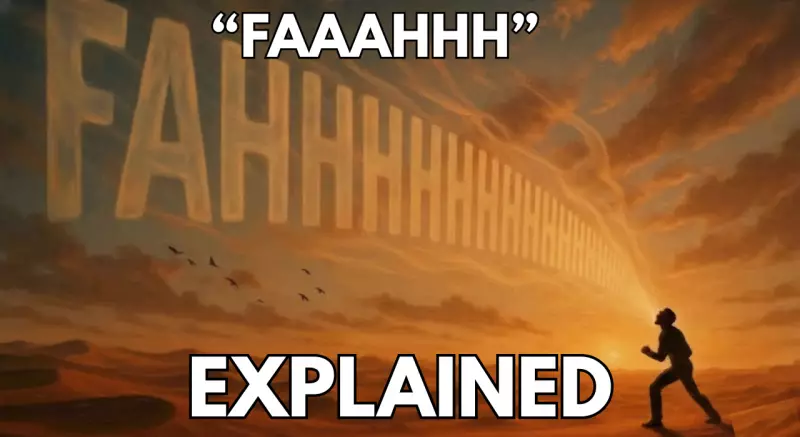
If you have recently heard friends or strangers letting out a loud, frantic 'faaahhh!' for no apparent reason, do not be alarmed. You are witnessing a full-blown internet phenomenon that has taken over platforms like TikTok and Instagram by late 2025. This is not a word or a scream, but a distinct, echo-tinged sound that has become the latest 'brainrot' trend, capturing a universal feeling of frustration, surprise, or spiritual collapse.
The Origin Story: From Obscure Clip to Viral Sensation
Unlike many meme sounds that appear mysteriously, the 'faaahhh' noise has a clear and traceable origin. According to detailed investigations and YouTube explainers, the original clip was created back in 2024 by YouTuber and TikToker Taileon. Known for his bizarre, low-fidelity vocal snippets, Taileon's raw recording was later discovered and shared by another creator named Premiumtai. From there, TikTok's powerful algorithm propelled the sound into the stratosphere.
By September 2025, 'faaahhh' had exploded across the internet. It became a staple in chaotic slideshow edits, surreal memes, and montages, serving as a universal audio exclamation point. The sound perfectly encapsulates a range of emotions from 'oh no' to 'what the hell,' resonating deeply with a generation that communicates through shared digital culture.

Evolution into a Cultural Phenomenon
The trend quickly evolved beyond simple reposts. It transformed into a vocal challenge where millions of users online, and increasingly in real life, began practising to perfectly replicate the exact timbre and length of the original 'faaahhh.' This collective effort turned into a strange, modern-day ritual, akin to rehearsing a medieval battle cry.
The meme's influence expanded into music, with rapper Juicy J releasing an official track titled 'Riley Faaahhh Remix.' Creators now meticulously edit their videos so that every 'faaahhh' aligns perfectly with a beat drop, transforming everyday fails and accidents into rhythmically satisfying moments. More practically, it has become Gen Z's favourite shorthand for minor inconveniences—spilling a drink, tripping, or any small mishap now warrants a heartfelt 'faaahhh.'
Why Does 'Faaahhh' Resonate So Deeply?
At its core, 'faaahhh' taps into a primal human instinct: the need to vocalize emotions that words cannot fully capture. Historically, warriors used battle cries, sailors sang shanties, and fans chant in unison. This trend is simply the 2025 digital remix of that ancient impulse. The sound itself is painfully relatable—it mimics the stifled yell of a parent who has stubbed a toe but is trying not to wake a sleeping baby. Everyone who hears it instantly understands the feeling.
The internet, true to its nature, has fully embraced the absurdity. Social media feeds are now filled with people rating each other's 'faaahhh' attempts, creating duet chains, and even producing 10-hour loops. A teacher went viral noting that it had become 'one of the most-used words in my classroom,' sparking debates about the linguistic creativity or doom of Generation Z.
This is the unpredictable nature of brain-rot culture: there is no formula. Trends like 'faaahhh' thrive on pure absurdity, perfect timing, and a shared sense of humour. While the meme will inevitably mutate into something new, for now, it has successfully created a moment of collective, noisy catharsis, leaving slightly older demographics squinting at their screens and asking, 'Why is everyone yelling faaahh now?'—which, for many, is half the fun.