

Hooligaanism's 'Bhalobashar Desh' Video: A Political Art Collaboration
Hooligaanism has consistently distinguished itself through music videos that master layered storytelling, from the viral Melar Gaan to Prithibita Bhalo Lokeder Noy. Their work blends a strong musical foundation with striking, often unexpected visual language. Now, their latest release, Bhalobashar Desh, arrives as a powerful testament to this artistic vision, marking a significant collaboration with globally renowned contemporary artist Dr. Subodh Kerkar.
The Visual and Conceptual Foundation
The video opens with evocative imagery: a burning boat drifting into view, a coastline dynamically reshaping itself to rhythms of absence and return, and Chau dancers transforming into living installations where gestures become language. At its core, this musical project features Dr. Subodh Kerkar, the Goa-based artist celebrated for large-scale performance installations intersecting ecology, memory, politics, and identity. Bhalobashar Desh represents his first foray into music video collaboration, expanding the grammatical possibilities of the medium.
In an exclusive conversation, the creative team—director Riddhi Sen, cinematographer Ishaan Ghosh, producer and band frontman Anirban Bhattacharya, and Kerkar—delved into the making of this ambitious project. The video draws inspiration from Kerkar's Ocean Odyssey project, but its genesis was serendipitous. Kerkar revealed he had been contemplating a music video collaboration after AR Rahman appreciated his work on Instagram, though that project remains pending. When approached for Bhalobashar Desh, he found its philosophical and political alignment compelling.

Political Art and Universal Themes
"I strongly believe that an artist has to be political. If you are not political, you are not an artist at all," Kerkar asserted. He views artists as receptors and transmitters of societal ideas, emphasizing that creation must reflect contemporary experiences, including global polarization around religion, race, and identity. Art, with its foundation in liberal thought, empathy, and human connection, possesses the unique power to unite people.
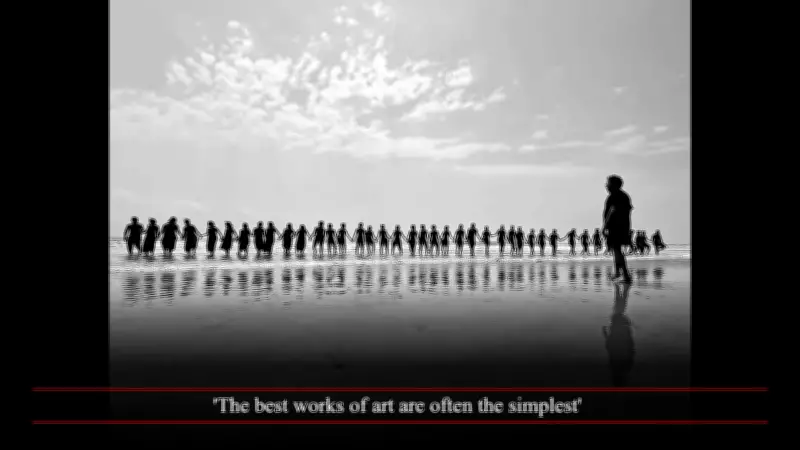
The video's visual language, conceived by Riddhi Sen, intentionally transcends specific locales or timelines. Powerful imagery of graves and children evokes universal themes applicable to conflicts in Iran or other war zones. Sen, a longtime admirer of Kerkar's work, explored his interpretations of civilizations born near water, which inspired the approach to representing India's vast diversity. "His visual language allowed people themselves to become the landscape—mountains, rivers, movement. In a single frame, through human formations, you could evoke geography and diversity," Sen explained.
Scale, Collaboration, and Artistic Integrity
Anirban Bhattacharya highlighted the band's enduring desire to push creative boundaries. Following the success of Melar Gaan, they sought to create something larger in thought and form, centered on love and diversity as national strengths. The collaborative process spanned five to six months, with Sen connecting to Kerkar via Instagram, fostering a hierarchy-free environment focused purely on creation.
"There’s this violent need to go viral these days. A few lines of a song, a clipped moment, that becomes the takeaway. But that can’t be the foundation of what we do," Bhattacharya noted. The team deliberately crafted an eight-minute video, defying the era of 30-second attention spans. They argued that engagement, not duration, is key, citing examples like Oppenheimer or theatrical productions that captivate audiences for hours.
Cinematic Challenges and Creative Solutions
Cinematographer Ishaan Ghosh expressed gratitude for the project, which renewed his faith in meaningful independent filmmaking. The collaboration required balancing scale and intimacy, utilizing wide drone shots while maintaining a focus on human elements. Ghosh's instinctive camera placement and movement were crucial in capturing the project's essence.

Budget constraints spurred innovation rather than limitation. Sen cited a sequence depicting childbirth at night, where conventional night shoots were impractical. Inspired by Kerkar's use of a circular mirror on water to create illusions of a night sky, the team achieved the effect with minimal resources. "That’s the power of art. You don’t need elaborate setups. It’s not about budget. It’s about ideas," Sen emphasized.
Legacy and Future Aspirations
The project also aimed to revive the legacy of large-scale music video productions in Bengali music, reminiscent of the MTV and indie pop eras. Bhattacharya acknowledged the challenge but expressed hope for rebuilding a community of artists, drawing inspiration from Bengal's rich history of collective practices like IPTA and theatre movements.
"Today, if something works, it gets repeated. But art cannot be pursued only like that. The idea is to keep building. To focus on the core practice. Not just chase virality," Bhattacharya concluded. The collaboration exemplifies how stepping outside comfort zones can generate new artistic energy, potentially fostering a slow-building resonance that enriches the cultural landscape.
