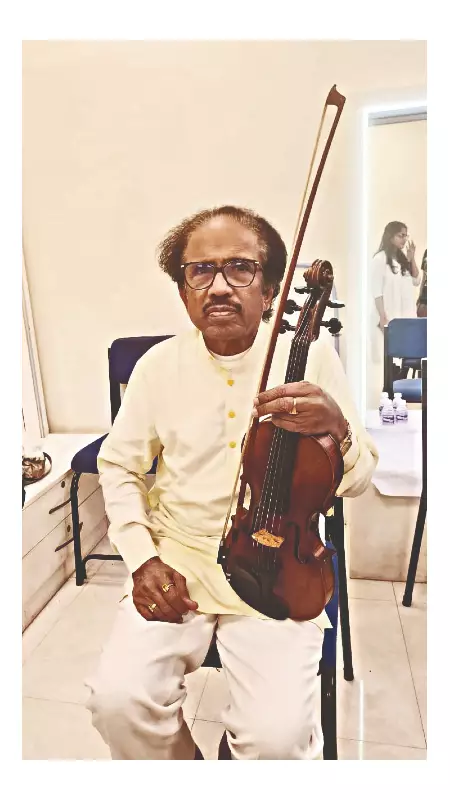
Legendary violinist Dr. L Subramaniam, who was recently honoured with the Padma Vibhushan, India's second-highest civilian award, has made a powerful appeal for change within the classical music ecosystem. At 78, the maestro, who is still in high demand, believes it is time for senior artists to consciously create space for the brilliant upcoming generation and for the tradition itself to embrace innovation to survive and thrive.
A Legacy of Innovation, A Call for Change
In an exclusive interview, Subramaniam reflected on the significance of the Padma Vibhushan, noting he was told he is the first violinist to receive this honour. "An award is not the final destination. You must always be learning," he stated, emphasizing that every concert is an exam for a performer. He dedicated the moment to his father and guru, V Lakshminarayana, whose dream was to elevate the violin from an accompaniment to a solo instrument in Indian classical music.
However, his thoughts quickly turned to the future. He expressed concern over dwindling crowds at traditional festivals like Chennai's Margazhi season compared to thirty years ago. "That is one of the reasons they are losing the crowd. We are just not bringing in new people who have different interests," he observed. Drawing a parallel with Western symphony orchestras that incorporated pop elements to attract millions, he stressed that innovation alongside tradition is non-negotiable to keep Gen Z engaged.

Stepping Back to Lift Others Up
In a significant personal decision, Subramaniam revealed he has drastically reduced his own festival performances. "Most senior artists sing for all the sabhas but that closes the door for the upcoming generation," he asserted. He now focuses on only one or two special concerts or projects a year. His argument is that while brilliant young artists may not draw large crowds initially, consistent opportunities will allow them to build their own audience over time. This, he believes, is crucial for the art form's continuity.
The Untapped Power of Instrumental Music
Dr. Subramaniam passionately advocated for a greater focus on instrumental music within the Indian classical landscape, particularly Carnatic music. He pointed out that Western classical music gained global popularity primarily through its instrumental repertoire. "Instrumental music has a much easier and wider reach," he said, noting that it transcends language barriers. He cited the global success of Pandit Ravi Shankar and Ustad Allah Rakha as examples of how instrumentalists can spread Indian music worldwide.
He lamented the current vocal-heavy focus in India and warned that for Indian music to be part of global festivals, which predominantly feature instrumentalists, this bias must change. "It should be 50-50," he urged, asking music organizations and audiences to keep an open mind. He also raised an alarm about the disappearance of traditional instrument makers, like those for the ghatam, kanjira, and tanpura, due to lack of orders.
Building a Sustainable Future: Orchestras and Global Stages
Outlining a path forward, Subramaniam spoke of his dream, through the Subramaniam Academy of Performing Arts (Sa Pa), to establish a professional orchestra system in India. He explained that in the West, orchestra musicians are salaried, providing financial security. "So if corporates and tech companies support, we can also have a similar system. There is so much talent," he said.
He is actively working to put Indian instruments on the world map. As an advisor to the Australian WOMAD Festival, he has facilitated the debut of nadaswaram and thavil artists there in March, introducing these ancient instruments to a new global audience. His own upcoming project, the "Navagraha" or nine planet symphony, features Sanskrit shlokas composed for a full symphony orchestra, with vocals by Kavita Krishnamurthy and Bindu Subramaniam, and includes a choir from Kazakhstan and a ballet. The tour begins on January 16, with a performance in Chennai's Lady Andal Venue on January 23.

Dr. L Subramaniam's message is clear: honour the past, but actively build the future. By making space for new talent, championing instrumental music, and fearlessly innovating, Indian classical music can secure its relevance for generations to come.