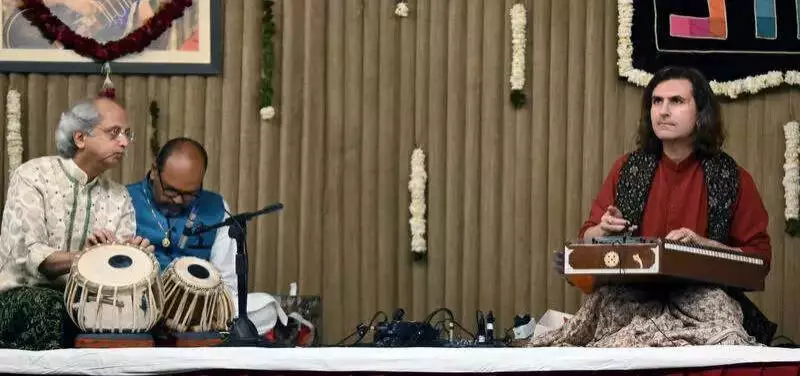
The ninth day of the prestigious Saptak Annual Music Festival in Ahmedabad witnessed a sublime confluence of legacy and artistry. On Friday, the main dais was graced by Rahul Sharma, the celebrated santoor maestro and son of the legendary Pandit Shivkumar Sharma. His performance, part of the festival's third baithak, captivated a packed house, offering a profound musical journey.
A Stage Set for Devotion and Learning
Occupying the top level of the distinctive two-tier stage, Rahul Sharma prepared his santoor as a group of dedicated Saptak students sat in padmasana on the level just below him. The young disciples, one notably adorned in a small blue winter cap, mirrored the palpable classical enthusiasm that filled the air. This visual setup beautifully symbolized the passing of the torch from a master to the next generation of musicians.
The Spiritual Journey of Raga Kaunsi Kanada
Sharma commenced his recital with the solemn and devotional Raga Kaunsi Kanada. The opening alaap was a masterclass in tenderness; his mallets caressed the santoor strings, producing sounds that flickered delicately like the flames of earthen lamps. This gentle invocation prompted scores of listeners in the audience to bow their heads in a silent, shared prayer.

As the deliberate tempo of the alaap seamlessly transitioned into the jod phase, Sharma was joined on stage by the renowned tabla maestro Yogesh Samsi. The jod serves as the crucial bridge between the introductory exploration and the climactic jhala. Here, the notes began to quicken with purpose but never haste. The santoor's resonant peals unfurled like a velvet carpet, upon which the intricate and precise riffs of the tabla tip-toed like scattered pearls.
A Climax of Unified Exaltation
Raga Kaunsi Kanada, with its inherent insistence on decorum and methodical intensity, is a natural choice for devotional compositions. Sharma's rendition built towards the jhala, the fast-paced, exhilarating finale. When he finally gave full rein to this climactic section, the hall erupted in spontaneous appreciation. The santoor's cascading notes and the tabla's rhythmic syllables intertwined perfectly, drawing collective wahs from the enthralled audience. At this shiny peak of the performance, all three elements—the santoor, the tabla, and the audience's admiration—united in a moment of pure exaltation.
By the end of his recital, Rahul Sharma had conquered the full Saptak house. His command over the instrument and the audience was effortless and profound, a powerful demonstration that he not only carries forward his father's immense legacy but also etches his own distinct mark on the world of Indian classical music.