Rishab Rikhiram Sharma Asserts Formal Discipleship Under Pandit Ravi Shankar
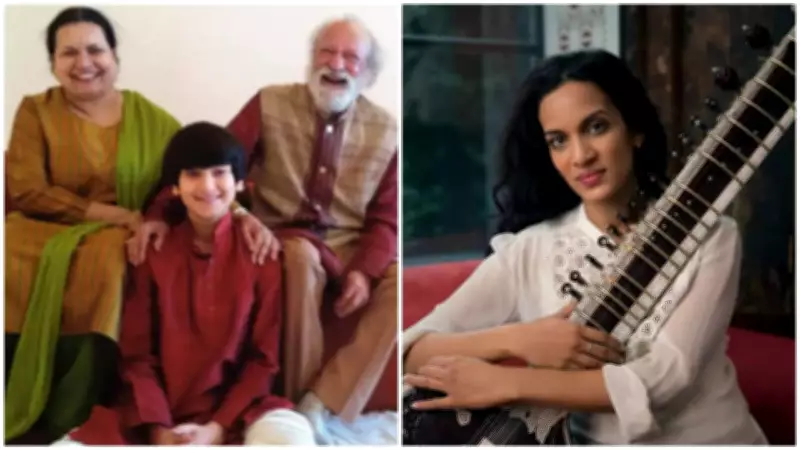
In a recent development that has stirred the classical music community, sitarist Rishab Rikhiram Sharma has officially responded to claims made by musician Anoushka Shankar, who denied that he was a disciple of her father, the legendary Pandit Ravi Shankar. While Anoushka praised Rishab's talent, she maintained that her father was never formally his guru. Now, Rishab has released a detailed statement, supported by photographs, asserting that he was indeed accepted as a disciple through a traditional Ganda Bandhan ceremony.
Detailed Account of the Ganda Bandhan Ceremony
According to a statement from Rishab's team, on January 3, 2012, a private meeting was held at the Ravi Shankar Centre in New Delhi. This gathering occurred at the express request of Pandit Ravi Shankar, following a personal call to Rishab's father, Sanjay Sharma, the previous day. The meeting included 13-year-old Rishab, his parents, his brother, Pandit Parimal Sadaphal, Shruti Sadamal, and Panditji with his wife Sukanya Shankar.
The statement claims that Sukanya Shankar had previously shown Pandit Ravi Shankar a YouTube recording of Rishab performing Raag Tilak Kamod at a Sanjay Rikhi Ram Vadya Parampara event in New Delhi on February 10, 2011. After reviewing this recording again on the morning of January 3, 2012, Pandit Ravi Shankar decided to accept Rishab as a shishya, intending to personally nurture his potential.

During the ceremony, Panditji asked Rishab to perform the same raag, listened attentively, demonstrated and corrected the composition, and conducted a formal lesson lasting several hours. He clarified that while he might not always be physically present, Pandit Parimal Sadaphal would supervise structured training, with periodic remote progress reviews. The session culminated in the formal Ganda Bandhan ceremony, where Panditji tied the traditional red thread around Rishab's wrist and spoke of Kartavya Vidya, emphasizing that the spiritual Guru-Shishya bond endures for life, even if the thread physically breaks.
Public Acknowledgment and Continued Training
The statement further references a public event on February 10, 2012, at Kamani Auditorium, where Pandit Ravi Shankar publicly introduced 13-year-old Rishab Rikhiram Sharma on stage as his youngest disciple. This occurred in the presence of Sukanya Shankar, members of the Sharma family, fellow disciples, and the assembled audience, marking Panditji's final public appearance in India before relocating to the United States.
Following Pandit Ravi Shankar's passing in December 2012, Rishab was invited by Sukanya Shankar to perform at the maestro's memorial gathering at Nehru Park on March 10, 2013, alongside other disciples from Panditji's extended teaching lineage. From 2013 onwards, Pandit Parimal Sadaphal continued Rishab's training in accordance with the guidance and directives of Pandit Ravi Shankar, a mentorship that has persisted to date.
Anoushka Shankar's Earlier Denial
Earlier, in an interview with Humans of Bombay, Anoushka Shankar had questioned Rishab's claim of being Pandit Ravi Shankar's last and youngest disciple. She stated, "Rishab is really talented and he is clearly speaking to people in a really wonderful way. I think there is some misunderstanding about his guruship. He learnt very intensively with someone very dear to me, one of my father's senior disciples Parimal Sadaphal, and he had a couple of lessons with my father, very informally, with Parimal uncle also in the room."
She added, "We knew him from childhood because he was the son of our instrument maker Sanjay Rikiram Sharma. So somehow that has gone blown up into some story of him being his last disciple or the youngest disciple, which isn't true. But he is super talented and deserves all success with or without that story."

Impact on the Classical Music Fraternity
The contrasting accounts have sparked conversations within the classical music fraternity about lineage, mentorship, and the interpretation of the traditional guru-shishya bond. Rishab, who comes from the Rikhi Ram family of instrument makers and is known as the first sitarist to perform a solo set at the White House, has seen his claim challenged, leading to a broader discussion on how such relationships are defined and recognized in Indian classical music.
This dispute highlights the nuances of musical heritage and the importance of formal ceremonies like Ganda Bandhan in establishing discipleship. As both sides present their perspectives, the debate continues to resonate among artists and enthusiasts, underscoring the enduring significance of guru-shishya traditions in preserving cultural legacies.