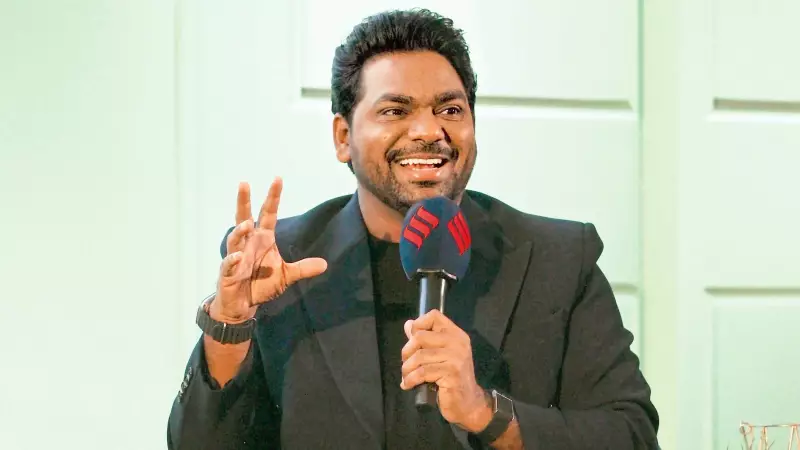
Stand-up comic Zakir Khan recently shared his thoughts on language, success, and personal growth at The Indian Express Adda. He engaged in a lively conversation with Anant Goenka, Executive Director of The Indian Express Group, and Devendra Pandey, Deputy Associate Editor.
The Evolution of Hindi and Language Diversity
Zakir Khan believes every pronunciation is correct unless it is intentionally wrong. He explained that if someone learns a word by reading it rather than hearing it, their pronunciation might differ. That does not make them incorrect.
He reflected on India's relationship with Hindi, calling it a newfound love. Khan emphasized that Hindi has a long history, and understanding it matters deeply. Born in Indore, Madhya Pradesh, he noted the complexity of Hindi words used there. However, every region adds its own flavour.

The Hindi spoken in Lucknow, Kanpur, Jabalpur, Gwalior, Bhopal, and Indore varies significantly. Your dialect carries the vibe of your region. Khan's Hindi has a Malwa touch, while Lucknow's speech shows Awadhi influence. All these flavours mix to create the language.
He acknowledged the importance of English too. Ideally, everyone should know every language. Language carries classism and hegemony. People often judge others based on how they speak. This reflects where they grew up, their school, background, and neighbourhood.
Overcoming Early Challenges in Comedy
When Khan started comedy, many felt this art form came from outside India and had to be in English. He strongly believed Hindi would connect more deeply with people here. The first three or four years were tough.
Sharing personal stories sometimes did not resonate with audiences. Khan sees this not as personal failure but as generational. It is a learning process. The internet changed everything by making everyday language the norm. Hindi found its space during this anti-elite moment.
Navigating Fame and Insecurity
Khan discussed the colonial hangover within Indians. He said it is okay because it is part of our history. The key is not to ridicule ourselves or celebrate it blindly. English has helped in the workforce, where it signals education.
For those from weaker economic backgrounds, language acts like clothing. It comes from learning and can show a different background. This opportunity is crucial.
He admitted feeling insecure about money and fame. Insecurity does not have a season. Khan pays attention to people with generational wealth because they have a handbook he lacks. His foundation feels weak despite his success.
Khan was supposed to be a school music teacher. He never received training to handle success. It takes generations to learn 'class'. He lives with constant anxiety due to having no backup. He belongs to the 'not-so-cool' crowd where mistakes are costly.
The Core of His Work: Personal Relationships
Khan's main focus has always been personal relationships. Comedy, popularity, money, and brands are secondary. He spends time helping friends with their lives, marriages, and family conversations.
His grandfather, Ustad Moinuddin Khan, advised giving good advice indirectly, like wrapping poison in a betel leaf. Khan cannot fix all the world's sadness but tries to improve what is close to him.
For the last five or six years, he has thought deeply about relationships with fathers and grandparents. These stories work because they come from genuine belief. If he does not truly believe in something, it will not translate.
Self-Censorship and Artistic Growth
Khan believes everyone should self-censor. The idea of saying whatever comes to mind is overrated. There is a gap between thought and speech that one must process. Every culture has its sensitivities, which change over time.
He respects Javed Akhtar but notes context matters. When language had elitist control, breaking that structure came with roughness. Every revolution brings mud with the water. As artists grow, they refine themselves. Society moves four steps forward and three steps back.
Unity Among Comedians and Performance Magic
Khan highlighted the strong camaraderie among comedians, not rivalry. They had no patrons or royal backing, so they stood together against the world. Competition exists, but what they fight for is bigger than them.

He feels at home on stage, having grown up there. After 100 shows, performance becomes automatic. Then the magic happens. His grandfather said what you do is not really yours; it is about timing and opportunity. God blesses you at that moment.
Khan works hard so that when God gives the chance, he is ready to handle it. Mistakes happen only to those who work. Without working, there can be no mistakes.
Rejecting Hierarchy and Staying Grounded
Khan avoids sofas in his shows because everyone is a VIP. He wants to see every audience member as a citizen. Hierarchy should not decide what people deserve. Respect is fine, but domination is not.
He decides which doors are closed and will knock, break, and open them himself. If he had settled, he would be a music teacher in Indore. The right to demand better is between him and his God.
His conviction comes from his father and grandfather. They always told him he was meant for greatness and to behave like it. Success never made him lose balance. His family was not rich, but they travelled in buses and general compartments, learning life early.
Rapid Fire Insights
In a rapid-fire session, Khan shared quick thoughts. He missed around 14 flights on his US trip. He believes Indore's cleanliness comes from a competitive spirit Mumbai lacks. Khan does not use his personal romantic encounters as material.
One life lesson from Indore is to slow down when you become well-known. From Delhi, he learned that having no hope is the worst thing. For his shows, he hopes audiences feel grandparents' love from Tathastu, learn to fake it till you make it from Chacha Vidhayak Hain Humare, and understand friendship's mental health benefits from Mannpasand.
He described contemporaries like Kunal Kamra as rebellious, Tanmay Bhat as visionary, Vir Das as a pioneer, Samay Raina as audacious, and Anubhav Singh Bassi as a favourite storyteller.
Audience Questions and Final Thoughts
Khan addressed audience questions about success and luck. He distinguishes between what we earn and what we receive. Gratitude is essential when people love and care for you.
For the next five years, he wants to do it all, comparing life to climbing mountain peaks. To young people abroad, he advises remembering the hard work that sent them there and staying in touch with family.
He performs mainly for the Indian diaspora, aiming to turn any venue into a living room. His interest in comedy began with joke books in school, realizing the power of being funny.
Khan's final advice to aspiring comedians is to do open mics. Comedy requires stage practice. Spend less time overthinking and more time performing.