

The Silk Route was a network of ancient trade routes that connected China, India, Central Asia, and the Mediterranean. It played a vital role in cultural exchanges between India and other countries, facilitating the exchange of ideas and commodities. In India, it covered seven main states, including ruins of ancient Vaishali (Bihar), Buddhist remains of Kushinagar (Uttar Pradesh), Sravasti (Uttar Pradesh), Kaushambi (Uttar Pradesh), Ahichhatra (Uttar Pradesh), an ancient site and Buddhist Stupa (Punjab), Arikamedu (Puducherry), excavated remains of Kaveripattinam (Tamil Nadu), an ancient monastery and stupa at Harwan (Jammu and Kashmir), Burud Kot (Maharashtra), and Indraprastha (Delhi).
The Global Appeal of Indian Chintz
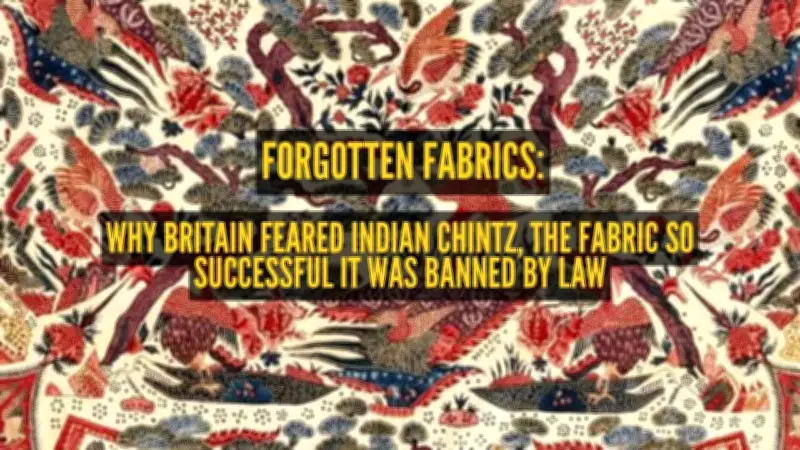
For centuries, India, enriched with numerous cultures and a long history, has inspired the world across borders. From Indian food to fashion, every part of the subcontinent's rich artistry has traveled abroad. While sometimes it has held its identity, other times it has succumbed to the pressures of assimilation. But did you know there was a time when an Indian textile was so popular among people and successful in markets that the British banned it by law? The Indian Chintz Portrait of Madame de Pompadour, mistress of King Louis XV, shows her wearing a chintz gown. A detail of the bedchamber of Marie Antoinette at the palace of Versailles also features chintz patterns.
Indian chintz patterns, also known as "chintz fabric," are a type of textile design that originated in India during the 17th century. The fabric, characterized by bright colors, bold patterns, and floral motifs, has gone in and out of style for the past 500 years. It gets its name from the Hindi word "chint," meaning spotted or variegated. At the time, the fabric was a proud product of India's textile production skills and methods that gradually went viral in markets outside the country.

The Rise of Chintz in Europe
At the same time, the Americas and Europe were undergoing a fashion renaissance led by trends arriving from the French royal court at Versailles, perhaps Europe's first major fashion influencer. The French aristocracy immediately fell for the floral patterns and saturated colors of Indian chintz, created with natural pigments such as cochineal and indigo that were still unavailable in Europe at the time. In England, during the reign of William and Mary (1689-1694), it is recorded that the queen had a taste for 'Chintz and East India calicoes.' Defoe wrote: "Her Majesty had a fine apartment (at Hampton Court) … most exquisitely furnished, particularly a fine chintz bed, then a great curiosity."
The East India Company (EIC) records indicate a demand for pieces made specifically as bed hangings in the 1680s, with quilts and palampores ordered in great quantities. In 1722, Wanstead House in Essex, the home of Josiah Child, then head of the EIC, was furnished in chintz in its minor bedrooms and dressing rooms.
Indian Chintz: Banned by the Law
While India had been producing chintz for a millennium, it was only after Portuguese explorer Vasco da Gama reached Calicut in India in 1498 that Indian chintz went global. Merchants began exporting the fabric across the globe when they found that wools and linens were not appreciated there. Thus started the 'calico craze,' which peaked in the late 17th century.
In the middle of the 17th century, chintz began to be used to make clothes. Soon, it became worn by all classes, both men and women, throughout Europe. According to Sarah Fee, author of 'Cloth That Changed the World,' Indian chintz is recognized as the first "mass fashion."
But while merchants were benefitting immensely from the calico craze, local textile merchants were suffering. Long-established silk, linen, hemp, and wool manufacturers rose up in protest and rioted against the cottons made by "heathens and pagans," wrote Fee. Thus, to protect domestic businesses, chintz was banned in France between 1686 and 1759 and partially banned in Britain between 1700 and 1774. Various edicts were also issued in Spain, Venice, Prussia, and the Ottoman Empire regarding the import and use of chintz and other textiles.

Soon, by the end of the 1700s, European manufacturers began to imitate chintz at home. British traders brought about technological innovations from circa 1770 to 1830, leading to the first massive factories and mill towns. With the US Declaration of Independence in 1776 and the arrival of minimalism, chintz's fortune in the West started to wane.
Indian Chintz: Alive and Colourful
Chintz has had highs and lows of fame. It remains one of the most popular fabrics in the world. In the 19th century, chintz saw its revival. It was popularized when Jackie Kennedy’s 1963 renovation of The White House featured "orange blossom" chintz. By the 1980s, it was on the runway thanks to Princess Diana and home brand Laura Ashley, whose chintz dresses the newlywed wore. It became a backdrop in cult classic films such as 'Risky Business' and 'Pretty in Pink.' During the Reagan reign, the White House revived the tradition of chintz at the hand of Nancy Reagan and her decorator Ted Graber. With a style he coined as "trend-resistant traditional," Graber used chintz in the President’s Study, the First Lady’s dressing room, and many other sitting rooms of the Reagan White House.
Now, with the rise of British maximalism as evident in series like Bridgerton, chintz is back to being the love of Europe. Today, the Royal Ontario Museum holds a world-renowned collection of Indian chintz titled 'Cloth that Changed the World: The Art and Fashion of Indian Chintz.'
