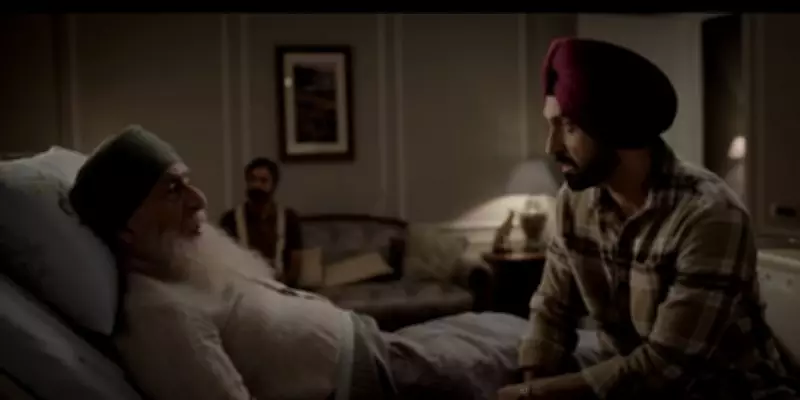
Imtiaz Ali's film Main Vaapas Aaunga presents a Partition love story that defies typical Bollywood tropes, focusing instead on a nonagenarian's desperate return to his past through the help of his grandson. The film stars Naseeruddin Shah as Ishar Singh Grewal, a grumpy 90-year-old with dementia who forgets that India and Pakistan are separate countries and insists on visiting Sargodha, his hometown, to meet the girl he loved.
Plot Overview
The movie opens with Ishar Singh developing dementia, leading him to order his driver to take him to an address in what is now Pakistan. Border security stops him, and he suffers a stroke, leaving him bedridden with rapidly progressing dementia. His two sons wait for him to die, but his grandson Nivi (Diljit Dosanjh) returns from Britain and pieces together his grandfather's fragmented memories. With a British passport, Nivi crosses the border and arranges a video call connecting Ishar Singh with his past. The film ends with Nivi standing against a backdrop of global bombings, drawing a parallel to the Partition of 1947.
Multiple Layers of Meaning
Surinder S Jodhka, writing for The Tribune, notes that the film resonates deeply with Partition families. He recalls his own family's experience: his grandfather's generation never spoke of returning to their birthplace, but the word 'pichhan' (the place left behind) was a daily reference. They idealized everything about the past—fields, food, friendships—yet fully embraced Nehru's vision of progress in India. A key scene shows Keenu (young Ishar) telling his brother not to look back, a phrase repeated decades later as Ishar Singh begs to return to Sargodha.

Nostalgia and Healing
The film's ending, where the grandson provides closure by traveling to Sargodha, offers new avenues for engaging with the past—not just for Partition survivors but for humanity confronting violence and homelessness. Jodhka argues that the only way to counter hatred is through love, as embodied by Keenu and Jiya's enduring affection. Modern technology, such as video calls, makes this 'vaapsi' (return) possible, but the film also urges us to draw on traditions of love and forgiveness from Gurus, pirs, and fakirs like Buddha, Guru Nanak, Farid, Kabir, Bulleh Shah, and Mirabai.
Critical Reception
With veteran Naseeruddin Shah in the lead, supported by Diljit Dosanjh, Sharvari, and Vedang Raina, the film weaves a story layered with universal themes of love, loss, violence, and separation. Jodhka emphasizes that while the specifics differ, the emotional truth is familiar to anyone from a Partition background. The film challenges the mid-20th-century ideas of progress, suggesting that a return to love and forgiveness is urgent for moving forward.