The Dramatic Fall That Couldn't Stop a Theatre Titan
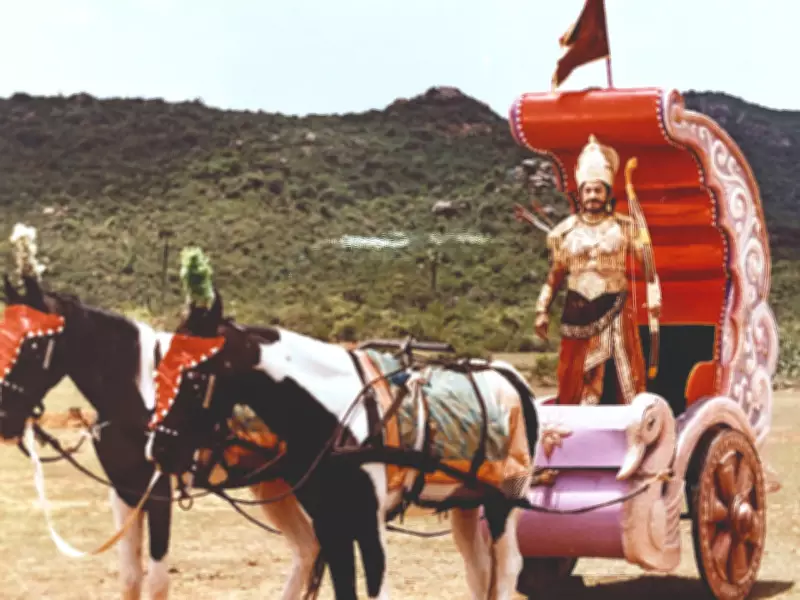
In late 1985, during a stage performance of the play Indrajith, veteran actor R S Manohar, playing the titular role of Ravana's son, suffered a terrifying 12-foot fall. Displaying remarkable fortitude, the injured actor struggled to his feet, completed the performance, and only collapsed after the curtains fell. He was immediately rushed into surgery.
A Misheard Command Leads to Disaster
Industrialist and arts patron Nalli Kuppuswami Chetti vividly recalls the incident. "Manohar was renowned for his special effects on stage," he explains. "To create the illusion of a severed head, he sat on a high trolley, hidden from the waist down between black sheets, appearing to hover." The actor instructed his stagehand to 'wait' by saying 'iru daa'. Tragically, the assistant misheard it as 'izhu daa', meaning 'pull'. The trolley was yanked, and the audience watched in horror as Manohar plummeted.
A Prolific Career Spanning Decades
Through the 1960s and 1970s, R S Manohar became a towering figure in Tamil theatre with over 7,900 performances. He was celebrated for his innovative 'dramascope' technique, which made plays feel like cinematic experiences with stereophonic sound, elaborate sets, and pyrotechnics.

From Academic Excellence to Theatrical Passion
Born on June 29, 1925, in Namakkal, Manohar was a graduate of Madras University and served in the University Officers' Training Corps and Indian Air Training Corps. Despite academic prowess, acting was his true calling. He performed in Shakespearean, Tamil, and Sanskrit dramas during his school and college years.
His nephew, S Shivpprasadh, who stages Manohar's major works in Chennai sabhas, notes his enduring relevance. "His devotion and dedication to excellence raised the standards of Tamil theatre permanently," he states. Through social dramas, historical epics, and mythological stories, Manohar projected the region's rich cultural heritage.
Transition to Cinema and Directorial Acclaim
For years, Manohar worked in the postal department's administrative wing before director R M Krishnaswamy discovered him for the lead role in the 1951 crime thriller Rajambal. Prudently, he only quit his stable job after establishing himself, knowing he competed with legendary villains like M R Radha and P S Veerappa.
His grasp of complex roles made him a director's favorite. With a cold, villainous stare and a thunderous voice, he sent chills down spines. Films like Kaithi Kannayiram, Vallavanukku Vallavan, and Iru Vallavargal in the 1960s cemented his impact.
Director P Vasu observes, "Manohar's screen presence challenged co-stars. One had to match his calibre. Cinema came naturally to actors with stage experience like MGR or Sivaji Ganesan."
Pioneering Realism and Sensory Immersion
Director K S Ravikumar, who volunteered at Manohar's plays in his youth, highlights the innovative stagecraft. "His backdrops were distinctive; he aimed for total sensory immersion," Ravikumar says. "If a play featured a jasmine garden, he sprayed jasmine perfume so the fragrance filled the auditorium. He pioneered realism on stage—if a python was needed, he brought a real one. He was fearless." Ravikumar calls him "the Shankar of theatre" for bringing grandeur akin to the famed film director.
Resilience After the Accident and Political Connections
After the 1985 accident, Manohar slowed down until 1991, when Chief Minister J Jayalalithaa, a longtime admirer, requested he stage Thirunavukkarasu. Despite frailty, he delivered a powerful performance. Shivpprasadh reveals, "Jayalalithaa's mother Sandhya acted in his plays. Jayalalithaa always watched his plays at the Music Academy in the same seat. She even postponed a Kalaimamani awards ceremony until he recovered from knee replacement surgery." At her behest, Manohar later staged Velicham, a government program on alcoholism's evils.

A Legacy Beyond Politics and Stage
Despite close associations with three chief ministers—M Karunanidhi, M G Ramachandran, and Jayalalithaa—Manohar never ventured into politics. His troupe, National Theatres, staged approximately 7,950 shows, and he acted in over 200 films.
His first mythological play, Lankeswaran, initially faced criticism for portraying Sita as Ravana's daughter. After consulting Kanchi Paramacharyar, who found no issue, the play was staged repeatedly in Ceylon, where Manohar was honored as 'Lankeswaran Manohar'.
Enduring Honors and Personal Traits
Manohar was honored as Nadaka Kavalar (Guardian of Theatre) in 1970. A voracious reader, he was known for precise diction. He passed away on January 20, 2006, leaving an indelible legacy in stagecraft that continues to inspire.
Actor-director R Pandiarajan, who featured Manohar in Manaivi Ready (1987), recalls, "I was a fanboy on set. Manohar reminded me I was the director and needed to guide him, not watch in awe." This humility, combined with his artistic fearlessness, defined a career that transformed Tamil theatre and cinema.