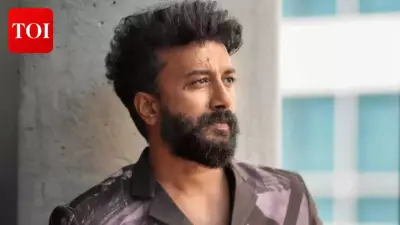
Actor-filmmaker Raj B Shetty is in a reflective mood as he prepares for the release of his highly anticipated multi-starrer '45'. The film, which features legendary actors Shivarajkumar and Upendra alongside him, represents a distinct commercial venture for Shetty. In a candid conversation, he delves into his passion for storytelling, the evolving dynamics of Kannada cinema, and his profound connection with the audience.
45: A Distinct Cinematic Experience
When asked about what drew him to '45', Shetty emphasizes that the film offers a unique cinematic experience. He clarifies that while the approach is more commercial and aims to cater to a mass audience, the core sensibility of making a good film remains uncompromised. "The sensibility remains intact," he asserts, promising audiences a distinct and engaging watch. He credits director Arjun Janya for his courageous vision and ability to dream big, a confidence that stems from an audience that is increasingly open to change.
The Audience-Filmmaker Cycle
Shetty strongly believes that it is the audience, not filmmakers, who ultimately dictate the direction of cinema. "Audiences dictate what cinema becomes, not the other way around," he states. The success of unconventional films empowers creators to trust their inner voice and explore new storytelling dimensions. However, he also acknowledges the cyclical nature of this relationship. Films have the power to change people, just as people's tastes change films. He cites the example of Upendra, whose revolutionary films like 'Om', 'A', and 'Upendra' altered audience perceptions and created his unique stardom.

He notes the unpredictable nature of box office success, where even distributors often cannot gauge a film's fate. "Audiences know from the very first show what a film is about, and they take it forward," Shetty says, highlighting the irreplaceable power of word-of-mouth, a force that has propelled many of his own projects.
The Philosophy of Choice and Originality
For Raj B Shetty, the primary criterion for selecting a role is novelty. "If it's something I haven't done before, it excites me," he explains. He strives to remain a perpetual student of cinema, embracing the fear and uncertainty that comes with unfamiliar territory. His upcoming role in 'Landlord' terrifies him because it involves portraying a kind of cruelty and strength he has never attempted, and that very fear is essential to his process.
Addressing the theory that there are only seven basic stories, Shetty agrees but stresses that storytellers bring unique voices. "My experience of love, violence, or life will never be the same as yours. That uniqueness is originality," he remarks. He warns against imitation, which only dilutes one's own authentic voice.
The Importance of a Grounded Team
Shetty underscores the critical importance of a core team that challenges him and keeps him grounded. In an industry where success can inflate egos, he values people who remember him as he was on day one. "A good team protects you from that," he says, cautioning against the danger of surrounding oneself with 'yes-men', which leads to creative stagnation and isolation within a few years.
On the State of Kannada Cinema
Shetty refrains from labeling the current era as particularly good or bad for Kannada storytelling. He views cinematic change as a slow, decade-long process, not something measured in months. Real change, he argues, is evident only when a significant number of films—10 or 12—are genuinely celebrated by audiences, thereby inspiring the next generation of filmmakers.
Connecting with Diverse Perspectives
Shetty reveals a remarkable capacity for empathy, stating he can connect with anyone, even a person with extreme views. He believes we often externalize evil and construct a flattering self-image by highlighting our good deeds while editing out our flaws. "Whoever that person is — saint or sinner — they are all representations of us, with small pluses and minuses," he philosophizes. This understanding allows him to listen and relate to anyone authentically.

This principle extends to his workspace. He fosters an open, hierarchical environment within his team by ensuring everyone shares the foundational goal of telling an authentic story, rather than merely making him a bigger star.
Moving Beyond Trend-Driven Stagnation
Shetty identifies a central irony in the film business: "Cinema is one of the riskiest businesses, yet everyone wants to play it safe. Ironically, the biggest risk is making films safely." He consciously avoids following industry trends, whether it's Malayalam-style thrillers or Tamil ultra-violence. His filmography—from 'Ondu Motteya Kathe' to 'Garuda Gamana Vrishabha Vahana' and 'Swathi Muthina Male Haniye'—lacks a connecting genre thread, driven instead by a pursuit of authenticity. Repeating past successes, he fears, would cause him to lose interest in cinema itself.