

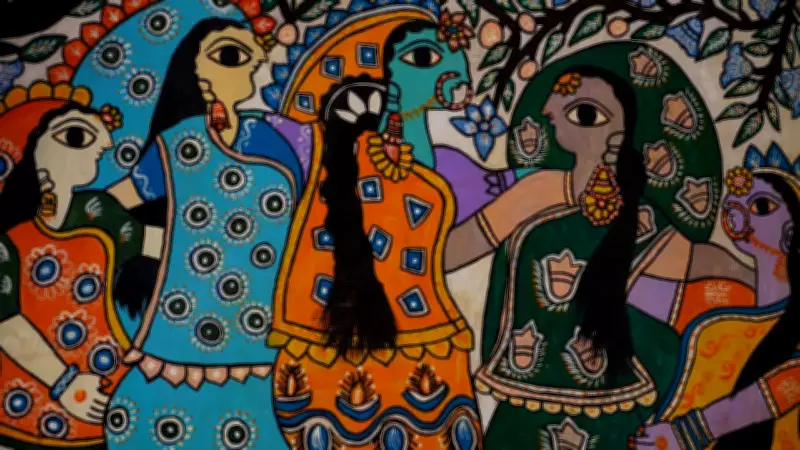
For centuries, Madhubani art was a domestic tradition in the Mithila region of Bihar, passed from mothers to daughters on mud walls for weddings and festivals. Using crushed leaves and rice paste, women created vibrant paintings for rituals. However, a severe drought in the 1960s forced a handful of resilient women to transfer these paintings from walls to paper to sustain their families. This survival tactic revolutionized Indian folk art, propelling Madhubani from local villages to international acclaim. Today, these five women are celebrated as pioneers who brought Madhubani to the world stage.
Sita Devi
Sita Devi was among the first to recognize the commercial potential of her art during the 1960s drought. She took a bold step by painting on handmade paper instead of mud, developing a distinctive style with vibrant blocks of blue, yellow, and red. Her work captivated audiences beyond Bihar, leading her to travel to the United States and Europe, where she even created a folk-art version of the New York City skyline. In 1981, she received the Padma Shri, proving that rural women could command global attention in the art world.
Baua Devi
Baua Devi was a teenager when the movement to commercialize Madhubani began, and she remains one of the last living pioneers of that era. Growing up in Jitwarpur, she loved storytelling through her drawings, blending ancient myths with personal dreams and real-life experiences. Her raw, mystical style caught the eye of international curators. In the late 1980s, she spent months in France painting murals, demonstrating the depth of Indian folk art. In 2017, she received the Padma Shri, a testament to her lifelong dedication to preserving the tradition.

Manisha Jha
While early pioneers laid the foundation, Manisha Jha builds upon it with a modern approach. Raised watching her grandmother paint, she trained as an architect, giving her art a unique edge. She merges traditional Madhubani techniques with contemporary geometry and themes such as women's rights and environmental crises. Manisha believes folk art must address current issues to survive. Through her international exhibitions and art school, she teaches new generations how to transform folk art into a viable career.
Dulari Devi
Dulari Devi's story is one of remarkable transformation. Born into a poor fisherman's community, she never attended school and worked as a domestic helper in the homes of upper-caste artists. Observing them paint, she decided to try it herself. Under mentors like Mahasundari Devi, she developed an ultra-fine line-drawn style. Her work depicts not just deities but also fields, fish, and the realities of working-class women, breaking down caste barriers through art.
Hema Devi
Hema Devi embodies the continuity of Madhubani art. Surrounded by national award-winning painters, she began painting at fifteen. Beyond paper, she experiments with papier-mâché and textiles, creating three-dimensional pieces. Her true strength lies in connecting with people; she travels across India and Europe conducting workshops, teaching the rhythm of Madhubani lines to foreigners and youngsters. She has transformed a static art form into a living, cross-cultural dialogue.

