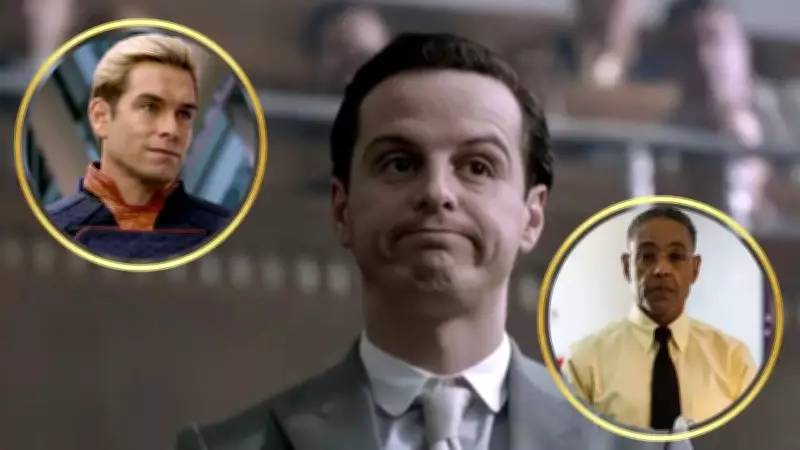
The Greatest TV Villains of All Time: From Gus Fring to Homelander
In the realm of television, the most memorable villains are not merely embodiments of evil; they are complex characters who force audiences to grapple with their motivations, occasionally eliciting sympathy despite their heinous actions. These antagonists have not only terrorized the heroes of their respective shows but have also permanently elevated the standards for what a television villain can achieve. Here, we delve into some of the most iconic villains in TV history, exploring what makes them so uniquely terrifying and compelling.
Gustavo Fring — 'Breaking Bad'
Giancarlo Esposito's portrayal of Gustavo Fring stands as a masterclass in villainy, arguably the greatest in television history. Fring is a man who constructs an empire of violence and control behind the impeccable facade of a fast-food restaurant owner, known for remembering every regular customer's name. What renders him truly terrifying is not his capacity for violence, but his extraordinary patience, discipline, and complete absence of panic in even the most dire situations. Every scene he inhabits crackles with a quiet menace, underscoring a character who is perpetually three steps ahead of everyone else in the room.
Joffrey Baratheon — 'Game of Thrones'
While many great TV villains operate with a discernible logic, Joffrey Baratheon terrifies in a more visceral and impulsive manner. As a boy king, his cruelty is unchecked, impulsive, and seemingly without consequence—until it dramatically is not. Jack Gleeson's performance imbues the character with a petulant, thin-skinned viciousness, making every appearance feel like a ticking time bomb. The show utilizes Joffrey brilliantly as a portrait of absolute power wielded by someone with the emotional maturity of a spoiled child, highlighting the dangers of unchecked authority.

Kilgrave — 'Jessica Jones'
David Tennant's Kilgrave ranks among the most chilling villains in superhero television history. Possessing the power to compel anyone to do his bidding, Kilgrave has spent his life genuinely unable to comprehend why this ability might be problematic. The show's serious exploration of his psychology adds depth to his character, presenting his obsessive fixation on Jessica Jones not as cartoonish evil but as the logical outcome of a man who has never encountered refusal. Tennant's breezy, almost playful charm amplifies the horror, making Kilgrave's actions land with even greater impact.
Homelander — 'The Boys'
Antony Starr's Homelander is currently the most terrifying villain on television, a Superman-level superhero with the emotional fragility of a deeply traumatized child and no real constraints to his power. What makes him uniquely disturbing is the show's framing of him as a product of a system that created, weaponized, and ultimately lost control of him. Homelander's desperate craving for love and validation has curdled into monstrosity, fueled by the realization that no one can deny him. Scenes where his carefully maintained smile begins to slip are suffused with pure, palpable dread.
Jim Moriarty — 'Sherlock'
Andrew Scott's Jim Moriarty burst onto television screens and immediately redefined the archetype of a villain in prestige drama. Discarding prior expectations, Scott portrays Moriarty as a character driven not by money, power, or ideology, but by the pure, almost artistic pleasure of chaos. He finds Sherlock Holmes intriguing enough to keep alive, while viewing everything else as disposable. Every interaction with Benedict Cumberbatch's Sherlock feels like a bomb with a short fuse, electric and unpredictable.
Benjamin Linus — 'Lost'
Michael Emerson's Benjamin Linus is one of television's greatest slow-burn villains. Introduced as a minor character, he gradually reveals himself as the most dangerous and calculating presence on the island. Linus's endless compulsion stems from the ambiguity of his truthfulness; viewers are left questioning how much of what he says is genuine, how much is manipulation, and whether even he can distinguish between the two after years of strategic deception. Emerson's performance, marked by a quiet, wounded intensity, makes every lie feel like a confession and every confession feel like a lie.