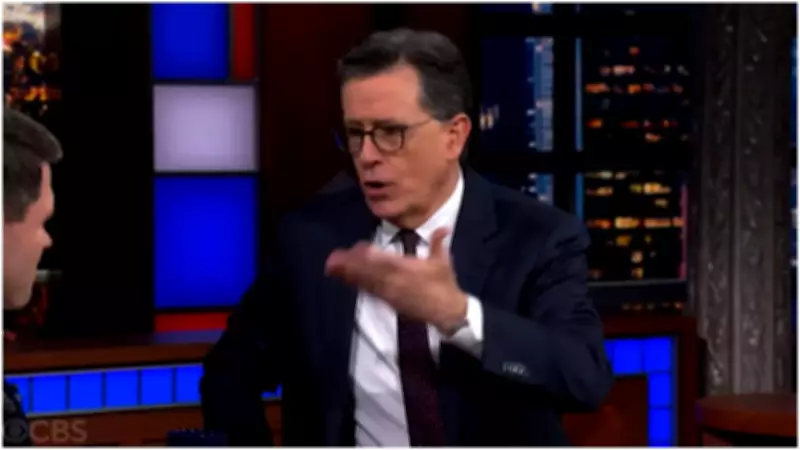
Stephen Colbert Accuses CBS of Blocking Texas Representative Interview Over FCC Rule Concerns
In a fiery opening segment of The Late Show, host Stephen Colbert made startling allegations that CBS network lawyers directly intervened to prevent him from interviewing Texas state representative James Talarico. Colbert claimed the network cited legal concerns stemming from new federal guidance on political airtime regulations issued by Federal Communications Commission (FCC) chairman Brendan Carr.
Colbert Defies Network Directives to Address Controversial Cancellation
After introducing his band and guest Jennifer Garner, Colbert turned to his audience with a provocative question: "You know who is not one of my guests tonight? That's Texas state representative James Talarico." The host revealed that Talarico had been scheduled to appear but was abruptly cancelled after what Colbert described as unequivocal instructions from network attorneys.
"We were told in no uncertain terms by our network's lawyers, who called us directly, that we could not have him on the broadcast," Colbert stated. He added that he received further instructions prohibiting him from even mentioning the cancellation, prompting his defiant response: "And because my network clearly does not want us to talk about this... Let's talk about this."

FCC's "Equal Time" Rule and the "Bonafide News" Exception
Colbert connected the network's decision to recent guidance from FCC chairman Brendan Carr regarding the long-standing "equal time" rule. This regulation requires broadcasters to provide comparable airtime to rival political candidates when a qualified contender appears on programming. Historically, news programs and many late-night shows have operated under the "bonafide news" exception, which Mediaite reported has traditionally exempted such programming from strict equal time requirements.
However, Carr signaled in a formal letter that this exemption might not automatically apply to entertainment talk shows. The FCC chairman suggested determinations could depend on whether there was evidence of "partisan motivation" in booking political candidates.
Colbert's Fiery Response to FCC Chairman
Colbert delivered a scathing rebuke to Carr, telling his studio audience: "Well, sir, you're chairman of the FCC. So, FCC you, because I think you are motivated by partisan purposes yourself." The comment drew enthusiastic cheers and applause from the live audience.
The host elaborated on his criticism, suggesting political motivations behind the regulatory pressure: "Let's just call this what it is. Donald Trump's administration wants to silence anyone who says anything bad about Trump on TV because all Trump does is watch TV." Colbert compared the former president to "a toddler with too much screen time" who "gets cranky and then drops a load in his diapers."
Late-Night Hosts in Regulatory Crosshairs
Colbert noted that he and fellow late-night host Jimmy Kimmel of ABC have been particularly affected by the regulatory threat. After both hosts discussed Carr's letter on their respective programs, the FCC chairman responded in an interview clip played by Colbert, suggesting that if hosts "don't want to have to comply" with broadcast regulations, they should "go to a cable channel or a podcast or a streaming service."
Colbert mocked this suggestion, saying: "Great idea, a man whose job is to regulate broadcast TV suggest everyone just leave broadcast TV."
Workaround Solutions and Continued Defiance
Despite the network restrictions, Colbert informed viewers that the interview with Talarico would be available on the show's YouTube channel, though he noted with evident frustration that "the network says I can't give you URL or a QR code." He promised viewers they could find the content by visiting the show's YouTube page directly.

Colbert also criticized CBS for what he characterized as premature enforcement of potential regulatory changes, noting that Carr had only released a letter suggesting he might eliminate the exception for late-night programming but hadn't actually implemented such changes yet. "My network is unilaterally enforcing it as if he had," Colbert stated sarcastically, adding that he wanted to assure viewers this decision was for "purely financial reasons"—a reference to CBS's publicly stated rationale for cancelling his show, which is scheduled to conclude in May.
Creative Compliance and Final Jab
Colbert detailed the extent of the restrictions, explaining that the rule even forbade "any candidate appearance including by voice or picture." In a demonstration of creative compliance, he showed an image captioned "James Talarico" while insisting it wasn't actually the representative but rather "a stock photo we found when we Googled 'not James Talarico.'"
The host concluded with his signature blend of humor and defiance: "I can't show any pictures of James Talarico. I'm not even sure I can say the words James Talarico. But what I can show you is what we always show when we have to pull material at the last minute. This tasteful nude of Brendan Carr."
The segment highlighted growing tensions between broadcast networks, regulatory bodies, and content creators over political speech and entertainment programming boundaries in an increasingly polarized media landscape.