

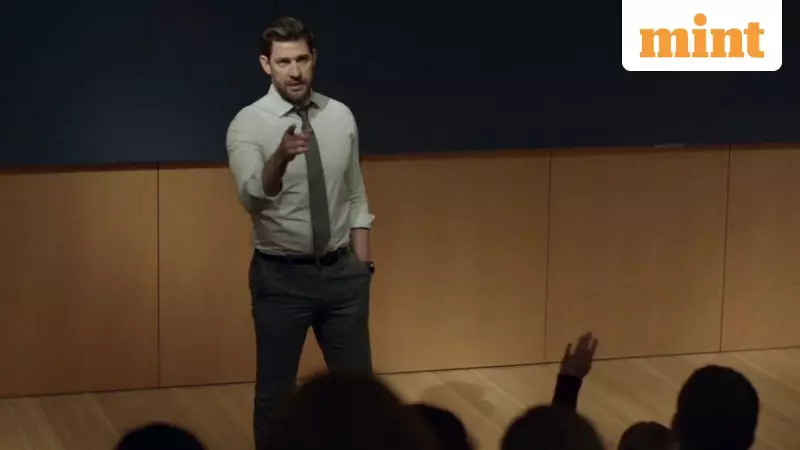
TV Show Scene Goes Viral as Real-World Venezuela Explainer
When Thalia Toha needed to explain the Venezuela situation to her teenage daughter, she found an unexpected teacher. She turned to a 2019 episode of "Tom Clancy's Jack Ryan." The Colorado mother discovered a scene that perfectly broke down complex geopolitics.
The clip shows CIA analyst Jack Ryan, played by John Krasinski, addressing a lecture hall. He asks about the world's greatest threat. Audience members suggest China, Russia, and North Korea. Ryan then reveals his surprising answer: Venezuela.
Internet Discovers 'Predictive' Television
This scene has exploded across social media. It gained massive attention following the arrest of Venezuelan President Nicolás Maduro. American troops captured Maduro and brought him to the United States to face drug trafficking charges.

One Instagram reel of the clip attracted forty million views in just two days. The viral moment has driven renewed interest in the Prime Video series. The show ended after its fourth season in 2023. Yet it remains in the platform's top ten most-watched shows more than a week after the news broke.
"The 'Jack Ryan' clip doesn't just help give the event more color," said Toha. "It also brings nuances, in a matter of minutes, that would've been hard for kids to understand." She described her children's reaction as a priceless lightbulb moment.
Viewers Connect Fiction with Current Events
Matt Keenan, twenty-four, from Red Bank, New Jersey, frequently watched the show with his father. After learning of Maduro's capture, they both immediately thought of the series. Keenan re-watched parts of season two to refresh his knowledge.
"What caught my attention was how the show laid out Venezuela's strategic importance," Keenan explained. "The oil reserves, the proximity to the U.S., the geopolitical implications. Now those exact talking points are part of the real-world conversation."
Ashleigh Ewald, a twenty-three-year-old public policy student at Georgia Tech, experienced a similar feeling. Her social media feeds flooded with the clip. She described rewatching the episode as "uncanny." It felt like art resurfacing to help people make sense of the moment.
Behind the Scenes: Striving for Realism
The show's creators worked hard to inject plausibility into the storyline. Carlton Cuse, a showrunner for season two, told Deadline that writers and researchers focused on grounding the story in real dynamics. "When you ground a story in real geopolitical dynamics, reality has a way of making it rhyme," Cuse said after the Venezuela news.
Daniel Green, director of Carnegie Mellon's entertainment industry management program, highlighted this approach. He pointed to the expert advisers writers collaborate with to infuse shows with reality. For "Jack Ryan," filmed in Colombia, this included former CIA operatives. They advised on everything from proper procedures to the realities of an analyst's job.
Not a Perfect Match: Fiction Versus Fact
The episode is not a flawless predictor. Professor Ryan gets several details wrong. Venezuela does not possess "next-gen nuclear missiles" as the character suggests. The country has significant gold deposits, but claims it has "more than all the mines in Africa combined" lack reliable data.
Most geopolitical analysts would also dispute that Venezuela represents a greater threat than Russia, China, or North Korea. These inaccuracies, however, seem lost on many viewers captivated by the broader narrative.
A History of Screen Prophecies
This is not the first time entertainment has seemingly predicted future events. A 2000 episode of "The Simpsons" featured Lisa Simpson inheriting a budget crisis from a former President Trump. The 2011 movie "Contagion" depicted a virus transferring from animals to humans, causing a global outbreak reminiscent of COVID-19.
Perhaps most eerily, the pilot episode of "The X-Files" spinoff "The Lone Gunmen" aired six months before September 11, 2001. It featured a plot where a pilot hijacks an airplane and flies it into the World Trade Center.

These examples have experts like Daniel Green wondering. "Maybe there's someone writing something now about the U.S. buying Greenland," he mused. The line between fiction and reality continues to blur, especially when a TV show provides the framework for understanding breaking news.
