Mortal Kombat II Trailer Revives Cultural Memory Through Ritual Combat
The world divides into two distinct groups when remembering Mortal Kombat. For some, it remains a classic video game franchise. For others, it represents a profound psychological event—the first time a digitized warrior in red pyjamas violently decapitated another digital fighter, holding the severed head aloft like a trophy while an emotionless voice announced the outcome with the detached tone of a weather forecast.
The Cultural Impact of "Finish Him"
The iconic phrase "Finish him" did more than enter popular culture—it became embedded in our collective nervous system. This command transformed into school corridor taunts, playground dares, late-night television punchlines, and an involuntary reflex buried deep within adult consciousness. Mortal Kombat didn't merely entertain; it fundamentally rewired expectations about digital entertainment.
The franchise taught an entire generation that spectacle could function as ritual, that violence could be stylized into meaningful symbolism, and that digital characters could feel more mythic than human actors ever could. This cultural reprogramming created lasting emotional connections that transcend traditional media consumption.

Karl Urban as the Perfect Johnny Cage
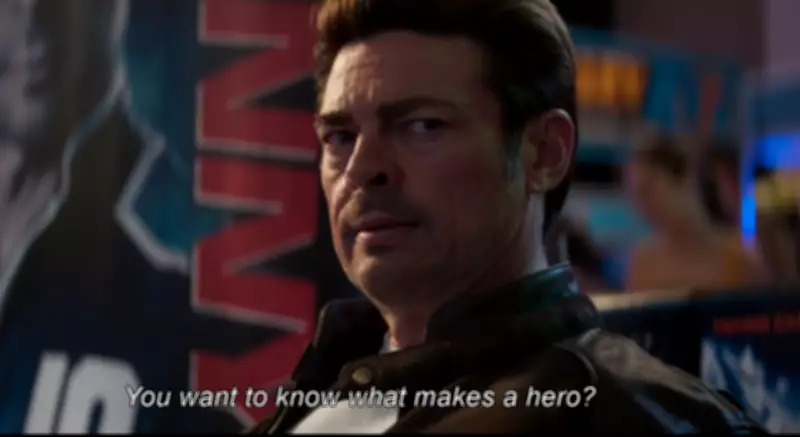
Every Mortal Kombat narrative requires a human anchor, and Johnny Cage has consistently served this essential purpose. The character functions as both participant and observer—his arrogance masking deeper insecurities, his humor concealing genuine uncertainty. Cage represents the audience's own disbelief at the extraordinary world he inhabits while simultaneously embracing its theatrical possibilities with enthusiastic abandon.
Karl Urban represents an exceptionally precise casting choice because the actor specializes in characters who maintain emotional credibility within heightened realities. His screen persona combines contained intensity with reluctant competence, projecting the demeanor of someone who has witnessed too much yet continues moving forward regardless.
This unique quality allows Urban to ground Johnny Cage in recognizable human behavior without diluting the character's essential theatrical nature. Cage must remain simultaneously believable and absurd, functioning as both protagonist and cultural commentary. Urban's presence makes this delicate balance not only possible but compelling.
The Tournament's Structural Restoration
The most significant promise within the new trailer isn't the anticipated violence but rather the tournament's restoration as the narrative's organizing principle. The 2021 film largely functioned as prologue, establishing characters and mythology while postponing the central competitive event. Mortal Kombat II appears to correct this structural decision by returning the tournament to its rightful place at the story's core.
This restoration matters profoundly because Mortal Kombat has always been structured around ritualized combat. The tournament represents more than narrative device—it embodies the franchise's fundamental logic. This framework creates order within chaos, establishes rules within myth, and transforms individual fights into symbolic confrontations between larger cosmic forces.
The expanded character roster reinforces this structural clarity. Iconic figures including Shao Kahn, Baraka, Sindel, and Quan Chi deepen the mythological ecosystem, while Scorpion's return and Sub-Zero's transformation reflect the franchise's cyclical understanding of identity and power dynamics. Each character brings distinct physical vocabulary and symbolic significance, making the appeal less about victory outcomes and more about how they fight, move, and represent larger concepts.
Nostalgia and Physical Memory
Video game nostalgia differs fundamentally from film nostalgia because it resides within the body as much as the mind. This memory exists in remembered muscle movements, the sensation of executing perfect combinations, and the emotional volatility of victory and defeat. Mortal Kombat was never experienced passively—it demanded active participation, rewarded technical mastery, and punished hesitation without mercy.

This participatory structure created emotional investment that traditional media rarely achieves. Players didn't simply observe mythological combat—they actively enacted it through their controllers. The trailer's visual language demonstrates awareness of this history, emphasizing choreography, timing, and physical consequence while treating combat as performance rather than narrative interruption.
The Elusive Perfect Adaptation
The persistent difficulty of adapting video games stems from structural differences between participation and observation. Video games generate meaning through player agency—individuals shape outcomes, making success and failure feel intensely personal. Film removes this agency, replacing it with observation and creating emotional distance where games create emotional ownership.
Most adaptations struggle because they attempt to replicate narrative details rather than experiential rhythms. They preserve plot while losing emotional texture. The most successful adaptations recognize that fidelity to emotional architecture matters more than narrative specifics—they recreate tension, rhythm, and symbolic clarity rather than attempting literal translation.
Mortal Kombat II appears to move closer to this sophisticated approach. The film prioritizes confrontation over exposition, emphasizes identity over explanation, and allows characters to express themselves physically rather than verbally. This represents significant progress toward authentic adaptation.
Confidence and Authentic Identity
What distinguishes the new trailer most clearly is its evident confidence. The film no longer appears uncertain about its identity or compelled to disguise its origins. Instead, it embraces the symbolic logic that made the original games culturally durable across decades.
Karl Urban's Johnny Cage embodies this confidence perfectly, functioning as a bridge between audience and mythology while grounding the experience without constraining its imaginative possibilities. His presence allows the film to expand its scope while maintaining emotional coherence throughout.
The expanded roster, restored tournament structure, and emphasis on choreographic excellence all suggest clearer understanding of what Mortal Kombat must become—myth enacted through motion, prioritizing symbolic clarity over narrative realism.
The Eternal Search Continues
The perfect video game movie may remain an ideal rather than achievable endpoint, but perfection isn't the only meaningful measure of success. Authenticity matters more profoundly. Emotional coherence matters more significantly. The ability to recreate experiential truth matters most of all.
Mortal Kombat II appears positioned to move closer to that essential truth than previous adaptations. The film understands that its power lies not in explanation but in execution, that its mythology functions best when expressed through action rather than exposition.
Most importantly, the adaptation recognizes that Mortal Kombat has always been less about violence than transformation—ordinary characters becoming mythological figures, ordinary spectators becoming emotionally invested participants. Somewhere within collective memory, the invitation still waits patiently, ready to be accepted once more.