

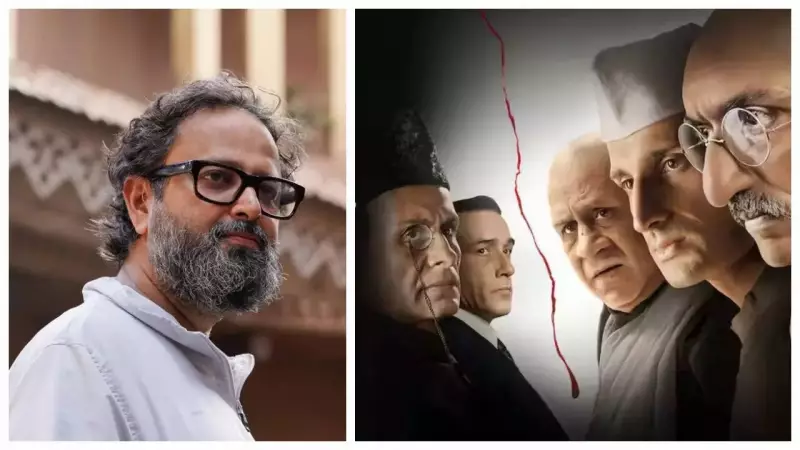
Nikkhil Advani Confronts History in Freedom at Midnight
When Nikkhil Advani talks about his series Freedom at Midnight, you immediately sense this project means more to him than just another historical adaptation. For Advani, this is a personal reckoning. He grapples with chaos, memory, responsibility, and the very limits of storytelling itself.
Retelling a Turbulent Chapter
Based on the seminal book by Larry Collins and Dominique Lapierre, Freedom at Midnight attempts to retell one of the most turbulent moments in Indian history: Independence and Partition. Advani makes it clear from the start. He refuses to present this period as something neat, noble, or orderly. The reality was far messier.
The Weight of Nehru's Famous Speech
Among the many challenges, one moment felt particularly overwhelming for the director. That was recreating Jawaharlal Nehru's iconic Tryst with Destiny speech delivered at the midnight of India's Independence.

"I think the Tryst with Destiny speech is incredibly important," Advani explains. "It ranks among the top modern and post-modern speeches of our lifetime. You have Martin Luther King Jr.'s I Have a Dream. You have John F. Kennedy's ask not what your country can do for you speech. You have Barack Obama's Yes We Can. And you have Nehru's Tryst with Destiny."
He emphasizes that getting this speech right was not optional. "For me to get the Tryst with Destiny speech right... that is something that even Siddharth and I spoke over and over again," Advani reveals. "Nehru is a colossal figure. You may have conflicting points of view on Nehru, but you cannot deny he gave an incredible speech."
Independence as Chaos, Not Romance
Looking back at the period, Advani consciously avoids romanticizing it. "Because at the end of the day, it is very easy for us to turn around and say they got it wrong," he states. "They shouldn't have done it this way; they should have done it that way. But there was chaos. There was confusion. There was a complete lack of information."
He describes the frantic collapse of timelines that led directly to catastrophe. "The British were supposed to leave in June 1948 after Cyril Radcliffe arrived," Advani notes. "Ten days after his arrival, Mountbatten made it August 1947. Suddenly, instead of having thirteen months to draw borders, Radcliffe was given just five weeks."
Rumors, fear, and misinformation spread like wildfire during this compressed, chaotic period. "Nehru is doing this, Jinnah is doing that... It was so much confusion," Advani says. "And it was deeply emotional."
The violence that erupted was unprecedented in scale and brutality. "There is a chapter in the book which says that never before and never after had there been so much sexual violence," Advani recounts somberly. "Fathers were killing their daughters. Brothers were killing their sisters so they wouldn't end up in the hands of the other community. They were unapologetic. Neighbors were killing neighbors. People had become monsters. They had become dark versions of themselves."
Amidst this horror, leaders faced impossible decisions. "And in all of this, Nehru was worried if ration was going to people in camps," Advani continues. "Gandhi was on a hunger strike to give Pakistan its Rs 55 crore. Princely states were seeking their own independence. And then there was the attack on Kashmir by tribals."
A Creative Choice: The Nameless Assassin
One of the most debated creative decisions in the series is the choice not to name Mahatma Gandhi's assassin onscreen. Advani explains this as a matter of historical perspective, not contemporary politics.
"At the end of the sixth episode, Madan Lal Pahwa was arrested on January 20th," Advani details. "The entire seventh episode is from the point of view of the DIG, the Home Ministry which is trying to investigate, and from the interrogation of Madan Lal Pahwa. None of them knew who Nathuram Godse was."

He emphasizes his commitment to the historical moment. "Now I am trying to transport you for six episodes into 1947, into the battle of Kashmir, into the palaces of the princes. Just because of my politics, I am not going to turn around and tell you this is the guy who shot him, this is his name, etc. They did not know. They had no clue what his name was. They had no clue where he was staying. They found a vest which said NVG in the Marina Hotel."
Advani points out that even the conspirators didn't have full information. "Even Madan Lal Pahwa did not know his name. He knew the guy who had brought him from Pune to Delhi as 'Kirkire.' He did not even know his name was Karkare. So for all intents and purposes, the assassin of Mahatma Gandhi was a ghost to the police, to the Home Ministry, and to Madan Lal Pahwa. So I treated him like a ghost. They had no clue what his name was. They didn't even know what he looked like. The episode is unraveling through these people. It's not unraveling through me."
What Comes Next for Advani
Even after completing Freedom at Midnight, Nikkhil Advani isn't done with history. He has already finished shooting his next project, Revolutionaries.
"Revolutionaries talks about people like you and me," Advani describes. "People who basically turned around and said why is injustice happening to us? Why are we being enslaved because of our color? They didn't want to have a dialogue with the British; they just wanted to kick them out. So it's much younger and more joshila... it's more raw."
The show features a young cast including Bhuvan Bam, Rohit Saraf, Pratibha Ranta, and Gurfateh Pirzada. It promises another intense look at India's past through Advani's distinctive lens.
