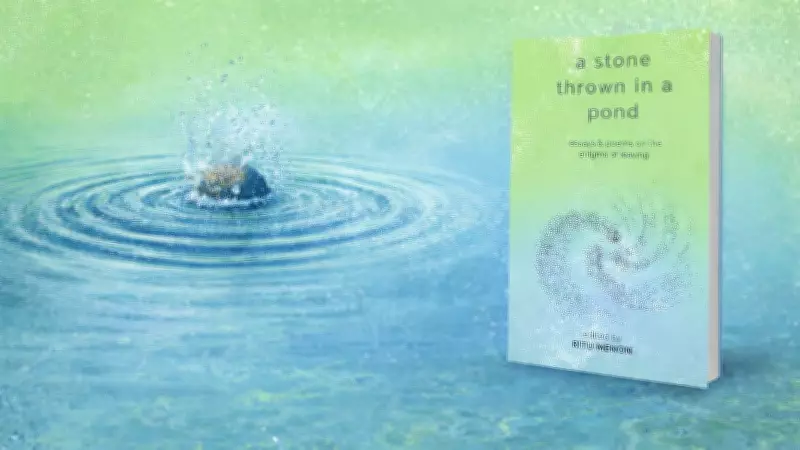
Ritu Menon's 'A Stone Thrown in a Pond' Delves into the Complexities of Leaving
What does it truly mean to leave? Is it an act of courage, a necessity, a betrayal, or a slow process of unbelonging? These questions resonate powerfully throughout Ritu Menon's anthology, A Stone Thrown in a Pond. This collection assembles a diverse group of poets, journalists, scholars, and writers to unravel the intricate threads of departure. The result is a rich mosaic of reflections—some piercingly clear, others shrouded in intimate ambiguity—that collectively reveal how leaving is less a singular action and more a lifelong, enduring condition.
A Stellar Assembly of South Asian Literary Talent
Menon, a founder of India's first feminist press, has curated an impressive and varied roster of contributors. The table of contents reads like a who's who of South Asian literary and intellectual excellence. It includes the Palestinian writer Adania Shibli, the poet Arundhathi Subramaniam, the cultural critic Ranjit Hoskote, the journalist Chaitanya Kalbag, the Hindi writer Kshama Kaul, the memoirist Anita Anand, the novelist Stephen Alter, and Menon herself, among others. Each contributor is tasked with exploring different facets of leaving—whether it be homes, homelands, identities, lovers, or lives. The anthology's ambitious scope is its defining characteristic, and its occasional unevenness only adds to its authentic, lingering truth.
Where the Political and Personal Converge
The most compelling entries in the collection are those where the political and personal seamlessly merge into a single, urgent voice. Adania Shibli's contribution, "Of Place, Time and Language," stands out as a masterwork of restrained fury. Writing from within the harsh reality of occupation, she examines leaving not as a choice but as a pervasive, suffocating condition. Her prose meticulously maps the psychological landscape of existing in a space where departure looms as a constant, low-grade threat. This piece provides a stark, necessary contrast to more nostalgic reflections, anchoring the entire collection in a world marked by forced movement and fractured geographies.

Grappling with Inheritance and Erasure
Equally powerful are the offerings from writers who grapple with themes of inheritance and erasure. Ranjit Hoskote's poetic sequence, which includes "Sidi Mubarak Bombay" and "Refugee," draws inspiration from forgotten historical figures and aesthetic movements to explore the leaving imposed by colonialism and conflict. He skillfully weaves archival fragments into a lament that feels both specific and expansive. Kshama Kaul's stark testimony of exile from Kashmir, "They Threw Me Out," carries a similar weight of historical rupture. Her concise prose echoes the sudden, violent nature of displacement, leaving a lasting impact on the reader.
Turning Inward: The Domestic and Familial
When the collection turns inward, focusing on the domestic and familial realms, its successes are more varied. Arundhathi Subramaniam's poems on the loss of her parents—"Finding Dad" and "Deleting the Picture"—are shattering in their simplicity. She directs her attention to the artifacts left behind: a bottle, a handwriting sample, a digital file. In doing so, she captures how death represents the ultimate, irreversible leaving, and how the living are left to sift through the stubbornly material echoes of a vanished presence. Similarly, Anita Anand's "26 Homes" transforms a life of perpetual motion into a philosophical inquiry into belonging. She poignantly asks what we carry from each departure and what we willingly shed along the way.

The Challenge of a Broad Mandate
However, the anthology's broad mandate can also be a weakness. Some contributions feel like polished excerpts from larger, separate projects, included here because they tangentially touch on the theme of leaving. This creates a pacing issue; the emotional and intellectual intensity of a piece like Shibli's is difficult to follow with a more leisurely meditation, no matter how lovely. For instance, Bulbul Sharma's remembrance of a lost garden or Chaitanya Kalbag's reflections on reconciliation operate on a different frequency. The reader is constantly asked to reset—from the geopolitical to the domestic, from the poetic to the prosaic—and not every transition lands gracefully. This is a book better consumed in piecemeal, allowing each contribution to resonate individually.
Dismantling the Romantic Myth of Goodbye
What the collection achieves overall is a subtle dismantling of the romantic myth of the leave-taker. There is little glamour to be found here. Instead, readers encounter the exhaustion of the refugee, the guilt of the survivor, the mundane paperwork of relocation, and the haunting of empty spaces. Jerry Pinto, in his characteristically cerebral style, probes the gendered dimensions of this trope, noting how narratives of departure are often coded male, while women are frequently left "in memoriam." Sabyn Javeri's essay on leaving behind the "good girl" persona complements this, framing departure as an internal, psychological rebellion. Together with Geeta Patel's heart-wrenching yet masterfully penned account of a traumatic childhood, Aamer Hussein's diasporic memories, Gagan Gill's poetic fragments of Partition, and Manjula Narayan's personal chronicle, they form a chorus that, while not always in perfect harmony, affirms the profound complexity of its subject.
A Case File on the Human Heart's Relationship with Exit
A Stone Thrown in a Pond serves as a compelling case file on the human heart's complicated relationship with exit. Some pieces resonate with the clarity of a struck bell, while others murmur from a distance. Yet together, they accomplish Menon's implied goal: to demonstrate that leaving is never a clean, definitive line. It is a circle, a recurring ghost, a stone whose ripples continue long after it has disappeared from sight. For its brightest, most unflinching moments, this collection stands as a worthy and often profound companion to the solitudes it so eloquently describes.
Book Details: A Stone Thrown in a Pond: Essays & Poems on the Enigma of Leaving edited by Ritu Menon, published by Women Unlimited Ink, 226 pages, priced at Rs 699.