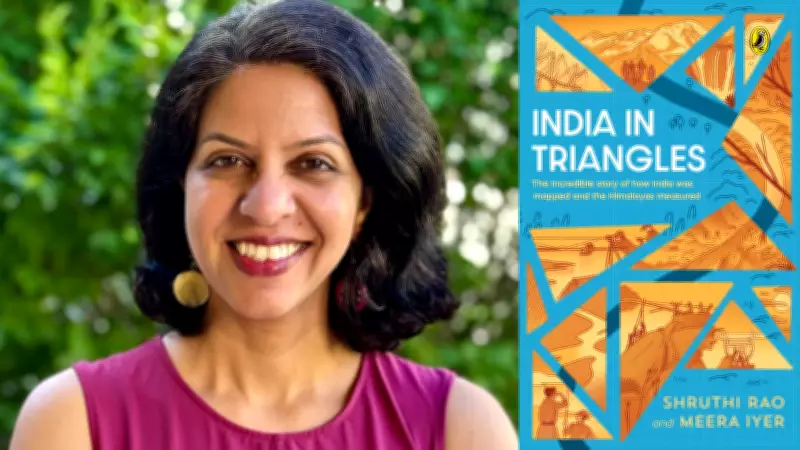
Shruthi Rao Breaks Down the Art of Engaging Younger Audiences
For author Shruthi Rao, the challenge of making intricate scientific and historical themes accessible to children is not just a professional pursuit but a personal passion. Many of her books, including the notable India in Triangles co-authored with Meera Iyer, are designed to simplify complex topics for younger readers without compromising on depth or accuracy.
From Engineering to Children's Literature
Rao, who holds a Master's degree in energy engineering and worked as an engineer, found her calling in children's literature through her experiences as a parent. "When my daughter was born, I realized I enjoyed explaining things to her and making complicated concepts as simple as possible," she shared. This natural inclination led her to write books that bridge the gap between advanced subjects and young minds, such as exploring the science of black holes or the history of India's Great Trigonometric Survey.
The Philosophy of Letting Children Think
Central to Rao's approach is the belief that children should not be lectured or talked down to. "You cannot tell them what to think," she emphasized. "We have opinions, but we must be careful to let them think and come to their own conclusions." She pointed out that children lack the context adults have, so writers must start from what young readers might know and avoid treating them as if they are unintelligent. "They can immediately figure out if you are trying to lecture them," she added, highlighting the importance of respect and engagement in children's literature.

Unveiling History in 'India in Triangles'
Her most recent book published in India, India in Triangles, delves into the Great Trigonometric Survey that mapped India during colonial times. This ambitious project involved trigonometry, advanced surveying techniques, and massive chains for calculations. Rao explained that the idea for the book had been in her mind for years after seeing British surveyor Sir George Everest's house in Mussoorie. "I knew there was a lot of history involved that I didn't know enough about," she said. Collaborating with Meera Iyer, who handled the historical aspects while Rao focused on the scientific side, allowed her to bring this fascinating story to life. Notably, some of the earliest groundwork for the survey was conducted in Bengaluru, with markers from that era still visible today.
Bengaluru's Influence and Writing Habits
Though currently based in California, Rao spent most of her life in Bengaluru, a city that profoundly influenced her writing. "I lived in a BHEL colony with people from all walks of life who spoke different languages," she recalled. "Back in the 1980s, it wasn't common to have such diversity. There were many families and stories, and I found people very interesting, which translated into an interest in writing about them." Her parents' love for books also fostered her early reading habits.
In terms of her writing process, Rao sticks to a disciplined routine, preferring to write at her desk. She reminisced about adapting her schedule when her daughter was young, writing during nap times. "Now that she's in college, I have lots of time but find I'm used to working with constraints," she admitted, reflecting on the challenges of adjusting to newfound freedom.
Advice for Aspiring Writers
For those looking to follow a similar path, Rao offered practical advice: "Read widely and always ask questions." She stressed the importance of verifying information due to the prevalence of inaccuracies and biased perspectives. "If you want to share information with others, you have to check your sources in multiple ways," she advised. Additionally, she encouraged analyzing why certain writings are enjoyable to better understand effective storytelling techniques.
Through her work, Shruthi Rao continues to inspire young readers by making learning an engaging and thought-provoking experience, proving that even the most complex topics can be made accessible with the right approach.