

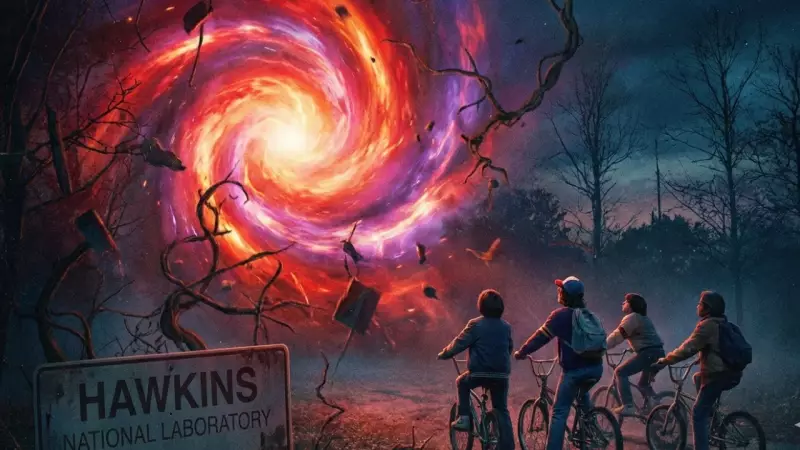
The latest season of the global phenomenon Stranger Things has taken a fascinating turn into the realm of theoretical physics. By its fifth season, the show has joined a grand tradition of science fiction by reframing its central menace, the Upside Down. It is no longer just a spooky parallel dimension but is now presented as something closer to a bridge through spacetime—a concept deeply rooted in real scientific equations, though wildly amplified for storytelling.
What is a Wormhole? The Science Behind the Fiction
In simple terms, a wormhole is a theoretical tunnel through spacetime. The idea originates from solutions to Albert Einstein's equations of general relativity, which describe how space and time can bend and curve. One particular solution allows for the possibility of a shortcut connecting two vastly distant points.
Physicists often illustrate this by imagining spacetime as a sheet of paper. If you fold the sheet and poke a hole through both layers, you create a shortcut, bypassing the long journey across the surface. This theoretical passage is formally known as an Einstein-Rosen bridge.

However, it is crucial to understand that these wormholes exist only in mathematics. No wormhole has ever been observed or detected in reality. Most models suggest they would be incredibly unstable, collapsing instantly under their own gravity. To keep one open would require exotic matter or negative energy, substances never observed in nature. Even if one existed, the extreme gravitational forces would likely tear apart anything attempting to travel through.
Why Hollywood Can't Resist the Wormhole Plot Device
Science fiction happily overlooks these monumental physical hurdles because wormholes solve fundamental narrative problems. They provide a sleek, science-adjacent justification for faster-than-light travel, instant galactic crossings, and connections between different worlds or timelines. This allows for grand spectacle without lengthy explanations.
This is why wormholes and their conceptual cousins appear repeatedly across films and TV. In Interstellar, a wormhole near Saturn enables a journey to another galaxy, with visuals guided by physicist Kip Thorne's equations. Contact, based on Carl Sagan's novel, uses a machine-generated wormhole for cosmic travel. The Marvel Cinematic Universe employs them as portals or the Bifrost. Even the horror film Event Horizon uses an artificial wormhole drive with catastrophic results.
Stranger Things and the Legacy of Spacetime Bridges
Stranger Things Season 5 positions itself firmly within this tradition. The Upside Down is now treated not as a complete alternate universe but as the interior of a damaged spacetime bridge. It looks familiar because it is intrinsically linked to Hawkins, yet feels wrong because it is an incomplete, scarred reality.
This is classic wormhole logic. The show suggests that the experiments in Hawkins didn't just open a door to another world; they damaged the fabric of spacetime itself. The Upside Down is the traumatic scar resulting from that damage. This concept aligns more with the spacetime ruptures of Interstellar or Event Horizon than with traditional tales of parallel dimensions.
The season also hints at connections through time, another speculative aspect of some wormhole theories that leads to famous paradoxes. Like most entertainment, Stranger Things uses the suggestion of time distortion without delving into its complex consequences.
Ultimately, the enduring power of the wormhole in storytelling lies in its feel of scientific plausibility. It sounds grounded enough for audiences to suspend their disbelief, allowing writers to explore bigger themes. In Stranger Things, it becomes a way to visualize how reality can be bent, how damage can spread, and how poking too many holes in the universe might make it push back.

