

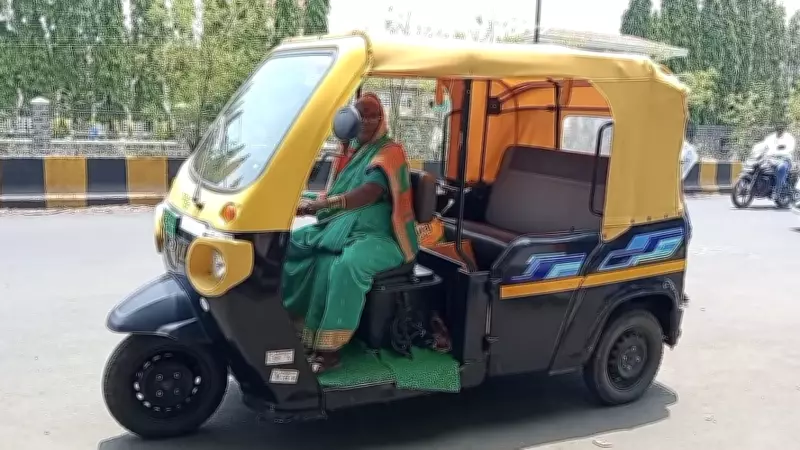
Mangala Awale, 65, Drives Auto-Rickshaw in Maharashtra, Redefining Ageing in India
In discussions about ageing in India, life after sixty is frequently portrayed as a period of withdrawal, slower daily routines, reliance on family, and a gradual retreat from public engagement. However, on the bustling roads linking Karad and Undale in Maharashtra, Mangala Awale is quietly and consistently rewriting this narrative each day. At 65, affectionately known as Mangala Aaji, she takes the driver's seat of her auto-rickshaw every morning, opting for movement over limitation and independence over societal expectations.
Her choice extends beyond mere livelihood; it embodies a profound commitment to dignity and self-respect. Widowed at a young age and shaped by decades of arduous labor raising her children, Mangala refused to let age dictate the confines of her existence. Instead, she embraced a role seldom associated with elderly women in rural India, transforming an ordinary auto-rickshaw into a powerful symbol of resilience, purpose, and quiet courage.
Choosing Independence After a Lifetime of Responsibility
Mangala Awale's life has been marked by resilience long before she ever sat behind the wheel. Widowed while her children were still young, she raised four children single-handedly, working as a laborer to secure their education and stability. Years of physical toil helped build a family that stands independently; her son now works as a driver for the Maharashtra State Road Transport Corporation (MSRTC), while her daughters are married.

For many, this stage would signify a well-deserved rest. But Mangala perceived things differently. As reported by BBC, she did not wish to depend financially on her children despite advancing age and health challenges, including diabetes. Instead, she sought a way to continue contributing, both to her own medical expenses and to her son's household. The solution emerged unexpectedly: driving an auto-rickshaw.
Learning to Drive at 65
With guidance from her son, Mangala learned to operate a rickshaw in just fifteen days. What might appear daunting even for younger learners became, for her, an empowering stride toward independence. Soon after, she began driving passengers daily from 9 a.m. to 6 p.m. along the Karad–Undale route.
Her earnings, typically ranging from ₹500 to ₹700 per day, may seem modest economically. Yet for Mangala, the value lies elsewhere—in self-respect. As highlighted in coverage by Punepulse, she articulated her motivation in simple yet powerful words: "I used to stay at home, but I realized sitting idle wasn't helping anyone. So, I learned to drive a rickshaw, with my son's guidance. It turned out to be a wonderful decision. Everyone should try to show this kind of courage... I drive the rickshaw to help with my son's household and my own medical needs... Driving doesn't scare me at all, and the other drivers are very understanding, they even say, 'Let the Aaji go first.'" Her statement captures something deeper than financial necessity—the emotional fulfillment derived from earning through one's own efforts.
Challenging Stereotypes on the Road
In many rural and semi-urban regions of India, elderly women are rarely visible in public professions, especially in roles traditionally dominated by men such as commercial driving. Mangala's presence on the road subtly disrupts these assumptions.
Passengers recognize her instantly. Fellow drivers offer encouragement and respect. What started as a personal decision has gradually evolved into a symbol of possibility for other women and senior citizens hesitant to transcend social expectations. Her story also mirrors a broader societal shift: ageing no longer necessarily equates to withdrawal from public life but can instead become a phase of renewed agency and engagement.
Following the Rules, Setting an Example
Mangala's journey has not been without obstacles. When transport authorities discovered she was driving, she was instructed to fully comply with licensing regulations. Rather than feeling disheartened, she chose to complete the official process and obtain her government driving licence properly, overcoming barriers such as limited formal education and a rural background.

This step reinforced her conviction that independence must align with responsibility. By adhering to regulations, she demonstrated that empowerment also entails accountability, setting a commendable example for others.
A Story Larger Than One Individual
Mangala Awale's narrative resonates widely because it touches on universal themes: dignity in work, intergenerational support, and the desire to remain purposeful regardless of age. Her daily rides are not merely commutes for passengers; they are moving reminders that courage often manifests in ordinary forms.
At 65, she did not set out to become a symbol. Yet through persistence and quiet determination, she has become precisely that—proof that independence is not defined by youth and that sometimes the most powerful revolutions commence with a simple decision: to keep moving forward.





