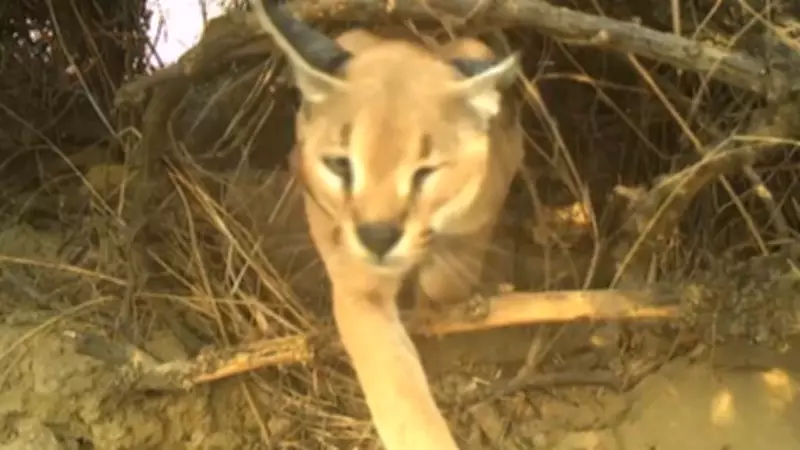
Rare Caracal Fitted with Radio Collar in Rajasthan Desert, Tracked Near Sensitive Border Area
Following the high-profile reintroduction of cheetahs in India, another elusive and critically endangered wild cat species—the caracal—is now capturing conservation attention as it teeters on the brink of extinction within the country. In a landmark scientific achievement, forest officials successfully fitted a male caracal with a radio collar for the very first time in the arid landscapes of Jaisalmer on January 25, marking a pivotal moment for wildlife research and protection efforts.
Breakthrough Monitoring Operation in the Thar Desert
Since its careful release back into its natural desert habitat, forest authorities have been conducting continuous, real-time monitoring of the animal's movements through an advanced satellite tracking system linked to the radio collar. This technological intervention provides unprecedented insights into the behavior and ecology of this mysterious feline, which is rarely observed in the wild.
In recent tracking data, the collared caracal's activity has been recorded alarmingly close to the sensitive India–Pakistan international border. The animal was traced to a specific hunting site, where the presence of another, uncollared caracal was also confirmed nearby through signs and evidence. Forest officials hypothesize that possible social interaction or territorial behavior between the two individuals may have prompted the radio-collared caracal to venture closer to the international boundary. Currently, its movement range appears confined to an area of approximately 5 to 6 square kilometers.

Heightened Coordination with Border Security Forces
Given the caracal's proximity to a high-security border zone, the Rajasthan Forest Department is now engaged in close, ongoing coordination with the Border Security Force (BSF) to ensure meticulous monitoring and robust protection of the animal within these sensitive areas. Chief Conservator of Forests (CCF) for Jodhpur, Anoop K.R., emphasized that western Rajasthan could potentially harbor the largest remaining wild population of caracals in India, making this region a critical stronghold for the species' survival.
Anoop K.R. further detailed that since the male caracal's release, a dual approach of satellite tracking and intensive ground-level monitoring has been maintained without interruption. Encouragingly, local villagers in the region have independently reported multiple sightings of caracals, reinforcing the belief that the Thar desert ecosystem serves as a vital refuge for this elusive and endangered predator.
Comprehensive Conservation Project Launched
In a significant parallel development, the Rajasthan government has formally initiated a dedicated, special conservation project for the caracal in collaboration with the prestigious Wildlife Institute of India (WII). This comprehensive initiative involves detailed mapping of distribution areas and habitat characteristics in the districts of Karauli and Sawai Madhopur, actively incorporating participation from local communities to enhance effectiveness and awareness.
The project also aims to refine contemporary wildlife management practices and develop scientifically rigorous population assessment methodologies specifically tailored for the caracal. Preliminary findings strongly suggest that western Rajasthan may indeed represent the most significant and viable remaining habitat for caracals in the entire country, underscoring the region's paramount importance for ensuring the species' long-term survival and recovery.
Scientific Precision in Rescue and Research
Under the direct guidance of CCF Anoop K.R., a joint team comprising experts from the Forest Department and WII executed the successful rescue, radio-collaring, and safe release of the male caracal on January 25. The entire operation was conducted with scientific precision and utmost care, prioritizing the animal's safety, health, and minimal stress throughout the delicate process.

The caracal is classified as a rare and extremely elusive wild species. Documented sightings are exceptionally uncommon, and substantive scientific data on its behavior, ecology, and population dynamics remain severely limited. Through the innovative use of radio collaring, researchers are now systematically gathering vital information on the caracal's movement patterns, habitat preferences, behavioral traits, and hunting ranges. This collected data is anticipated to significantly strengthen and inform future conservation strategies and policy decisions.
Scientists and conservationists believe that the unique desert ecosystem of Jaisalmer provides a crucial and suitable natural habitat for the species. The resumption of systematic, technology-aided monitoring of this endangered wild cat after many years represents a major and commendable step forward in national conservation efforts, offering renewed hope for securing a sustainable future for the caracal in India.