

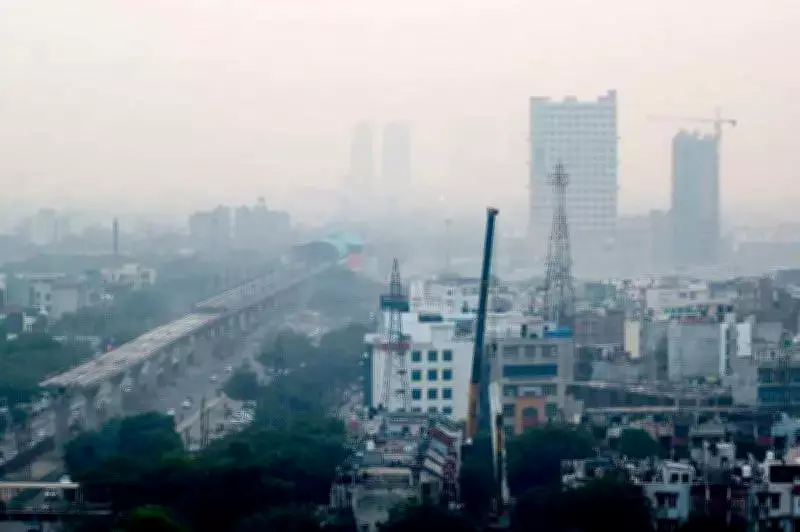
Bengaluru's Invisible Air Quality Challenge: A Steady Threat to Public Health
Unlike northern Indian cities with dramatic winter smog, Bengaluru's pollution manifests as a constant, subtle presence. The city experiences no school closures due to air quality emergencies, no widespread panic buying of protective masks, and no dense grey blankets obscuring the skyline. Instead, residents face a daily reality of traffic congestion, road dust, and air that feels deceptively normal.
The Numbers Behind the 'Moderate but Constant' Pollution
Experts from the Air Quality Sector at Bengaluru-based research think tank CSTEP reveal concerning data. Between 2019 and 2024, Bengaluru's annual average PM2.5 levels—measuring fine particulate matter with diameters of 2.5 microns or less—consistently ranged between 30-35 μg/m³ (micrograms per cubic metre). This represents a "moderate but constant" level of fine pollution persisting throughout the year.
These figures starkly contrast with World Health Organization guidelines, which recommend annual PM2.5 concentrations not exceed 5 µg/m³ for optimal public health protection.

While some Indian cities like Chennai, Hyderabad, and Kolkata have seen decreasing PM2.5 concentrations, exposure remains critically high nationwide. Most urban centers exceed India's National Ambient Air Quality Standards (NAAQS) annual limit of 40 μg/m³ for PM2.5.
Seasonal Variations Offer Only Temporary Relief
Bengaluru experiences significant seasonal fluctuations in air quality. During winter months (December through February), the seasonal mean PM2.5 concentration peaks at 43 μg/m³, surpassing NAAQS limits. The monsoon season (June through September) brings temporary improvement, with levels dropping to 19.8 μg/m³.
"Except for Chennai, which has slightly lower PM2.5 concentrations than Bengaluru, other metros exhibit relatively higher concentrations than Bengaluru," explains Prakash Doraiswamy, Sector Head for Air Quality at CSTEP.
Preliminary analysis for 2025 shows unusually lower concentrations compared to previous years, with investigations underway to determine the causes behind this anomaly.
The Widening Gap with Global Health Standards
When measured against international benchmarks, Bengaluru's air quality situation appears even more concerning. "Bengaluru, like other metros, exceeds the WHO guideline several times over," notes Nirav Lekinwala, Senior Associate at CSTEP, describing the WHO's 5 µg/m³ guideline as a long-term public health goal rather than a standard Indian cities approach.
Lekinwala adds that Bengaluru's relatively benign reputation is partially shaped by how pollution is officially measured. Using data from Central Pollution Control Board monitoring stations, experts found Bengaluru crossed India's daily PM2.5 standard of 60 µg/m³ on approximately 27% of days in recent years.
Comparisons with WHO daily limits—which recommend PM2.5 shouldn't exceed approximately 15 µg/m³ over 24 hours—prove challenging because India's Air Quality Index framework operates on different national standards.
Understanding Pollution Sources in Bengaluru
Transportation dominates Bengaluru's air pollution profile. The most recent source-apportionment study reveals vehicles contribute approximately 40% of PM2.5 concentrations in the city, according to Doraiswamy.
Resuspended road dust and windblown soil together account for roughly 25%, reflecting the impact of traffic movement on poorly maintained roads. Secondary particles—sulphates and nitrates formed in the atmosphere from precursor gases—contribute another 16%, pointing to emissions from coal-based sources beyond city limits.
Other contributors include wood burning (approximately 4% of PM2.5) and construction activity. "Construction contributes less than 1% of PM2.5 concentrations, though it accounts for around 6% of PM10," notes Lekinwala, emphasizing these figures represent pollution measured after atmospheric mixing.

Emission-based estimates focusing on pollutant sources rather than atmospheric concentrations tell a similar story. Transport remains the largest source of PM2.5 emissions, followed by diesel generator sets and waste burning. Construction activity contributes an estimated 3% of PM2.5 emissions and about 11% of PM10 emissions based on 2019 data, excluding large infrastructure projects like metro construction.
Medical Evidence of Health Impacts
Dr. Ravindra Mehta, founder of Vaayu Chest and Sleep Speciality Clinic in Bengaluru and an innovator in interventional pulmonology, challenges assumptions about Bengaluru's air quality. He describes as a "fallacy" the notion that Bengaluru's air is acceptable.
"While Bengaluru benefits from moving air, which prevents conditions from becoming as severe as Delhi's, the AQI has been steadily increasing over the last two years due to a significant rise in traffic intensity," warns Dr. Mehta. "This upward trend, or 'uptick', in pollution is worrying and should trigger immediate action from all sections of society—civil society, politicians, planners and policymakers—instead of waiting for a catastrophe."
Dr. Mehta observes clear patterns in respiratory illnesses over recent years. "Respiratory illnesses are much more common now. India already carries the unfortunate tag of being the asthma capital of the world," he explains, noting that asthma affects approximately 5–10% of the general population, with severe cases comprising about 10% of that total.
"We are seeing much more allergy, asthma, lung function issues and related conditions. This season in particular—with a combination of weather changes, increasing traffic, pollution, and high levels of travel and social mixing—our numbers have been the highest seen in years."
Data collected through screening programmes conducted by the Vaayu Clinic among traffic police, bus workers and construction workers reveals concerning trends. "We now have data from around 9,000 to 10,000 individuals, and nearly 29% of them show lung capacity issues," reports Dr. Mehta. "All of this reflects a progressive increase in pollution in the city."
Regarding pollution sources, Dr. Mehta emphasizes traffic's central role. "From a medical point of view, it's a mix—all the problems lie in that mix. It starts with traffic, and there are multiple issues there. It's not just the volume of traffic, but slow-moving traffic. When vehicles are idling or barely moving, pollutants concentrate in the air because engines continue to emit, leading to greater exposure and impact."
The Cumulative Nature of Bengaluru's Pollution Problem
The Garden City doesn't experience dramatic smog alerts or widespread use of gas masks. Its air quality challenge operates more subtly—steady, familiar, and consequently easier to ignore. While Bengaluru's pollution lacks the visual drama of northern Indian cities, experts caution against equating visibility with risk.
The damage here accumulates gradually through everyday exposure, creating health impacts that rarely generate headlines but persist long after traffic congestion clears. This cumulative effect transforms air pollution from an occasional crisis into a routine public health threat requiring sustained attention and comprehensive mitigation strategies.





