

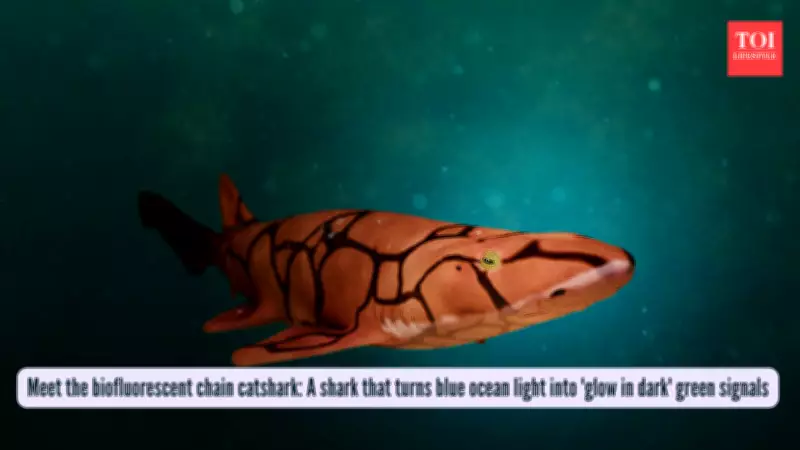
The Biofluorescent Chain Catshark: Nature's Deep-Sea Glowing Wonder
Beneath the ocean's surface, where sunlight dwindles into faint blue whispers, lies a realm of natural marvels that continue to astonish scientists. Among these aquatic secrets is a creature that transforms the deep blue sea into a neon spectacle through biological fluorescence.
Meet the Shark That Glows in the Dark
The chain catshark (Scyliorhinus retifer) presents a seemingly ordinary appearance under normal lighting conditions, displaying a tan-brown coloration with distinctive chain-like dark markings. However, when exposed to the blue wavelengths that dominate deeper ocean waters, this remarkable shark undergoes a stunning transformation, emitting a vivid green glow that creates a striking visual display.
This phenomenon differs fundamentally from bioluminescence, where organisms like fireflies generate their own light through chemical reactions. Instead, biofluorescent creatures like the chain catshark absorb existing blue light and re-emit it as green light through specialized biological mechanisms.

The Science Behind the Glow
According to research from the National Institutes of Health, the chain catshark's remarkable ability stems from its unique adaptation to deep-water environments where red light wavelengths disappear rapidly. The shark has evolved to convert the scarce blue light into distinctive green signals that stand out against the dim blue background of its habitat.
A groundbreaking 2019 study published in iScience identified the specific chemical compounds responsible for this biofluorescence. Researchers discovered that bromo-tryptophan-kynurenine metabolites in the shark's skin—relatively novel compounds among vertebrates—are derived from tryptophan metabolic pathways. These compounds not only produce the characteristic green glow under blue light but also exhibit significant antimicrobial properties that help protect the shark's skin.
The glow follows distinct chain patterns across the shark's body, with certain areas emitting brighter fluorescence to create vivid visual contrast. As the research paper noted, "Bromo-tryptophan-kynurenines are biofluorescent and show antimicrobial activities," highlighting their dual functionality.
Visual Communication in the Deep
National Geographic research reveals that chain catsharks possess retinas exceptionally sensitive to the specific green wavelengths they emit. This creates what scientists describe as a "private visual channel" that allows these sharks to communicate with members of their own species while remaining relatively inconspicuous to other marine creatures.
Their photoreceptors peak at blue-green wavelengths, perfectly matching the light they emit, enabling them to detect subtle visual cues invisible to most other ocean inhabitants.
Evolutionary Advantages of Biofluorescence
A comprehensive 2017 review in Philosophical Transactions of the Royal Society B outlined several crucial functions for this biofluorescent capability:
- Species Recognition: The distinctive glow patterns help sharks identify members of their own species in the dimly lit depths
- Reproductive Signaling: During courtship rituals, the fluorescence may serve as visual attractors for potential mates
- Camouflage Enhancement: The glowing patterns can help break up the shark's body outline, providing effective camouflage against predators
These fluorescent patterns become particularly vivid when viewed through specialized filters, giving chain catsharks significant advantages in their low-light deep-water environments along the western Atlantic continental shelf.
Potential Medical Applications
The unique compounds found in chain catshark skin hold promising potential for medical science and biotechnology. Researchers are exploring several practical applications:

- Fluorescent Markers: The biofluorescent compounds could serve as natural markers for cellular imaging and medical diagnostics
- Antibiotic Development: The antimicrobial properties offer potential pathways for developing new antibiotics to combat growing drug resistance
- Biomimetic Materials: The shark's skin texture, featuring specialized denticles that may channel light like microscopic fiber optics, could inspire new optical technologies
This remarkable deep-sea creature demonstrates how nature's evolutionary innovations in remote ocean environments can provide valuable insights and potential solutions for human challenges, bridging marine biology with medical advancement through the study of biofluorescence.





