Chinese Manjha Menace: How a Festive Tradition Turns Deadly Across India
What should be a vibrant splash of color across India's skies is increasingly casting a dark and dangerous shadow on the ground below. Kite flying, a cherished tradition during festivals like Makar Sankranti and Independence Day, brings families together in joyous celebration on rooftops and open spaces. However, behind the bright paper kites and festive cheers lies a growing and lethal threat: Chinese manjha, a sharp synthetic string that has been linked to serious injuries and tragic deaths across multiple states.
What Exactly Is Chinese Manjha?
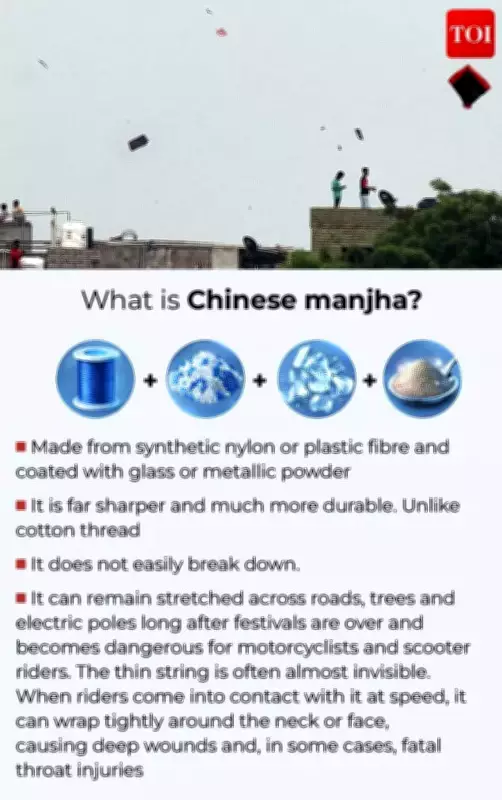
Traditional Indian manjha is typically made from cotton thread coated with powdered glass to enhance its strength for competitive kite duels. While it can cause minor cuts, it is biodegradable and generally considered less harmful. In stark contrast, Chinese manjha is a very different and far more dangerous product. It is manufactured from synthetic materials such as nylon or plastic fibers and coated with glass or metallic powder, making it exceptionally sharp and highly durable. Unlike its cotton counterpart, this synthetic string does not break down easily in the environment. It can remain taut across roads, entangled in trees, and draped over electric poles long after the festive seasons have concluded.
This persistence makes Chinese manjha particularly hazardous for motorcyclists and scooter riders. The thin, nearly invisible string poses a severe risk; when riders encounter it at high speeds, it can wrap tightly around the neck or face, leading to deep lacerations and, in devastating cases, fatal throat injuries.

A Series of Alarming Incidents Reported Nationwide
Several distressing cases reported by The Times of India underscore the grave seriousness of this ongoing problem. During Makar Sankranti celebrations on January 13, 2026, at least 15 people lost their lives and hundreds were injured across Gujarat, with most incidents attributed to sharp kite strings or falls from terraces. The fatalities were distributed with six deaths in Saurashtra-Kutch, six in central Gujarat, and one each in Ahmedabad, Bharuch, and Aravalli. Among the victims was a heartbreaking case of a 10-month-old girl in Gandhidham, who died after her father fell when a fragile terrace sheet gave way.
The EMRI 108 ambulance service recorded a staggering 4,948 emergencies on January 14, which was approximately 30% higher than usual, with Ahmedabad reporting the highest number of cases. In a separate incident in Jamnagar, police registered a case after a 14-year-old boy was electrocuted by an illegally installed fence while attempting to retrieve a kite. Additional fatal incidents were reported in Vadodara and Rajkot, highlighting the widespread nature of the crisis.
Impact on Wildlife and Public Safety
In Maharashtra, more than 600 birds, including owls, crows, pigeons, kites, and parrots, were injured since January 14, 2026, during kite-flying festivities. Activists have squarely blamed banned Chinese manjha and sharp glass-coated threads for these injuries. The worst-affected areas were Dahisar, Borivli, Kandivli, and Malad, where 330 injured birds were reported. Rescue groups noted that many birds were left entangled in strings hanging from trees and buildings, with several large birds of prey treated at a temporary rescue center in Masjid Bunder. Wildlife volunteers emphasized that despite restrictions imposed by the National Green Tribunal, banned nylon and glass manjha continues to be used illicitly.
Meanwhile, in a concerning public safety lapse, children were observed flying kites from the newly opened Shrikant Jichkar flyover near Futala Square, causing sharp strings to fall onto the busy road below. Motorists were forced to slow down abruptly to avoid injury, prompting officials to label it a serious safety oversight and announce plans to deploy security guards to prevent recurrences.

Tragic Cases Across Multiple States
In Lucknow, multiple injuries were reported within just a few days. One widely noted case involved a young woman riding a scooter who suffered deep cuts to her forehead and ear after colliding with a stray thread stretched across a road. Police acknowledged that despite regular raids and awareness campaigns, illegal sales persist, with traders often hiding banned stock and selling it secretly during peak festival demand. In response, Lucknow's West Zone Commissionerate held meetings with kite sellers and enthusiasts under the slogan "Shauq ke badle shok nahin," urging people not to turn a beloved hobby into grief.
In Jaipur, a six-year-old boy named Dheer Sanganeria died during Makar Sankranti celebrations after Chinese manjha slit his throat while he was looking out of a car sunroof. He was rushed to the hospital but was declared dead on arrival. In Sangareddy district, Telangana, 38-year-old Avadhesh Kumar, a migrant worker from Uttar Pradesh, was killed when Chinese manjha hanging across a road cut his throat as he rode his motorcycle to a market. Doctors at a government hospital declared him dead on arrival.
Another tragic incident in Telangana involved four-and-a-half-year-old Nishvikaditya, who died after the string became entangled around her neck while she was traveling with her parents on a two-wheeler in Kukatpally. Despite being rushed to the hospital, she later succumbed to her injuries. In Bidar district, Karnataka, 48-year-old Sanjiva Kumar lost his life after Chinese manjha sliced his neck while he was riding his motorcycle to bring his daughter home for Sankranti celebrations.
Alongside these deaths, more than 150 injuries were reported in Jaipur alone. Numerous bikers, a police constable, and children across Telangana and other states suffered serious neck and facial wounds. Many birds were also injured or killed after becoming trapped in the abrasive string. These incidents collectively demonstrate that the danger remains pervasive despite repeated enforcement drives and public warnings.
Government's Zero-Tolerance Approach and Enforcement Challenges
The Uttar Pradesh government has adopted a zero-tolerance policy towards Chinese manjha. Police have been instructed to intensify raids, seize illegal stock, and prosecute offenders. Under environmental and safety regulations, the manufacture, sale, storage, and transport of synthetic manjha are strictly banned. Those found responsible can face fines, imprisonment, and additional charges if injuries or deaths occur. Officials have stressed that such fatalities may be treated as cases of criminal negligence.
However, enforcement remains a significant challenge. The string is often smuggled across state borders or sold online under misleading names. Monitoring every small retailer becomes even more daunting during the festive season when demand peaks.
The Human and Environmental Cost
Behind each headline lies a personal tragedy. Victims include students, daily wage earners, delivery workers, and commuters—ordinary people caught unaware in dangerous situations. Two-wheeler riders are particularly vulnerable, as the string often hangs at neck height across busy roads. Doctors report a range of injuries, including deep neck cuts requiring stitches, facial wounds that may leave permanent scars, severe blood loss, nerve damage, and fatal throat injuries in extreme cases. Hospitals commonly experience a spike in such cases around Makar Sankranti and Independence Day.
Birds are also heavily affected, with many becoming entangled in mid-air, suffering broken wings or death. Because Chinese manjha is non-biodegradable, it can persist in the environment for months, continuing to pose risks to both wildlife and humans.
Why Does Chinese Manjha Remain Popular?
Despite the ban, Chinese manjha continues to be used for several reasons. Kite flyers value its exceptional strength and cutting ability during competitions, as it is durable and does not snap easily. Smuggled stock can be cheaper in bulk, and some buyers are either unaware that it is banned or underestimate the associated risks. Yet, what provides an advantage in the sky can become a deadly hazard on the road.
Legal, Environmental, and Safety Concerns
The ban on Chinese manjha is grounded in public safety and environmental protection. The National Green Tribunal has prohibited nylon and synthetic manjha due to the harm caused to humans and wildlife. States including Uttar Pradesh, Delhi, Rajasthan, and Gujarat have issued strict orders to enforce this ban. Chinese manjha creates several environmental problems: it does not decompose, can cause electrocution when tangled in power lines, injures birds and animals, and contributes to waste management issues. The damage is therefore both immediate and long-term.
Police Action and Public Awareness Initiatives
Police have stepped up inspections in markets, especially before major festivals. Illegal stock is seized, and cases are registered against traders. In Lucknow, officers have engaged with shopkeepers to encourage compliance rather than relying solely on punishment. Nevertheless, black-market sales persist, and online platforms complicate tracking sellers. Authorities are urging the public to report shops selling banned manjha. Awareness campaigns promote the use of cotton thread, educate schoolchildren about risks, encourage riders to wear helmets with neck protection, and advise the removal of stray thread from roads and trees.
Preventive Steps for Safer Celebrations
Experts advise simple safety measures to mitigate risks:
- Use only cotton or biodegradable thread for kite flying.
- Avoid flying kites near busy roads and high-traffic areas.
- Wear helmets and full-face protection when riding two-wheelers.
- Install protective guards on motorcycles during festival seasons.
- Safely remove any visible stray thread from public spaces.
- Supervise children closely while they are flying kites.
Implementing such steps can significantly reduce injuries and save lives.
Preserving Tradition Safely for Future Generations
Kite flying remains a powerful symbol of celebration, freedom, and community spirit in India. The aim is not to end this cherished tradition but to make it safer for everyone involved. Using eco-friendly thread does not diminish the enjoyment of the festival; instead, it ensures that celebrations do not end in tragedy. By adopting safer practices, communities can uphold the joy of kite flying while protecting lives and the environment.
The Way Forward: A Collective Effort
Experts assert that tackling the Chinese manjha issue requires a multifaceted approach. This includes stronger border checks to prevent smuggling, vigilant monitoring of online marketplaces, strict penalties for repeat offenders, and robust community awareness programmes. Cooperation with environmental groups and the promotion of protective gear may also contribute to reducing risks. Ultimately, lasting change will occur when demand for banned manjha declines through sustained education and enforcement efforts.
Conclusion: A Call for Responsibility and Action
Chinese manjha has tragically turned a joyful tradition into a recurring public safety crisis. Despite bans and stringent policies, injuries and deaths continue due to illegal sales and a lack of awareness. Responsibility lies with both authorities and citizens. By choosing safer alternatives, reporting violations, and spreading awareness, lives can be saved. Festivals should bring happiness, not heartbreak. Celebration must never come at the cost of human life.