

Marine Ghosts: The Science of Invisibility in the Ocean Depths
For centuries, the ocean has captivated humanity with its mysteries, home to creatures with abilities that seem almost supernatural. Among these, certain fish have evolved predation techniques so stealthy and sophisticated they are compared to unidentified flying objects (UFOs), operating with near-imperceptible precision. Instead of relying on brute force, these marine predators master the art of camouflage, blending seamlessly into their watery environment to ambush unsuspecting prey.
UFO-Like Camouflage: The Art of Disappearing in Open Waters
In the vast, featureless expanses of the open ocean, hiding is a formidable challenge for fish with nothing to conceal themselves against. Yet, nature has devised ingenious solutions. Some species manipulate light through reflection or refraction, creating illusions that merge them with the background. A groundbreaking study titled "Ultra-black Camouflage in Deep-Sea Fishes" reveals that certain deep-sea fish possess skin capable of absorbing over 99% of incoming light. This ultra-black adaptation renders them nearly invisible, appearing as mere voids in the water until they strike.
Additionally, translucency serves as another effective strategy. Fish in open waters can become transparent, allowing light to pass through their bodies and making them virtually undetectable. These adaptations are not just aesthetic; they are critical survival tools in a world where being seen can mean becoming prey.

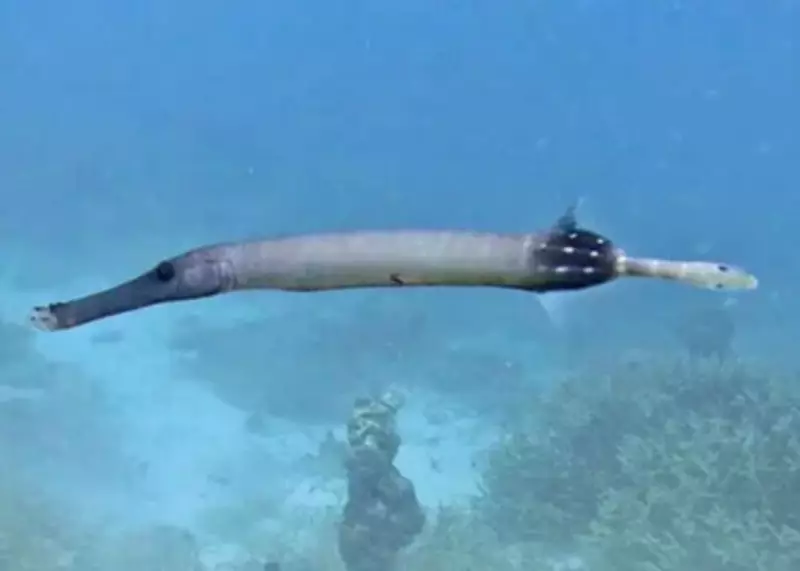
Ghost Hunting: The "Shadowing" Technique of the Trumpetfish
One of the most fascinating discoveries in marine biology involves the trumpetfish, an elongated predator that takes camouflage to a new level. Researchers have documented a behavior termed "shadowing," where the trumpetfish follows a harmless species to stalk its victims. As noted by scientist James Herbert-Read, "Shadowing behavior of the trumpetfish appears to be an advantageous method to enhance its hunting efficiency." By leveraging nonthreatening companions, the predator reduces the likelihood of alarming its prey, effectively becoming a "ghost hunter" in the process.
Field experiments on "Predatory Trumpetfish Behavioral Patterns" confirm that this tactic significantly lowers detection rates, marking a unique instance in nature where one living organism is used as camouflage by another. This strategy underscores the complexity and innovation of marine predation.
The Science Behind the Illusion: Evolution and Adaptation
Camouflage in the ocean is a multifaceted phenomenon rooted in physics, biology, and behavior. Studies indicate that reducing reflectance can make fish exceptionally hard to spot in bioluminescent environments. Moreover, some species utilize polarization, enhancing their camouflage effectiveness by up to 80% compared to mirror-like techniques. These evolutionary optimizations demonstrate how nature has refined camouflage into a highly efficient scientific tool.
In an ecosystem where survival hinges on observing without being observed, such adaptations are paramount. Whether through light manipulation, transparency, or strategic shadowing, fish have become masters of disguise. The culmination of these innovations results in predators that swim like ghosts, resemble UFOs, and hunt like phantoms, revealing the extraordinary capabilities hidden beneath the waves.






