

Gurgaon's Air Quality Deteriorates, Inches Closer to 'Very Poor' Category
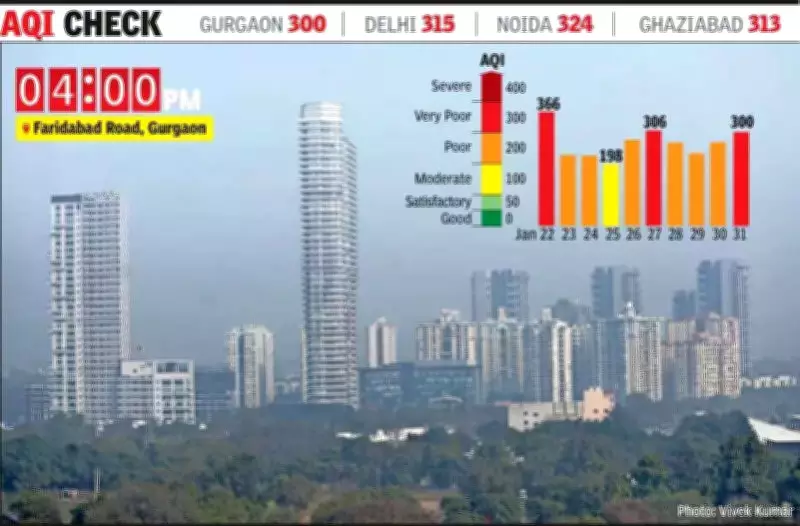
The air quality in Gurgaon took a significant turn for the worse on Saturday, with the city's overall Air Quality Index (AQI) climbing to 300, marking a concerning escalation from the previous day's reading of 268. This places Gurgaon's air quality just one point away from slipping into the 'very poor' category, raising alarms among residents and environmental authorities alike.
Monitoring Stations Record Alarming Pollution Levels
Detailed data from the city's four monitoring stations revealed a troubling picture of air pollution distribution across different areas. Two stations crossed into the 'very poor' category, with Sector 51 recording the highest AQI at 360, followed closely by Vikas Sadan at 333. The remaining two stations maintained positions in the 'poor' category, with Teri Gram registering 253 and Gwalpahari at 235.
Particulate Pollution Reaches Dangerous Levels
The concentration of harmful particulate matter presented an even more alarming scenario. PM2.5 levels, representing fine inhalable particles, exceeded safe limits dramatically across all monitoring locations. Sector 51 recorded the highest concentration at 500 µg/m³, followed by Vikas Sadan at 463 µg/m³, Gwalpahari at 365 µg/m³, and Teri Gram at 348 µg/m³. These figures stand in stark contrast to the World Health Organization's 24-hour guideline of just 15 µg/m³, indicating pollution levels more than 30 times higher than recommended safety thresholds.

PM10 levels, representing coarser particles, also showed significant exceedances of safety standards. Sector 51 recorded 500 µg/m³, Vikas Sadan 445 µg/m³, Gwalpahari 259 µg/m³, and Teri Gram 215 µg/m³. These measurements far surpass both the WHO's 24-hour guideline of 45 µg/m³ and the Central Pollution Control Board's annual permissible limit of 100 µg/m³ for PM10.
Weather Conditions Aggravate Pollution Situation
According to the System of Air Quality and Weather Forecasting and Research (Safar), weather conditions on Sunday are expected to remain unfavorable for pollutant dispersion. The agency cited low wind speeds and limited ventilation as primary factors contributing to the accumulation of pollutants in the atmosphere.
Safar specifically noted that a ventilation index below 6,000 m²/s combined with average wind speeds of less than 10kmph creates conditions that are not conducive to pollutant dispersion. The agency projected a ventilation index of just 3,000 m²/s for Sunday, along with a maximum mixing depth of 1,150 meters, indicating limited vertical mixing and weak air movement that can effectively trap pollutants near ground level.
Wind Patterns and Forecast Predictions
The meteorological forecast paints a concerning picture for the immediate future. Surface winds are likely to originate from the north, with particularly calm conditions expected during morning hours. Wind speeds may see a slight increase to approximately 5kmph during daytime hours, potentially reaching around 8kmph in the afternoon before weakening again to about 5kmph during evening and night periods.
These atmospheric conditions, characterized by minimal wind movement and poor ventilation, create an environment where pollutants accumulate rather than disperse, leading to the deterioration of air quality that residents are currently experiencing.
Implications and Future Projections
With forecasts indicating that air quality may deteriorate further in the coming days, there is a strong possibility that Gurgaon's overall AQI will slip into the 'very poor' category. The combination of high particulate pollution levels and unfavorable weather conditions creates a perfect storm for continued air quality degradation.
The breach of both WHO guidelines and Central Pollution Control Board limits at almost all monitoring stations underscores the severity of the pollution situation in Gurgaon. As residents navigate these challenging environmental conditions, authorities continue to monitor the situation closely while experts emphasize the need for immediate measures to address the growing air quality crisis in the city.






