

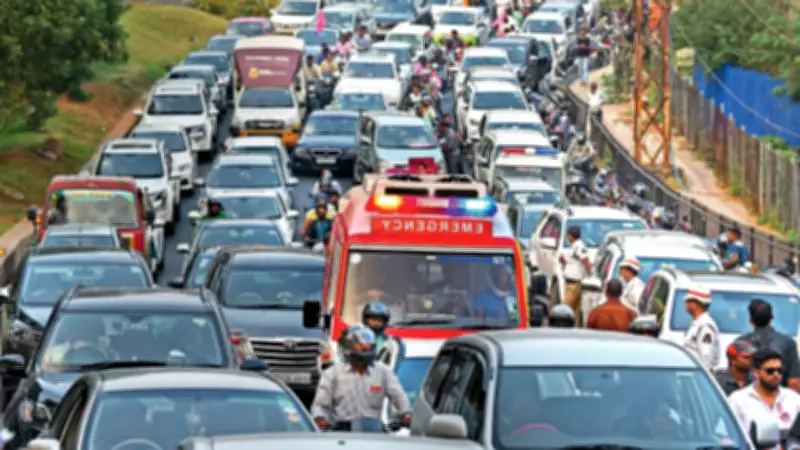
Hyderabad's Traffic Crisis Jeopardizes Critical Emergency Response Times
In trauma care, the first 60 minutes, known as the 'golden hour,' are pivotal for saving lives. However, in Hyderabad, this crucial window is increasingly compromised by severe traffic congestion, stalled signals, and uncooperative motorists, leading to dangerous delays for emergency vehicles.
Ambulance Drivers Face Perilous Delays on City Roads
M Krishna, an ambulance driver from Amberpet, highlights the grim reality: "We waste nearly 20 minutes in traffic during every trip." He points to massive congestion hotspots such as Afzalgunj, Abids, areas near NIMS, and Lakdikapul Metro station. Motorists often hesitate to yield, fearing traffic fines, which exacerbates the problem.
Another driver, M Suresh, shares that at Chaderghat signal alone, ambulances lose eight to ten minutes during peak hours. "Between Balanagar and Kukatpally, we lose nearly 25 minutes during peak traffic hours," he adds. These delays can turn manageable medical situations into life-threatening emergencies by the time patients reach hospitals.

Traffic Police Efforts and Motorist Non-Compliance
With over 6,000 ambulances operating among more than one crore vehicles in Hyderabad, traffic police acknowledge the challenge of monitoring every emergency vehicle. Officials state that top priority is given when hospitals alert the traffic control room in advance, with green corridors created and junctions cleared in real-time for swift passage.
However, from IT corridors like Madhapur and Gachibowli to busy areas such as Mehdipatnam, Dilsukhnagar, and Secunderabad, motorists frequently fail to yield to siren-blaring ambulances. This non-compliance significantly delays critical response times, undermining police efforts.
Fire Tenders Struggle with Narrow Roads and Parking Issues
Fire department officials echo similar concerns, noting that several residential and commercial areas lack adequate access roads. Indiscriminate parking on streets leaves little room for large fire tenders to maneuver. P Dattu, a station fire officer, explains: "Though traffic police provide green channels at junctions, people do not move aside to give us space." He cites the Nanal Nagar–Tolichowki stretch as particularly problematic due to heavy congestion throughout the day.
Study Reveals Alarming Traffic Patterns and Infrastructure Gaps
A recent joint study by IIT Hyderabad and TCS, conducted over two weeks, assessed the city's traffic patterns and their impact on emergency vehicles. Field observations at hotspots like Hi-Tec City junction, Masab Tank–Virinchi Hospital stretch, Jubilee Hills Check Post, KBR National Park Junction, and Mehdipatnam revealed key findings:
- Ambulances take between 2.7 to 6.5 minutes to cross a single traffic signal, depending on traffic intensity and time of day.
- Drivers are often reluctant or unsure about yielding to emergency vehicles.
- Traffic signals fail to prioritize ambulances, forcing them to wait through regular cycles.
- Despite sirens, many motorists hesitate or block lanes due to confusion or lack of space.
The study collected feedback from daily commuters, emergency responders, and traffic engineers through Google Forms, highlighting widespread issues in the city's emergency response infrastructure.
Global Best Practices in Emergency Services
Comparing Hyderabad's challenges with global cities offers insights into potential solutions:

- Singapore: Emergency calls are routed to a central command center with GPS-enabled ambulances dispatched in under 60 seconds. Motorists face heavy fines for failing to yield, and driver training includes emergency response protocols.
- Berlin: Combines fire and ambulance services under one command, aiming for ambulances to reach patients within 8 minutes in 80% of life-threatening cases. Fines up to €320 and penalty points enforce compliance.
- Paris: Deploys advanced ambulances with on-site medical teams and allows use of bus lanes. Fines up to €135 and penalty points are imposed on motorists who do not yield.
- Tokyo: Operated by the Tokyo Fire Department, with strategically located stations to reduce response radius. Motorists are trained to pull left and avoid intersections, aided by electronic sirens and loudspeaker announcements.
These examples underscore the importance of integrated systems, strict enforcement, and public awareness in ensuring efficient emergency response.
Urgent Call for Stakeholder Action
Doctors warn that the 20-minute delays in Hyderabad's traffic could mean the difference between life and death. Stakeholders, including traffic authorities, urban planners, and the public, must prioritize measures to safeguard the golden hour. Enhancing infrastructure, enforcing traffic laws, and educating motorists are critical steps to prevent further loss of life on the city's roads.





