

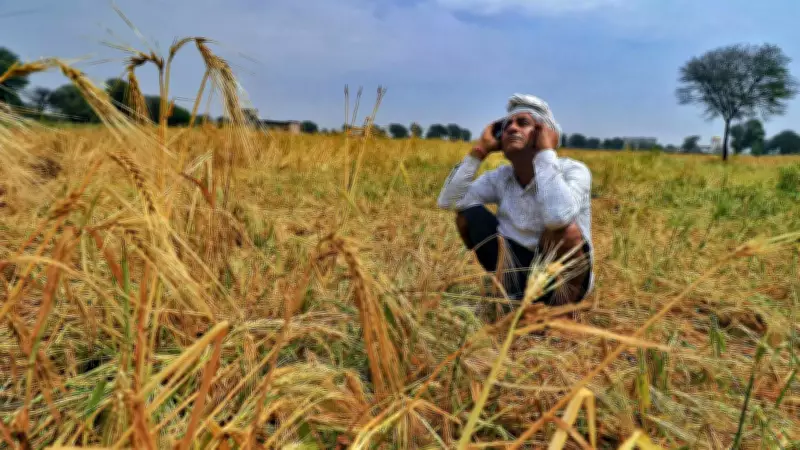
In a development that spells potential trouble for India's agricultural sector and broader rural economy, the India Meteorological Department (IMD) issued a concerning forecast on Monday. The agency predicted 'below normal' southwest monsoon rainfall for the June-September period across the country, citing heightened risks from emerging El Niño conditions. Historically, El Niño events are strongly correlated with reduced rainfall over the Indian subcontinent during the monsoon season.
Quantitative Forecast and Probability Analysis
"Quantitatively, the seasonal rainfall over the country as a whole is likely to be 92% of the Long Period Average (LPA) with a model error of +/- 5%," stated IMD chief Mrutyunjay Mohapatra during the release of the first-stage long-range monsoon forecast. The LPA, calculated using data from 1971 to 2020, stands at 87 centimeters. Rainfall measuring between 90% and 95% of the LPA is officially classified as 'below normal'.
The IMD's probability forecast reveals a 31% chance of 'below normal' rainfall and a 35% probability of 'deficient' rainfall, which is defined as below 90% of the LPA. This combined probability clearly indicates a higher likelihood of less-than-normal precipitation across India during the upcoming monsoon season.

Impact on Monsoon Core Zone and Agricultural Concerns
Although the meteorological department plans to release a more detailed updated forecast in late May, focusing on spatial rainfall distribution, the initial probability map highlights significant risk. It shows 'below normal' rainfall anticipated in India's 'monsoon core zone'. This critical region encompasses most of central and western India, where agricultural operations are heavily dependent on monsoon rains.
This scenario is poised to severely impact irrigation systems, drinking water supplies in arid and semi-arid zones, reservoir capacities, and hydro-power generation potential. The timing is particularly precarious as the country already faces high input costs for farming, including diesel and fertilizers, alongside elevated energy costs exacerbated by ongoing conflicts in West Asia.
Broader Agricultural and Economic Implications
Insufficient rainfall adversely affects not only the acreage of kharif crops, which are sown during the summer, but also rabi crops planted in winter. Reduced soil moisture and lower water levels in irrigation reservoirs can compromise overall food grain output. This occurs despite numerous measures implemented over the years to bolster the farm sector's resilience against drought conditions.
El Niño and Counteracting Climate Factors
The potential development of El Niño conditions this year, characterized by warming ocean surfaces in the central and eastern tropical Pacific Ocean, raises the likelihood of depressed rainfall during the latter half of the monsoon, specifically August and September. However, other climatic factors, such as the Indian Ocean Dipole (IOD), may offer some mitigation.
"Positive IOD conditions typically lead to increased rainfall. We anticipate that this could counterbalance the impact of El Niño during the second half of the monsoon season," explained Mohapatra. Currently, neutral IOD conditions prevail over the Indian Ocean, but the latest climate models suggest that positive IOD conditions are likely to develop towards the end of the southwest monsoon season.
Additional Influences: Northern Hemisphere Snow Cover
Snow cover over the northern hemisphere also plays a role in monsoon dynamics. The IMD noted that snow cover extent from January to March was slightly below normal. "Winter and spring snow cover extent over the Northern Hemisphere, as well as Eurasia, generally exhibits an inverse relationship with subsequent southwest monsoon seasonal rainfall over the country," the department clarified.






