

Kochi Road Accidents Show Strong Connection to Weather Conditions
A recent analysis has uncovered a clear link between weather patterns and road accidents in Kochi city. Researchers from the Amrita Institute of Medical Sciences conducted this important study, examining data from 2018 to 2023. They published their findings in an Indian Council of Medical Research journal.
Temperature and Rainfall Play Key Roles
The study reveals that 56% of daily accidents happen when the average minimum temperature falls below 21.71 degrees Celsius. This situation mainly creates fog, which reduces visibility for drivers. At the same time, 57% of daily accidents occur when rainfall measures less than 2.1 millimeters. Light rain causes vehicles to skid on road surfaces.
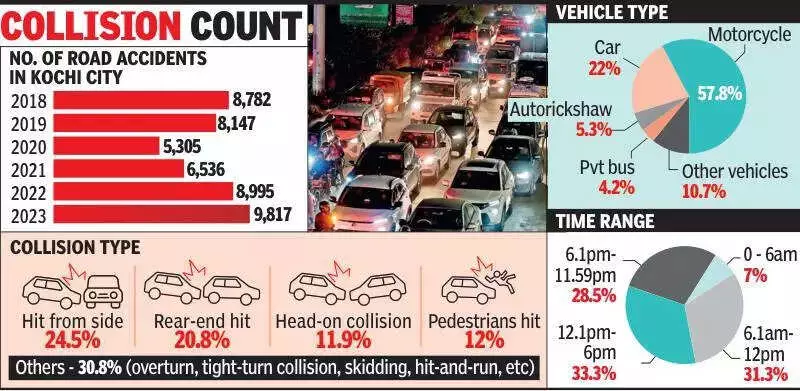
During the six-year study period, a total of 47,582 accidents occurred on roads within Kochi city police limits. The analysis shows that 33.4% of these accidents take place between 12pm and 6pm. Morning hours also see significant accident numbers.

Experts Explain the Weather-Accident Connection
Traffic experts point to specific mechanisms behind these weather-related accidents. Dileep Kumar K G, a motor vehicle inspector in Ernakulam, explains the rainfall effect. "Tarred roads expand during summer heat, trapping oil in small pores. When the first drizzle arrives, the road contracts and pushes oil out of these pores. The oil mixes with water on the road surface, creating slippery conditions that cause vehicles to skid."
Regarding temperature effects, he adds, "When minimum temperatures drop to 20-21 degrees Celsius, fog formation becomes common. This reduced visibility directly contributes to accidents."
Surprising Findings About Speed and Road Types
The study presents some unexpected results about accident patterns. Lower speed limits do not necessarily mean fewer accidents. In fact, 52% of accidents occurred in areas with speed limits of 40-60 kilometers per hour.
Road type analysis shows that 62.5% of accidents happen on district or minor roads within the city. National highways account for 24.8% of reported mishaps.
Dr. Aswathy S, the study's lead author and professor of community medicine at AIMS, explains driver behavior patterns. "During heavy rain, motorists typically drive more carefully or wait for conditions to improve. But when it's only a drizzle, they often feel safe to drive normally. This false sense of security contributes to accidents."
She further notes, "The same pattern appears on minor roads where drivers tend to be less conscious about traffic rules. Additionally, our minor roads experience higher vehicular volume and more pedestrian traffic, creating conditions ripe for accidents."
Multiple Factors Contribute to Accident Rates
Transportation experts emphasize that weather interacts with other factors to create dangerous conditions. Dr. S Shaheem, principal scientist at the National Transportation Planning and Research Centre, observes, "A multitude of reasons can lead to accidents, including limited sight distance and poor road designs."
He explains the road type statistics, "Most serious accidents and fatalities actually happen on national highways. However, since district and local government roads have greater total length in our city, they show higher accident numbers. Our district or minor roads are not designed for vehicles traveling above 60 kilometers per hour. When reckless driving and ignored traffic rules combine with these design limitations, accident numbers increase significantly."
The study titled 'Road Traffic Accidents and Climatic Factors in an Urban Area in Kerala' represents collaborative work between multiple departments. Public health, community medicine, and biostatistics departments at AIMS worked with the department of atmospheric sciences at Cochin University of Science and Technology to complete this comprehensive analysis.

