

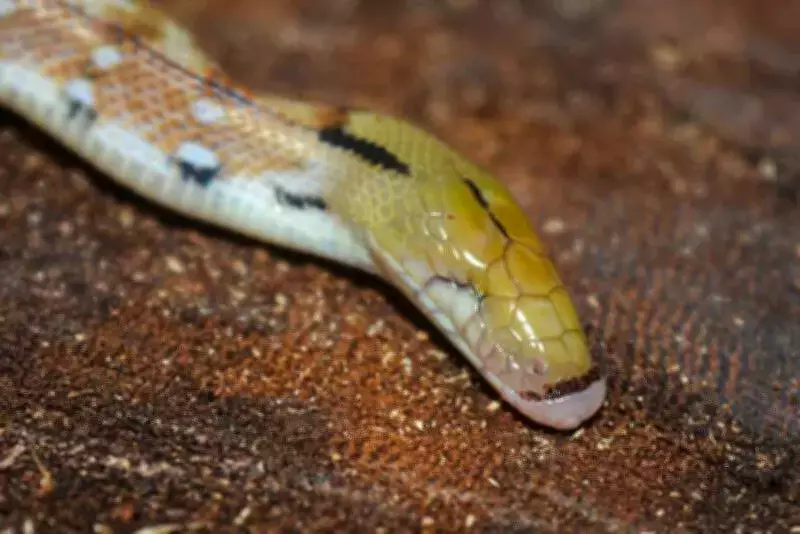
Rare Eyeless Snake Discovery in Pune Makes International Scientific Headlines
A remarkable and exceptionally rare case of a Common Trinket Snake (Coelognathus helena) born without eyes has been scientifically documented and published in the prestigious international journal, Reptiles & Amphibians, based in the United States. The groundbreaking discovery was made by Solapur ophiologist Rahul Shinde and Pune-based snake rescuer Anil Kanaskar, highlighting a significant contribution to reptile biology and developmental studies.
Unprecedented Encounter with an Eyeless Specimen
On December 19, 2024, Anil Kanaskar received an urgent call from the Sutarwadi area in Pashan, Pune, regarding an unusual snake specimen. Upon arrival and careful examination, Kanaskar encountered a truly extraordinary Common Trinket Snake. The snake exhibited a complete absence of eyes, with the ocular region entirely covered by smooth scales and no visible pupils whatsoever.
"During my initial assessment, it became immediately evident that this was no ordinary find," Kanaskar recounted. "The snake had no eyes. The area where eyes should be was seamlessly covered with scales. We also noted slight deformities in the jaw structure, which pointed toward a congenital abnormality present from birth."

Recognizing the scientific importance of this anomaly, Kanaskar promptly contacted expert ophiologist Rahul Shinde for specialized guidance and collaborative study.
Scientific Diagnosis: Bilateral Anophthalmia
Ophiologist Rahul Shinde conducted a detailed analysis and identified the condition as bilateral anophthalmia. This is a congenital developmental disorder where both eyes fail to form during the early embryonic stages. Such abnormalities are extraordinarily rare in snakes, and researchers believe this case represents the first ever recorded instance of bilateral anophthalmia specifically in the Common Trinket Snake species.
"This is an extremely rare condition, and documenting it at an international level carries significant scientific weight," Shinde emphasized. "It occurs when the primary eye structures fail to develop or degenerate during early embryonic stages. Such findings are crucial as they help advance our fundamental understanding of embryological development and congenital deformities in reptiles."
Broader Implications for Herpetology and Wildlife Science
The study's publication in an international journal underscores its considerable relevance to multiple scientific fields, particularly herpetology (the study of reptiles and amphibians) and developmental biology. Scientifically, anophthalmia arises during embryonic growth when optic structures fail to form or regress prematurely. This can potentially be due to genetic factors, environmental influences, or a combination of both, though the exact cause in this particular case remains unknown and warrants further investigation.
Despite its significant physical deformities, the eyeless snake appeared to be in good health during observation. After a thorough period of study and comprehensive documentation to preserve all scientific data, the snake was safely released back into its natural habitat, adhering to ethical wildlife research practices.
Emphasizing the Need for Systematic Wildlife Documentation
Experts involved in the study stress that this discovery not only contributes a vital record to reptile biology but also powerfully underscores the urgent need for systematic documentation of rare anomalies in wildlife. The Common Trinket Snake is a non-venomous species, often active during both day and night (nocturnal/diurnal), and is mostly terrestrial. It is commonly found in gardens, old buildings, and forests across South Asia.
"The documentation of such a rare deformity at an international level holds strong scientific value," the researchers concluded. "It provides invaluable insights that can inform future studies on reptile development, conservation genetics, and the impacts of environmental factors on wildlife health. This case from Pune serves as a compelling reminder of the hidden wonders and mysteries still present in our natural world, waiting to be discovered and understood."






