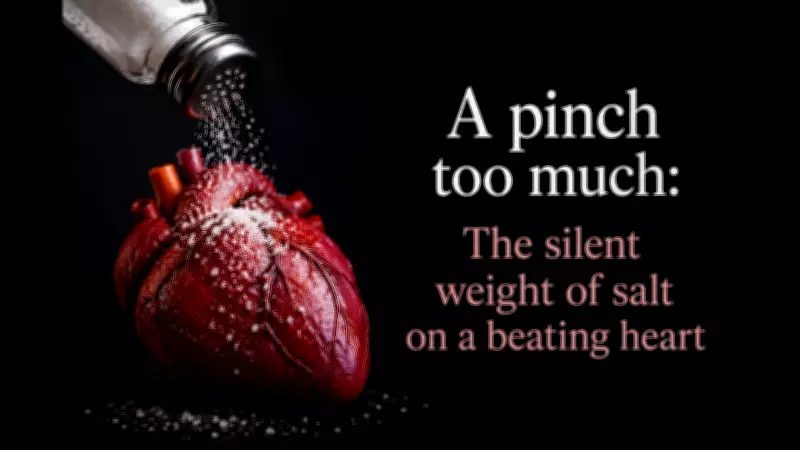
Most people consume far too much sodium, leading to a silent crisis that contributes to hundreds of thousands of preventable deaths each year. The American Heart Association recommends no more than 2,300 milligrams per day—roughly a teaspoon. Yet the average American consumes about 3,400 milligrams daily, 50% more than recommended. Surprisingly, only a small fraction comes from the salt shaker; about 70% of dietary sodium comes from processed foods and restaurant meals.
Global Salt Consumption Trends
The problem is not confined to the United States. In the United Kingdom, the Food Standards Agency found that Britons consume around 8.4 grams of salt daily, well above the recommended 6 grams. Similarly, Australia's health department reports that most adults exceed daily limits. This is a worldwide issue.
India's Salt Problem
India faces a particularly severe challenge. According to a study published in the Indian Journal of Medical Research (IJMR), the average Indian consumes between 9 and 10 grams of salt per day—double the World Health Organization's recommendation of 5 grams. This high intake is directly linked to hypertension, which is already at epidemic levels in India.

How Salt Affects the Heart
Salt stiffens blood vessels and forces the heart to work harder. Over time, this damages the heart and raises blood pressure. Harvard researchers have linked high sodium intake to increased risks of heart disease and stroke. The CDC estimates that reducing sodium could prevent hundreds of thousands of heart attacks and strokes annually in the US alone.
Dr. Rushikesh Patil, Associate Director and Cardiologist at Dr. L H Hiranandani Hospital, Powai, Mumbai, explains how that extra pinch of salt affects the heart without people realizing it.
Q&A with Dr. Rushikesh Patil
Is there any benefit to reducing salt consumption for heart diseases in India?
Dr. Patil: Yes, salt has been a significant part of Indian culture, from the Dandi March to its use in fortification. However, increased salt consumption is a major risk factor for hypertension and cardiovascular diseases. Population surveys show Indians consume twice the WHO limit of less than 5 grams per day. Cardiovascular diseases account for about one-third of all deaths in India, with hypertension being the highest risk factor. Clinical trials have proven a correlation between increased salt intake and higher blood pressure, leading to increased stroke risk and mortality. Excess salt causes water retention, raising blood pressure and leading to heart attacks and strokes. Evidence shows that lower salt consumption reduces cardiovascular disease risk. In the Trials of Hypertension Prevention, a 10–15 year study, participants who reduced sodium had a 30% decrease in cardiovascular events and a 20% decrease in mortality.
How can we control high blood pressure?
Dr. Patil: Given the difficulty of behavior change campaigns, promoting low sodium salt (LSS) may be effective. LSS replaces some sodium chloride with potassium chloride. Potassium consumption lowers blood pressure; the sodium-to-potassium ratio is key. Salt substitution has been proven to lower blood pressure and reduce cardiovascular disease. In a randomized trial in Siddipet district, Telangana, 502 hypertensive rural residents using salt with 30% potassium for 3 months saw significant reductions in systolic blood pressure (4.6 mmHg) and diastolic blood pressure (1.1 mmHg). The Salt Substitute and Stroke Study (SSaSS) in China found that salt substitute users had 14% fewer strokes, 13% less cardiovascular disease, and 12% lower mortality. However, there is a risk of hyperkalemia from increased potassium intake, especially for those with kidney disease or on certain medications.
Despite limited knowledge about LSS, other salts like Himalayan pink salt, black salt, and sea salt are marketed with unproven health claims. These contain similar sodium content with only trace minerals and no scientific evidence of health benefits.

Why focus on kitchen salt for cardiovascular health?
Dr. Patil: In India, the three main sources of sodium are: salt added during home cooking or at the table, foods prepared outside the home (restaurants, street vendors, school meals), and processed or packaged foods. Few Indian studies show that household salt contributes about 80% of total sodium intake among adults. However, sources vary by state—for example, in Ladakh and Assam tea gardens, salt in tea is a major contributor. Unlike Western nations where processed foods dominate, Indians consume more salt through home cooking and traditional accompaniments like pickles and papads. Therefore, the kitchen is an ideal place for intervention. Even a slight reduction in cooking salt can make a big difference.
Should public health policy support a transition to low-sodium salt?
Dr. Patil: To address rising hypertension and cardiovascular disease, sodium reduction must become mainstream. An integrated approach should target main sodium sources. Initiatives like front-of-pack labeling, food reformulation (setting salt reduction goals, motivating producers to make low-sodium products), taxation of high-fat, salt, and sugar (HFSS) foods, and restricting HFSS advertising to children can reduce sodium in packaged foods. Policymakers should also promote accessibility and awareness of low-sodium salt to help consumers make better choices. However, this is not a one-size-fits-all intervention; people with kidney disease or using certain drugs may be at risk from elevated potassium levels.
How does additional salt in the Indian diet lead to preventable heart diseases?
Dr. Patil: A significant number of heart attacks and strokes are linked to high salt consumption. Reducing salt intake by even 20-30% could have a huge impact. Recent modeling research on the benefits of low-sodium salt in India estimated that conservative use could save 214,000 cardiovascular-related deaths per year. However, the rising prevalence of heart disease is also connected to modern lifestyle and work patterns.