

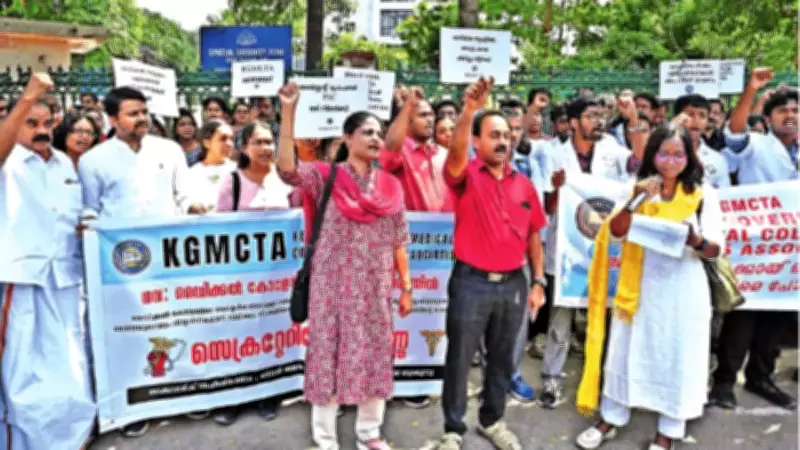
Kerala's Healthcare Heroes Turn Protesters in 74-Day Strike
Government medical college doctors in Kerala, once celebrated as frontline heroes during the COVID-19 pandemic, have now been on strike for 74 consecutive days. These physicians, who form the backbone of one of India's most acclaimed public health delivery systems, are accusing the state government of broken promises spanning unpaid salary arrears, chronic staff vacancies, and dangerously unsafe workplaces.
From Pandemic Praise to Present Protest
During the height of the COVID-19 crisis, Kerala's healthcare workers received global recognition for their tireless efforts. Doctors worked around the clock, often for weeks without rest, with the singular mission of saving lives. The state's entire healthcare model was hailed internationally for delivering health outcomes comparable to developed nations despite modest income levels. Several government hospitals earned acclaim for performing rare and advanced surgical procedures typically available only at top private or specialized centers.
Six years later, the picture has dramatically changed. Kerala's healthcare model now stands at a critical crossroads. While hospital infrastructure continues to expand rapidly, manpower and essential equipment remain in dangerously short supply.

The Dual Fronts of Medical Dissent
The protest movement has developed on two parallel fronts:
- Medical College Doctors: Government medical college teachers have been protesting for 74 days and have now declared an indefinite boycott of outpatient services, academic duties, and non-emergency surgeries.
- District and Taluk Doctors: Physicians manning district hospitals and health centers began protesting last Thursday in Thiruvananthapuram, demanding basic workplace safety and protection from assaults. Their mobilization followed the suspension of a doctor at Nedumangad district hospital after a newborn's death allegedly due to medical negligence.
Both groups allege that repeated verbal and written assurances from the state government have been systematically violated, leaving them feeling overworked, undervalued, and unsupported by their employer.
Core Demands: Pay, Posts, and Protection
For government medical college teachers, the key demands include:
- Correcting pay anomalies in entry and promotion scales
- Releasing pending salary revision arrears since 2016 (amounting to ₹10-20 lakh per doctor)
- Creating long-pending teaching and non-teaching positions
- Ending unscientific staff redeployments
- Improving infrastructure for patient care
The remaining government doctors demand basic workplace safety and protection from assault, arguing they are frequently made scapegoats for systemic failures including chronic staff shortages, poor infrastructure, and lack of clear treatment protocols.
According to the Indian Medical Association's Kerala chapter, an average of five attacks on doctors are recorded weekly in the state, with zero convictions to date.
Warning of System Collapse
Dr. Rosnara Beegum T, president of the Kerala Government Medical College Teachers' Association (KGMCTA), warns of a "complete collapse" of Kerala's public health system within five years if these issues remain unaddressed. She notes that very few young doctors now join the public health sector, resulting in significant vacancies at entry levels.
The statistics reveal alarming gaps:
- Government medical colleges have 375 vacant posts out of 2,106 sanctioned positions (18% vacancy rate)
- The directorate of health services has approximately 600 vacancies out of 6,200 sanctioned posts (nearly 1 in 10 positions unfilled)
As the protest intensifies, the state government has declared that striking doctors will not receive payment for days they do not work.
Severe Understaffing Amid Rising Patient Load
Kerala's public healthcare infrastructure includes 14 government medical colleges, 18 district hospitals, 18 taluk hospitals, 226 community health centers, and 849 primary health centers staffed by 10,868 modern medicine doctors.

Despite visible cracks in the system, Kerala's public healthcare is experiencing a steady rise in both outpatient visits and hospital admissions. This increase is attributed not only to improved facilities but also to rising medical costs that have forced many small and medium private hospitals to close. Approximately six tertiary care private hospitals have seen foreign direct investment, further limiting affordable options.
Thiruvananthapuram Medical College, the state's most popular facility, illustrates this trend clearly. Pre-pandemic outpatient numbers averaged 3,000-3,500 daily; this has risen to 4,500-5,000 (sometimes reaching 6,000). Admissions have similarly increased from fewer than 3,000 pre-COVID to around 3,500 currently.
Government insurance schemes, technically valid at several private hospitals, face implementation challenges due to payment delays that make private facilities reluctant to treat insured patients. This forces patients to pay out of pocket, resort to crowdfunding for critical care, or seek treatment at government hospitals despite long wait times.
Patient Stories Highlight Systemic Failures
Public health expert Dr. Raman Kutty describes a "complex situation" where Kerala continues to outperform most Indian states on health indicators statistically, but those numbers "hide a harsh ground reality: our public hospitals are severely understaffed."
Patient experiences reveal the human cost of systemic failures:
- Sumaiya in Thiruvananthapuram struggles to breathe after thyroid-gland surgery where a guide wire was left in her chest, detected later via X-ray. Her family has spent two months trying unsuccessfully to obtain medical records to pursue a negligence case.
- At Palakkad District Hospital, a nine-year-old girl's fracture treatment turned tragic when doctors allegedly ignored a wound until it necessitated amputation of her hand.
Vinod D, the girl's father and a daily wage worker, questions government claims of "health for all," asking "where is that health when the poor have to pay with their limbs, dignity, and lives?"
Standardization and Equity Concerns
Fr. John Choorapuzhayil of the Wayanad Social Service Society notes that "the worst affected are the poor and the terminally ill, especially cancer patients. Many choose to suffer in silence at home rather than push their families from poverty to extreme poverty through out-of-pocket treatment costs."
Dr. Sunil P K, president of the Kerala Government Medical Officers' Association, emphasizes that standardization of public healthcare is urgently needed. "The quality of care varies drastically across districts. One general hospital may have super-specialty facilities, while another in the same district may lack even basic ones. These gaps in patient care are rarely acknowledged, let alone fixed."
Kerala built its reputation on exceptional health outcomes; it now faces a critical test of governance—whether it will match new hospital infrastructure with adequate personnel, fair compensation, and proper protection, or allow a celebrated public health model to erode ward by ward.





