

Kerala's Abortion Access Crisis: Legal Rights Clash with Medical Harassment
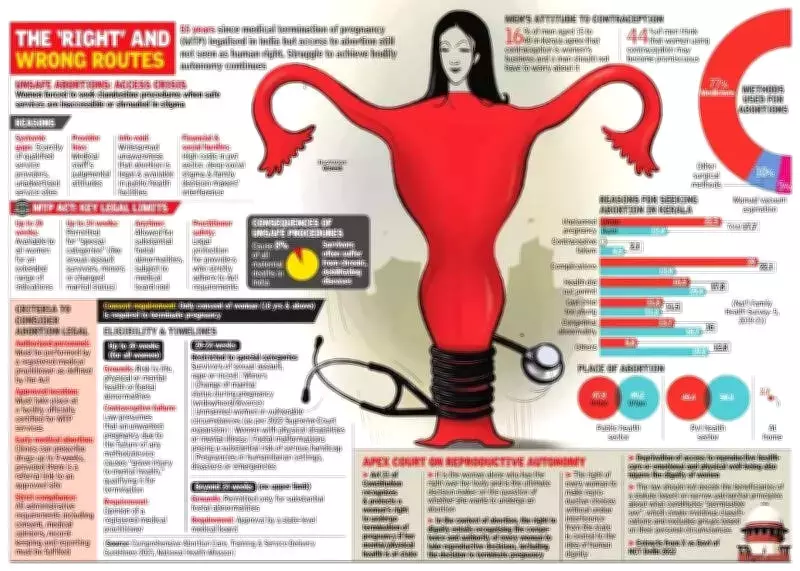
Justice Ruth Bader Ginsburg of the U.S. Supreme Court once articulated a vision of choice not as a privacy notion or a doctor's right, but as a woman's fundamental right to control her own destiny, free from state interference. This ideal, however, remains a distant reality for many women in Kerala, where accessing Medical Termination of Pregnancy (MTP) procedures is fraught with obstacles, humiliation, and exploitation.
A Harrowing Experience at Ernakulam General Hospital
Swati (name changed), a woman with promising career prospects in Bengaluru, found herself at the gynaecology outpatient department of Ernakulam General Hospital, seeking to terminate a seven-week pregnancy. After visiting three major hospitals and two clinics in Kochi, she and her partner were confronted with unreasonably high costs in the private sector, leading them to a government facility. What followed was a stark reality check on how bodily autonomy and reproductive rights, guaranteed by law and the Supreme Court, are often mythical in practice.
From the moment her OP sheet was reviewed, Swati faced hostile, judgmental, and humiliating behavior. "One senior doctor slammed my OP sheet on the table and asked condescendingly why I came to a govt hospital after undergoing a scan at a private hospital," she recounted. Her colleague went further, questioning, "Why was I making them commit kolapathakam (murder)?" This moral equating of a legal procedure with murder was compounded by laughter and patronizing inquiries into how the "mistake" occurred, with doctors implying they should not have to "pay for my mistake."

Prescribed a blood test and instructed to return with a "female bystander," Swati left due to the humiliation, bearing significant personal financial burden to seek care elsewhere. Her complaint to the hospital superintendent highlighted how such actions breach the MTP Act's intent, violate medical ethics, and constitute harassment and discrimination. She has yet to receive a response.
Systemic Barriers and Exploitative Practices Across Kerala
Swati's ordeal is not isolated. Accessing MTP at government facilities is increasingly difficult statewide, while private sector doctors often show reluctance, charge exorbitant fees, or refuse outright. The couple's journey illustrates this: one major private hospital refused the procedure, another demanded Rs 70,000 for an in-patient process, and a third denied MTP completely. At a clinic in Edappally, a doctor insensitively stated they refuse even rape victims, asking, "What she would get out of it," and demanding Rs 25,000 for medicine prescription alone.
Ultimately, they paid Rs 17,000 at a hospital in Tripunithura for medicine-based MTP and tests. This lack of access contributes to unintended pregnancies being carried to term, with children sometimes abandoned, neglected, or killed, underscoring a public health crisis.
Expert Insights: Ethical Dilemmas and Societal Stigma
Dr. Edwin Peter, founder of Sex Education Kerala Foundation, notes that planned parenthood remains uncommon in Kerala, hindered by social, religious, and varying value systems. "Many don't understand that pregnancy is an individual's choice," he says, emphasizing that doctors should not impose moral values on patients, though they have a duty to protect life. He argues that human rights conventions do not assign rights to cell structures before birth, making MTP a termination of pregnancy support, not a human rights violation.
Dr. Peter criticizes doctors for prioritizing cell groups over full-fledged persons, highlighting that government hospital doctors are legally bound to provide MTP services. Denial constitutes a serious rights issue and professional injustice.
Dr. Praveen Gopinath, a Payyannur-based gynaecologist, describes MTP as a procedure done in shadows due to increased paperwork aimed at preventing female foeticide. "This has reduced service providers, enabling overcharging," he explains, adding that it neither curbs female foeticide nor improves sex ratios, but only exploits patients and fosters illegal practices.

Dr. Jayasree A.K., an author and rights activist, observes that society has turned against MTP, especially after global pro-life campaigns. "MTP is considered a sin in Kerala," she says, citing social media backlash against government posts on MTP. This stigma deters doctors, increasing risks amid public-medical conflicts. She laments the lack of pressure from civil society organizations to demand this right openly.
Calls for Government Action and Systemic Reform
Dr. Peter advocates for government initiative to establish MTP-specific clinics in every district, offering at least medicine-based procedures. He notes that first-trimester MTP is often a simple outpatient process with basic investigations, yet unmarried individuals are particularly exploited through higher charges or forced admissions.
The crisis in Kerala reveals a profound disconnect between legal rights and on-ground realities. Without urgent intervention, women will continue to face harassment, financial exploitation, and denial of their reproductive autonomy, undermining the very principles of justice and healthcare equity.





