

Kolkata Hospital Toilet Crisis: Patient Death Exposes Critical Healthcare Infrastructure Gap
The tragic death of a cardiac patient at RG Kar Medical College and Hospital has brutally exposed a fundamental flaw in Kolkata's public healthcare system: the severe absence of accessible toilets within emergency wards. This incident has triggered urgent questions about patient safety and basic infrastructure in government-run medical facilities across the city.
Fatal Journey to a Pay-and-Use Facility
The patient, whose condition required immediate medical attention, was forced to walk nearly 40 meters and climb a full flight of stairs to reach a pay-and-use toilet facility. This physically demanding ordeal proved fatal, as the individual collapsed at the hospital on Monday. A comprehensive ground survey by The Times of India has since confirmed that this is not an isolated incident but rather a widespread, systemic problem affecting most state-run hospitals in Kolkata.
Most emergency departments in government hospitals lack functional, on-site toilet facilities, compelling critically ill patients and their distressed relatives to leave the wards entirely. They must navigate hospital corridors to access distant, often pay-per-use toilets, creating both a financial burden and a dangerous physical challenge for those in vulnerable health states.

Heartbreaking Accounts from Patients and Families
The human cost of this infrastructure failure is vividly illustrated by personal testimonies. Somnath Bhandari, who brought his brother Bappa from Birbhum to SSKM Hospital, described a harrowing experience. "My brother has severe chest pain and can barely walk, yet we had to carry him on our shoulders and take him outside to a paid toilet. There should be toilets on the same floor with attendants. Here, there is none," he recounted, highlighting the absence of both facility and support.
Another patient, suffering from a renal disorder, expressed the daily struggle: "Walking to the toilet is still manageable, but climbing stairs is extremely difficult." For many, the simple act of using a restroom becomes an insurmountable obstacle, exacerbating their medical conditions and causing unnecessary suffering.
Overwhelmed Facilities and Severe Shortages
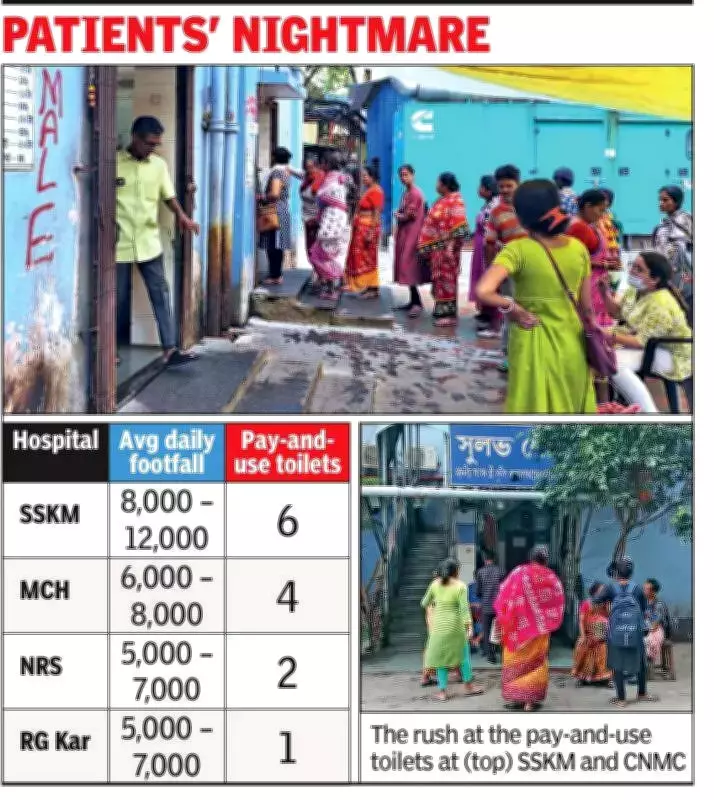
The scale of the problem is staggering when viewed against patient volumes. SSKM Hospital, which handles an astonishing 8,000 to 12,000 patients daily, provides only six pay-and-use toilets for this massive influx. While newer Outpatient Department (OPD) blocks are equipped with toilets, the majority of older hospital buildings either lack operational facilities entirely or have them permanently locked, rendering them useless.
At Medical College and Hospital, the situation is equally dire. Between 6,000 and 8,000 patients depend on a mere four pay-and-use toilets. For those admitted to the emergency ward, the concept of receiving assistance to reach a toilet is virtually non-existent. Debendra Haldar, accompanying a stroke patient, voiced the frustration felt by many: "We are completely on our own. When getting a bed itself is uncertain, how can we expect help to reach a toilet?"
Systemic Infrastructure Failure Across Major Hospitals
The crisis extends to other major institutions. At NRS Medical College and Hospital, only two pay-and-use toilets are available for the entire patient population, starkly underscoring the severe infrastructure shortfall. Although the hospital does have a toilet within its emergency and OPD sections, access remains heavily restricted, leaving patients and relatives with no viable alternatives.
As a result, countless individuals—often waiting for hours in crowded corridors and open areas—are left with no option but to rely on these distant, paid facilities. This not only compromises patient dignity and comfort but poses a direct threat to health outcomes, particularly for those with mobility issues, cardiac conditions, or other critical illnesses.

The patient's death at RG Kar Hospital serves as a tragic wake-up call, revealing a deep-seated neglect of basic amenities in Kolkata's public healthcare infrastructure. It underscores an urgent need for systemic reform to ensure that emergency wards are equipped with accessible, functional toilets, thereby safeguarding patient safety and upholding fundamental standards of care.





