

Union Government Announces Major Upgrade for Visakhapatnam ESIS Hospital to Medical College
The Union government has unveiled significant plans to transform the Employees' State Insurance Scheme (ESIS) hospital in Visakhapatnam into a full-fledged medical college. This strategic initiative is designed to substantially expand medical education opportunities while simultaneously strengthening healthcare delivery for ESI beneficiaries across the region.
National Initiative for Healthcare Enhancement
This development forms part of a comprehensive nationwide effort to improve both medical education infrastructure and healthcare services under the ESI social security scheme. The Employees' State Insurance Corporation (ESIC) has identified ten ESIC/ESIS hospitals across India for conversion into medical colleges, with Visakhapatnam prominently included in this transformative list.
Union Minister of State for Labour and Employment Shobha Karandlaje provided crucial confirmation regarding this upgrade during a Rajya Sabha session on February 5. The minister clarified that the transformation would strictly adhere to National Medical Commission norms and regulations, but emphasized that the process awaits the formal handover of the hospital from the Andhra Pradesh government to ESIC authorities.

"The handing over of the ESIS Hospital, Visakhapatnam, by the state government to ESIC is currently awaited," Minister Karandlaje stated during her parliamentary response, highlighting the procedural step necessary for the project's advancement.
Systemic Healthcare Reforms and Integration
Parallel to this medical college initiative, ESIC is pursuing broader systemic reforms aimed at expanding healthcare access for insured workers nationwide. A particularly significant proposal involves the integration of services between Ayushman Bharat Pradhan Mantri Jan Arogya Yojana (AB-PMJAY) and the extensive ESIC hospital network.
This convergence strategy would eliminate existing caps on treatment costs while enabling completely cashless medical care at PMJAY-empanelled hospitals across the country. Healthcare experts anticipate this integration will dramatically improve accessibility, especially in regions that currently lack adequate ESIC-run medical facilities.
Visakhapatnam's Expanding Healthcare Infrastructure
For major industrial hubs like Visakhapatnam, the proposed medical college would complement significantly expanded referral options for patients. A specialized central ESIC team conducted a detailed feasibility assessment visit to the city in January 2026 to evaluate the hospital's transformation potential.
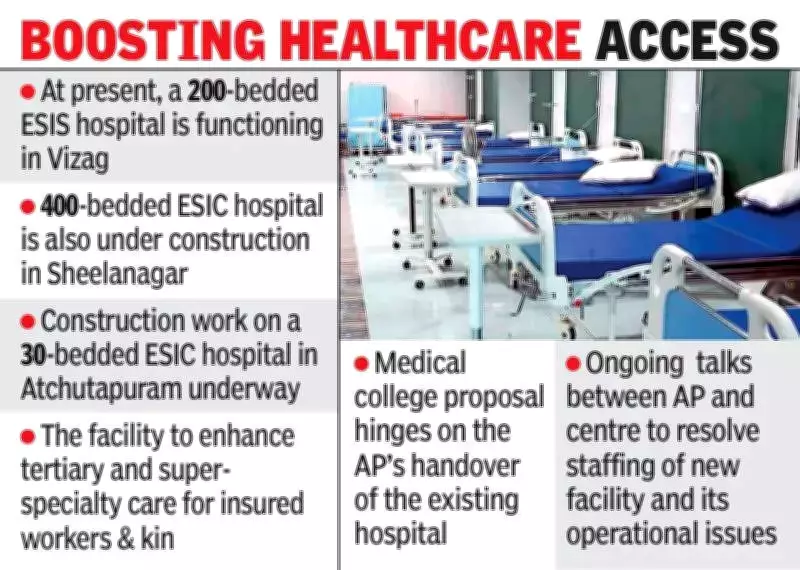
Simultaneously, ESIC is advancing a larger hospital development project at Sheelanagar, scaled to accommodate 400 beds—comprising a 350-bed general hospital complemented by a 50-bed super-specialty wing. This substantial facility, with construction costs exceeding ₹380 crore, is expected to substantially enhance tertiary and super-specialty care capabilities for insured workers and their family members.
Current Healthcare Landscape and Future Prospects
- Presently, a 200-bed ESIS hospital continues to function effectively in Visakhapatnam
- The 400-bed ESIC hospital at Sheelanagar remains under construction as an advanced medical facility
- Construction work on a 30-bed ESIC hospital at Atchutapuram in Anakapalli district is progressing steadily
ESI hospitals serve the crucial purpose of providing comprehensive, cashless medical care to insured workers and their dependants under the ESI scheme, forming an indispensable component of India's social security system. Beyond direct patient care responsibilities, these hospitals actively support broader public health objectives by reducing the substantial burden on state healthcare facilities. In numerous locations, they additionally function as vital teaching and training centers for medical and paramedical professionals.
The medical college proposal's realization fundamentally depends on the Andhra Pradesh government's formal handover of the existing hospital facility. Ongoing discussions between state and central authorities continue to address staffing considerations, operational challenges, and continuity of patient care arrangements during the transition period.






